
What if future-proofing your multi-storey Perth home didn’t require massive structural demolition, months of disruption, or giving up the neighbourhood you love? Exploring vertical mobility equipment perth should feel like an empowering step towards lifelong independence, yet the early research often brings hesitation. Between deciphering Complex Home Modifications under the NDIS, worrying about floor penetrations through established foundations, and choosing between compact residential lifts and specialised platform systems, the technical decisions can quickly seem daunting.
It is completely natural to feel cautious about altering your home’s layout or managing unfamiliar Western Australian building approvals. You deserve a straightforward path forward without unnecessary stress or confusing jargon. This 2026 checklist delivers a practical roadmap tailored specifically to local architectural styles, WA building regulations, and individual mobility needs. Below, we break down the vital differences between lift models, detail council permit expectations, and outline what to look for in an experienced Perth provider so you can plan with total confidence.
Key Takeaways
- Understand the core differences between residential lifts, stairlifts, and platform lifts to match the right solution to your mobility goals and floor plan.
- Learn how to navigate Western Australian building regulations and council permit pathways smoothly under the Building Act 2011.
- Discover the essential steps for accessing NDIS Complex Home Modifications funding with the support of a qualified WA occupational therapist.
- Explore how compact, low-impact designs like the Swift Home Lift series preserve your living space without requiring extensive structural demolition.
- Find out how to choose reliable vertical mobility equipment perth providers who deliver comprehensive, turnkey support from design to practical completion.
What is Vertical Mobility Equipment? Defining Your Options
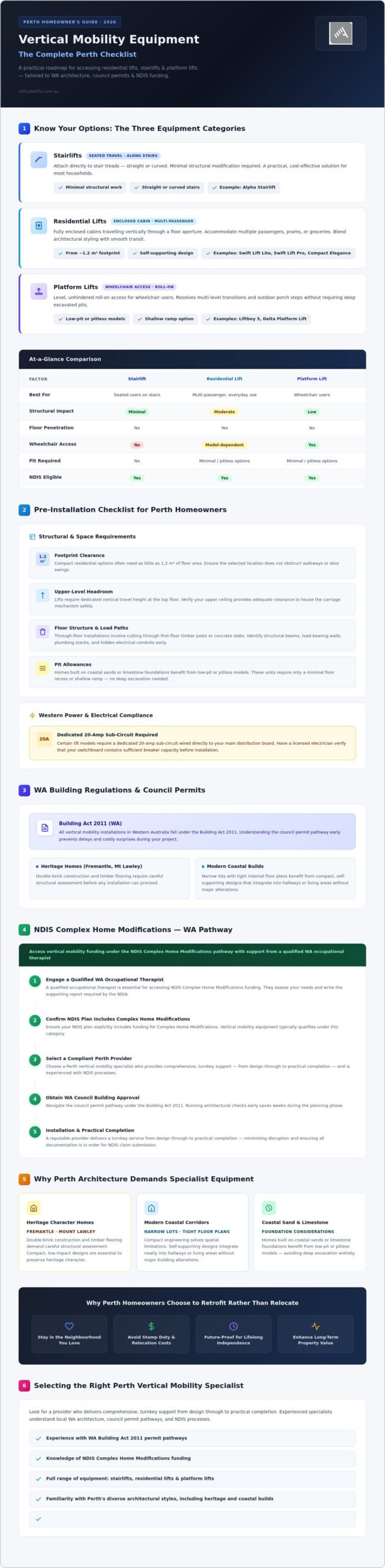
Vertical mobility equipment encompasses any mechanical system engineered to transport individuals safely between different floor levels in a building. Across Western Australia, retrofitting these systems has rapidly become the preferred strategy for ageing in place. Instead of facing substantial stamp duty and relocation costs, Perth homeowners are choosing to adapt their existing properties. Today’s hardware bridges the gap between essential accessibility and architectural luxury, offering seamless options that enhance both daily independence and long-term property value. Selecting the right vertical mobility equipment perth families rely on begins with understanding the distinct categories available.
Stairlifts vs. Residential Lifts: The Core Differences
Every home presents unique physical requirements, making it vital to distinguish between seated, platform, and enclosed cabin systems:
- Stairlifts: Designed for seated travel along an existing staircase, models like the Alpha Stairlift attach directly to the stair treads. They require minimal structural modification and provide a practical, cost-effective answer for straight or curved stairs.
- Residential Lifts: These fully enclosed cabins travel vertically through an aperture between floors. Solutions such as the Swift Home Lift Lite or Swift Lift Pro accommodate multiple passengers, prams, or groceries, blending architectural styling with smooth transit.
- Platform Lifts: Ideal for wheelchair users, vertical platform lifts provide level, unhindered roll-on access. Dedicated units like the Liftboy 5 or the Delta Platform Lift resolve multi-level transitions and outdoor porch steps without requiring deep excavated pits.
Why Perth Architecture Demands Specialist Equipment
Perth’s distinct housing stock requires a tailored installation approach. Heritage character homes in suburbs like Fremantle or Mount Lawley often feature double-brick construction and timber flooring that demand careful structural assessment. Conversely, modern builds across newer coastal corridors frequently occupy narrow lots with tight internal floor plans. Compact engineering solves these spatial limitations. Modern options like the Compact Elegance Home Lift and the Swift series feature small footprints and self-supporting designs, allowing homeowners to integrate vertical travel neatly into hallways or living areas without major building alterations.
The Perth Homeowner’s Pre-Installation Checklist
Careful preparation turns an ambitious retrofit into a smooth home enhancement. Before ordering vertical mobility equipment perth suppliers recommend, evaluating the physical reality of your living space is essential. Whether your goal involves accommodating an electric wheelchair, assisting a family member who uses a walking frame, or future-proofing your two-storey residence, having a clear plan prevents costly surprises. You can review national funding benchmarks in the NDIS guide to providing home modifications, but your immediate task is confirming how hardware integrates with your local building fabric.
Structural and Space Requirements
Every home presents unique structural tolerances. Running through these architectural checks early will save weeks during council planning:
- Footprint clearance: Compact residential options often need as little as 1.2 square metres of floor area. Ensure your selected location does not obstruct essential walkways or door swings.
- Upper-level headroom: Lifts require dedicated vertical travel height at the top floor. Verify that your upper ceiling provides adequate clearance to house the carriage mechanism safely.
- Floor structure and load paths: Through-floor installations involve cutting through first-floor timber joists or concrete slabs. Identifying structural beams, load-bearing walls, plumbing stacks, and hidden electrical conduits early prevents sudden design changes.
- Pit allowances: Established homes built on coastal sands or limestone foundations benefit from low-pit or pitless models. These units require only a minimal floor recess or a shallow ramp, avoiding deep excavation.
Western Power and Electrical Compliance
Reliable operation depends on adequate domestic power. Modern lifts run on standard residential electricity, but certain models require a dedicated 20-amp sub-circuit wired directly to your main distribution board. Have a licensed electrician verify that your switchboard contains sufficient breaker space and modern Residual Current Device (RCD) protection to comply with Western Australian electrical safety rules. Given Perth’s intense summer storms and occasional grid outages, look for systems equipped with onboard battery backups. These secondary power cells guarantee safe automatic lowering to the ground floor if mains electricity drops out.
Once you have noted your dimensions and switchboard capacity, consulting an experienced Perth home lift specialist for an obligation-free structural audit is the best way to finalise your site feasibility before lodging council paperwork.
The NDIS Checklist for Home Modifications in WA
Funding vertical mobility equipment perth through the National Disability Insurance Scheme requires a clear, methodical process. Because residential lifts and structural retrofits involve penetration between levels and statutory council permits, the NDIA classifies them as Complex Home Modifications (CHM). Securing approval means proving that the modification represents a necessary and value-for-money investment in your long-term independence. To keep your application on track, you will need to complete several critical administrative steps outlined in the official NDIS guide to home modifications before any building work starts.
- Check your plan budget: Confirm that your NDIS plan contains dedicated funding under ‘Capital Supports’, specifically allocated for ‘Home Modifications’.
- Engage a local assessor: Partner with an NDIA-registered Occupational Therapist (OT) based in Western Australia to conduct a comprehensive functional home assessment.
- Gather comparative quotes: Obtain itemised quotes from qualified NDIS registered lift providers in Perth who understand both NDIA price arrangements and local council requirements.
- Verify compliance: Ensure the specified equipment strictly adheres to Australian Standards (such as the AS 1735 series for private residence lifts and limited-mobility devices).
Working with WA Occupational Therapists
Your Occupational Therapist acts as your primary clinical advocate throughout the CHM pathway. They are responsible for producing a detailed clinical justification explaining why lower-cost options, like basic ramps or internal room reconfigurations, cannot resolve your accessibility barriers. To support this assessment, document your daily movement routines and specific physical challenges across both levels of your residence. The OT correlates these daily obstacles directly with the technical features of compliant machinery, recommending appropriate models such as the Liftboy 5 or Delta Platform Lift to ensure reliable wheelchair access.
Choosing NDIS Registered Providers
Selecting an NDIS registered specialist guarantees accountability across procurement, engineering, and sign-off. Registered providers must uphold rigorous quality, safety, and auditing benchmarks, ensuring every piece of hardware integrates seamlessly with local structural conditions. Choosing a locally owned Western Australian team also simplifies scheduled preventative maintenance and servicing through your ongoing NDIS plan. For a deeper breakdown of funding thresholds, OT reporting hours, and practical milestones, consult our dedicated 2026 Resource Guide to NDIS Home Lifts.
Comparing Vertical Solutions: Which Equipment Fits Your Space?
Finding the right match between your floor plan and vertical mobility equipment perth residences demand comes down to balancing spatial geometry with daily living habits. A modern multi-storey townhouse in East Perth faces vastly different physical realities than an expansive coastal home in Hillarys. Rather than forcing a bulky elevator into a tight hallway, selecting purpose-built machinery ensures every square metre functions effortlessly without sacrificing interior flow.
When to Choose a Compact Home Lift
If your household needs to transport groceries, heavy laundry baskets, or multiple family members simultaneously, an enclosed residential lift is the most versatile answer. The Compact Elegance Home Lift and the Swift Home Lift series excel in retrofit scenarios because they eliminate the need for a separate, heavily built masonry shaft. Instead, these through-floor systems travel directly through a neat aperture cut between storeys, preserving structural sightlines and open-plan living. Choosing a small footprint home lift keeps civil building work to a minimum while fitting neatly into existing architectural layouts.
The Role of Platform Lifts for Wheelchair Access
When roll-on wheelchair independence is the core objective, platform lifts offer dependable, barrier-free transitions without requiring steep ramps. For split-level living rooms, garage steps, or front porticos with vertical rises up to 1.3 metres, the Liftboy 5 provides an unobtrusive, self-contained solution. For traversing full flights of stairs while remaining in a wheelchair, inclined systems like the Delta Platform Lift (engineered for straight stairs) and the Stratos Platform Lift (designed for curved or turning stairwells) mount directly along the stair line. Both options incorporate sensitive anti-crush safety edges, non-slip flooring, and weather-resistant components engineered to withstand Western Australia’s intense coastal sunshine and salt air.
Conversely, if seated transit without a wheelchair meets your mobility goals, the Alpha Stairlift offers a streamlined, budget-friendly alternative that keeps stairs accessible for the rest of the household. Contact the Altitude Lifts team today to review your floor plans and pinpoint the ideal vertical solution for your home.
Selecting the Right Perth Vertical Mobility Specialist
Investing in vertical mobility equipment perth homeowners can count on requires partnering with a specialist who handles the entire process, not just the hardware supply. Under Western Australia’s Building Act 2011, major structural installations demand certified building approvals (Form BA1 or BA2). Choosing a provider offering a complete turnkey service means your installation team coordinates with licensed builders, electricians, and surveyors on your behalf, removing the burden of managing multiple separate trades.
Before entering any contractual agreement, confirm that your prospective supplier possesses direct expertise in the following key areas:
- Turnkey project management: Complete oversight of architectural drawings, floor penetrations, beam reinforcement, and final council certification.
- NDIS compliance and registration: In-depth knowledge of capital funding pathways, quote submission protocols, and collaboration with local occupational therapists.
- Inventory and technical support: Warehousing of local replacement parts and technical expertise across the Perth metropolitan area to minimise servicing delays.
- Engineering knowledge: Familiarity with Australian Standard 1735 benchmarks and local council bylaws across metropolitan municipalities.
Why Local WA Expertise Matters
Western Australia’s unique geology and architecture demand localised knowledge. In riverside suburbs like Applecross or South Perth, high water tables make deep pit excavation risky and expensive. In contrast, sandy coastal soils require specific footing stabilisation. A local specialist will often recommend pitless or low-pit designs like the Swift Home Lift Lite or Liftboy 5 to bypass groundwater challenges entirely. Local teams also offer physical showrooms where you can test equipment firsthand, whether checking the smooth rail glide of the Alpha Stairlift or examining cabin finishes, giving you complete reassurance before installation begins.
Post-Installation Support and Maintenance
Longevity depends on consistent, professional upkeep. Elevators and stairlifts contain sensitive microswitches, battery packs, backup braking systems, and drive mechanisms that require periodic maintenance. A thorough annual service agreement should cover thorough lubrication, cable or screw inspection, emergency lowering checks, and alignment recalibration. Providers with a dedicated local presence offer substantially faster call-out turnarounds across Perth, keeping your vertical mobility equipment running smoothly and safely for decades to come.
Future-Proof Your Multi-Storey Living with Confidence
Adapting your home should be an empowering journey towards lasting freedom, comfort, and peace of mind. Taking stock of your floor plan early, clarifying your NDIS modification goals, and choosing low-impact hardware ensures your renovation proceeds without unnecessary disruptions. Selecting the right vertical mobility equipment perth families rely on is ultimately about safeguarding your lifestyle in the home and neighbourhood you love.
Managing structural retrofits, Western Australian council permits, and tailored spatial engineering becomes straightforward when you partner with a dedicated local team. As an NDIS registered provider and locally owned WA specialist, Altitude Lifts delivers expert retrofit installations designed specifically for local home designs. Ready to explore what is possible in your space? Request a free Perth site assessment from Altitude Lifts today and take the first step towards seamless, confident multi-level living.
Frequently Asked Questions
Do I need a building permit for a home lift in Perth?
Yes, installing a residential lift in Western Australia requires a building permit under the Building Act 2011. Because installing a lift involves structural work such as cutting through floor slabs or timber joists, applications must go through your local council using Form BA1 (certified) or Form BA2 (uncertified). Stairlifts attached directly to existing stair treads without structural alterations generally do not require a building permit.
How much space does a compact residential lift actually require?
Compact through-floor lifts require as little as 1.2 square metres of floor footprint. Modern systems like the Swift Home Lift Lite or Compact Elegance eliminate the need for external machine rooms and bulky masonry shafts. This makes them ideal for established Perth residences where preserving hallway width and open-plan living areas is essential. You only need clear floor space between levels and adequate top-floor ceiling overrun.
Can NDIS funding cover the entire cost of a stairlift in WA?
Yes, NDIS funding can cover the total cost of a stairlift if it satisfies the criteria for reasonable and necessary support. Your plan must include Capital Supports funding for Assistive Technology or Home Modifications. A Western Australian occupational therapist must assess your mobility needs and document why the equipment is clinically justified. Sourcing vertical mobility equipment perth participants need through an NDIS registered provider ensures compliant quotes and seamless claim management.
What happens to the lift if there is a power failure in my Perth suburb?
Modern residential lifts will not leave you trapped between floors during an unexpected power blackout. Quality systems feature built-in battery backup safety units. If mains power cuts out during a storm, the secondary battery immediately activates to lower the lift safely to the ground floor and open the doors. Stairlifts such as the Alpha Stairlift operate directly off rechargeable onboard batteries, ensuring continuous use even when the grid fails.
How long does the installation of a vertical lift typically take?
Physical installation of a compact vertical lift generally takes between two and five days once on-site building preparations are complete. Prefabricated, shaftless systems assemble significantly faster than traditional concrete-shaft elevators. The broader timeline requires several weeks beforehand to finalise structural engineering drawings, secure local council building approvals, and complete any required dedicated electrical wiring before the installation team arrives.
Are stairlifts or home lifts better for narrow Western Australian hallways?
The best choice depends on whether your staircase or an adjacent room provides more usable clearance. In properties with narrow stairwells, a folding model like the Alpha Stairlift keeps the flight clear for other household members. However, if stairs are too narrow to maintain safe egress, selecting vertical mobility equipment perth homeowners can install through a living room corner or hallway void avoids obstructing the staircase altogether.
Can a lift be installed on the exterior of a WA home?
Yes, dedicated platform lifts can be installed outdoors to bridge raised porticos, split-level entertaining decks, and front entryways. Equipment such as the Liftboy 5 or Delta Platform Lift incorporates weather-resistant electrical housings, anti-slip decking, and corrosion-resistant metal finishes. These protective elements ensure reliable long-term performance under Western Australia’s intense coastal sunshine, heavy winter rains, and salt-laden air.
What is the weight capacity of a standard residential platform lift?
Standard residential platform lifts typically deliver a safe working load between 250 and 300 kilograms. This capacity easily supports an occupied powered wheelchair alongside an accompanying carer or family member. Compact vertical platforms like the Liftboy 5 and inclined models like the Delta Platform Lift comply with Australian Standard 1735 guidelines, ensuring steady, reinforced lifting mechanisms that handle daily mobility aids securely.