
Meeting the bare minimum Australian building standards doesn’t automatically mean a residential lift is genuinely safe for your family. True peace of mind doesn’t come from merely ticking a regulatory compliance box; it relies on active engineered redundancies and failsafe mechanical systems. That is why understanding the essential home lift safety features is vital before you commit to any domestic installation.
A residential elevator should elevate your lifestyle and future-proof your mobility, not create quiet anxiety about sudden power outages or curious pets triggering mechanical pinch points. You deserve absolute certainty that if the mains grid drops out or an obstruction appears, your lift responds instantly and protects the people inside.
This guide cuts through complex compliance jargon to outline the non-negotiable safeguards, AS/NZS 1735 engineering requirements, and emergency protocols necessary for total household protection. From automatic battery lowering systems to compliant 4G cellular communications, here is your definitive checklist for selecting an engineered solution that balances domestic luxury with uncompromising safety.
Key Takeaways
- Navigate Australian Standard AS 1735 requirements to understand how strict mechanical tolerances and load limits protect your household.
- Discover the non-negotiable home lift safety features every domestic lift requires, from full-height infrared light curtains to electromechanical door interlocks.
- Overcome blackout anxieties by learning how automatic battery-backup lowering systems guarantee safe passenger exit without manual intervention.
- Identify vital accessibility safeguards, including flush floor thresholds and compliant cabin dimensions tailored for wheelchair users and NDIS participants.
- Follow a practical Western Australian vetting guide to confirm engineering certifications and local council building approvals before installation begins.
Understanding Residential Lift Standards: Why Australian Safety Compliance Matters
Genuine home lift safety is never an afterthought or an optional add-on. In private dwellings, true safety functions as a rigorously engineered system of physical interlocks, electrical cut-offs, and redundant mechanical backups designed to operate seamlessly under pressure. Installing a lift isn’t like installing ordinary home appliances. It requires structural slab penetrations, substantial electrical integration, and absolute mechanical precision to keep your family secure.
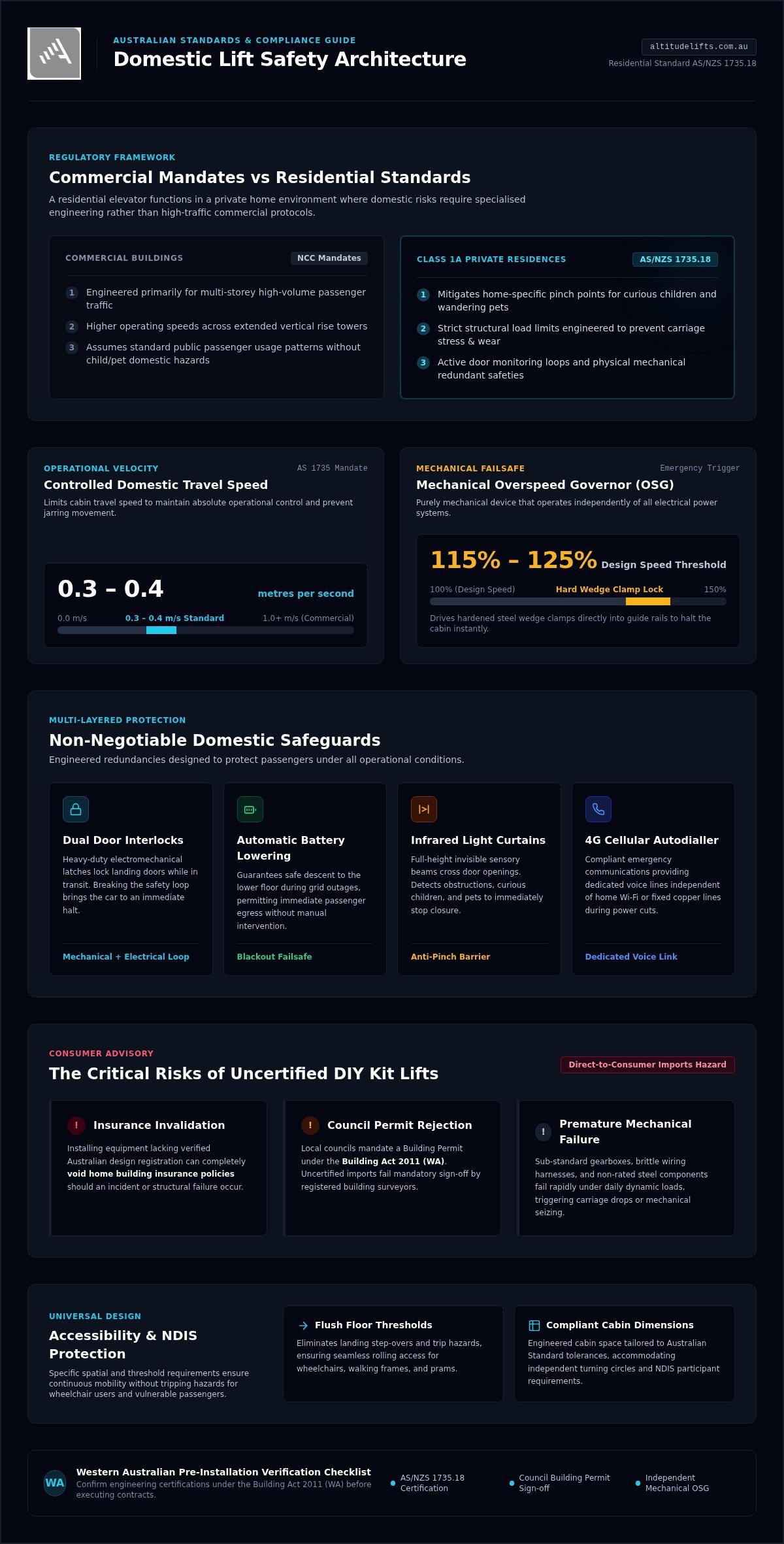
Commercial elevators in multi-storey office towers operate under broad National Construction Code (NCC) commercial mandates. By contrast, private Class 1a residences require equipment built specifically to Australian Standard AS 1735. This difference matters immensely. Generic commercial codes focus on high-traffic passenger volumes, whereas residential standards focus directly on domestic safety risks, such as children playing near thresholds or pets wandering into closing doors. Adhering to these local standards ensures that core elevator safety systems and mechanics, including overspeed safeties and door monitoring loops, perform reliably in a domestic setting.
The Role of Australian Standard AS 1735 in Home Safety
The definitive benchmark governing automatically controlled private residential elevators is AS/NZS 1735.18. This national standard establishes strict limits for domestic equipment to prevent structural stress and mechanical wear. For instance, it caps residential travel speed at a controlled 0.3 to 0.4 metres per second, preventing jarring movements while maintaining complete operational control. AS 1735 also mandates precise structural load ratings, meaning modern systems like the Swift Lift Pro are engineered to withstand continuous dynamic loads without compromising cabin stability or guide rail alignment.
Imported vs Certified Lifts: Recognising the Regulatory Risks
The rise of uncertified DIY kit lifts sold online creates genuine household risks. Direct-to-consumer imports frequently lack local engineering verification, using brittle wiring harnesses and rudimentary mechanical stops rather than compliant home lift safety features. Opting for an unverified overseas import exposes families to significant hazards:
- Insurance invalidation: Installing equipment lacking verified Australian design registration can void your home building insurance policy if an incident occurs.
- Council certification rejection: Western Australian local councils require a valid Building Permit under the Building Act 2011 (WA); uncertified lifts fail sign-off by registered building surveyors.
- Premature mechanical failure: Sub-standard gearboxes and non-rated steel components fail quickly under everyday use, causing sudden carriage drops or mechanical seizing.
Australian Standard AS 1735 compliance serves as non-negotiable homeowner protection, ensuring every structural bracket, motor brake, and safety circuit withstands real-world domestic demands.
The Essential Home Lift Safety Features Checklist
Evaluating domestic lifts requires looking beyond sleek cabin finishes and quiet drives. A genuinely safe lift integrates multi-layered physical barriers and electronic sensors that work together to eliminate everyday risks. When auditing prospective models against rigorous Australian Standard AS 1735 safety requirements, every homeowner should verify a core group of non-negotiable home lift safety features before signing an installation contract.
Mechanical Safeguards: Interlocks, Brakes, and Overspeed Governors
Mechanical protection serves as your lift’s final, uncompromising line of defence. Even during total electrical failures, these hardware components physically prevent accidents from happening:
- Dual electromechanical door interlocks: These heavy-duty latches keep landing doors mechanically locked whenever the carriage is in motion. They break the electrical safety loop if a door is forced even slightly ajar, bringing the car to an immediate, safe halt.
- Mechanical overspeed governor (OSG): If downward travel exceeds safe design parameters by 115% to 125%, this purely mechanical governor activates. It drives hardened steel wedge clamps into the guide rails, stopping the carriage independently of electrical power or suspension cables.
- Calibrated overload sensors: Weight-sensing plates beneath the cabin floor alert passengers and temporarily lock the drive system if cabin capacity is exceeded, protecting motors from strain.
Sensors and Obstruction Detection: Protecting Children and Pets
Modern homes are dynamic spaces filled with children, curious pets, and stray household items. Preventing pinch points and shear hazards requires proactive, continuous spatial monitoring.
Compliant domestic installations feature full-height infrared light curtains. These emit a dense invisible grid of 30 or more beams across the entire doorway. The moment an arm, walking stick, or pet crosses the threshold, the closing doors instantly retract without making physical contact. For low-rise platforms such as the Liftboy 5, sensitive safety edges and pressure-activated undertrays provide essential exterior protection. If an object or animal rests beneath the descending platform, the undertray immediately isolates drive power to prevent crushing.
To inspect physical clearances and site requirements ahead of your build, review our detailed 2026 Perth Home Lift Checklist: A Homeowner’s Guide. If you have questions about which protective mechanisms suit your floor plan, feel free to connect with Altitude Lifts for clear, personalised guidance.
Power Failures and Faults: How Modern Lifts Prevent Entrapment
Sudden electrical storms or grid blackouts can trigger genuine panic for homeowners considering a lift. The thought of an elderly relative or child suspended between floors in total darkness is terrifying. Modern residential engineering renders that fear obsolete. Domestic lifts in Australia are designed around fail-safe protocols that treat power cuts as standard operating scenarios rather than catastrophic emergencies, deploying multi-layered home lift safety features that protect occupants automatically.
Automatic Emergency Battery Lowering Systems (UPS)
When suburban mains power drops out, modern lifts switch instantaneously to an onboard Uninterruptible Power Supply (UPS) without a perceptible shudder. The car does not plummet or freeze indefinitely. Instead, intelligent drive logic takes command, powering the cabin slowly and quietly down to the nearest lower landing level. Once aligned within the standard levelling tolerance, the system releases the electromechanical interlocks and powers the doors open. Passengers step out onto solid ground without needing manual tools, external rescue keys, or emergency service intervention.
Emergency Communication: Landlines, GSM Autodiallers, and Intercoms
Communication systems provide the next layer of reassurance. Relying on standard household Wi-Fi or mains-powered NBN modems during a blackout is dangerous, as local network routers immediately lose power. Modern installations rely on dedicated 4G VoLTE cellular autodiallers equipped with their own internal backup batteries.
- Complete 3G shutdown compliance: With Australia’s 3G network fully decommissioned, older diallers no longer work. Modern lifts utilise 4G VoLTE cellular units supporting Band 28 (700 MHz) to maintain reception through thick residential masonry and lift shafts.
- Backlit cabin controls: Control panels feature clearly illuminated emergency buttons, ensuring immediate visibility even if internal lighting circuits trip.
- Direct dialling protocols: A single button press initiates programmed calls across designated family mobile numbers or a monitored emergency dispatch service.
These robust communication channels and fail-safe battery backups are critical elements in domestic mobility retrofits, adhering strictly to NDIS complex home modification guidelines for vulnerable participants. For regional or coastal Western Australian properties facing fringe cellular reception, external high-gain antennas can be mounted outside the shaft structure to ensure a solid connection. Should a mechanical fault ever occur simultaneously with an electrical outage, manual descent valves remain accessible from outside the carriage, allowing trained attendants to lower the cabin safely from the exterior landing.
Accessibility Safeguards: Protecting Vulnerable Passengers and NDIS Participants
A residential lift must provide dignity and independence without introducing new physical risks. For seniors, wheelchair users, and family members living with limited mobility, thoughtful design details matter just as much as heavy mechanical brakes. True accessibility demands that every transition, button, and surface actively prevents falls and missteps. Selecting the right specialised home lift safety features ensures vulnerable passengers navigate multi-level homes with complete confidence.
Operating controls must also reflect the physical capabilities of the household. While fully enclosed residential elevators use convenient one-touch automatic push buttons, low-rise platform lifts often employ hold-to-run constant pressure controls. This format requires the user to maintain continuous pressure on the switch, stopping the platform instantly if hand contact is lost. For households with curious toddlers or relatives experiencing dementia, key-lockable isolation switches allow carers to disable lift operation entirely when supervision is unavailable.
Wheelchair Stability, Levelling Accuracy, and Threshold Protection
Entering and exiting a carriage presents the highest risk of trips and wheelchair tip-overs. Compliant systems use electronic micro-levelling sensors to align the lift floor with landing thresholds within a strict tolerance of ±6 mm. This eliminates dangerous steps that catch small front castor wheels or walking frames. Carriages should feature heavy-duty commercial non-slip flooring alongside ergonomically positioned stainless steel handrails.
For open vertical platform solutions such as the Liftboy 5, sensitive access ramps double as automatic anti-roll barriers. The moment the platform begins its ascent, the access ramp folds upward into a secure vertical lock, preventing wheelchairs from rolling backward off the edge. Homeowners comparing vertical platform lifts against traditional ramps will find practical guidance in our overview of wheelchair access solutions WA property owners rely on for compliant, dignified mobility. If you are exploring government support for structural accessibility, discover the approval criteria in our comprehensive guide to NDIS Funded Home Lifts Perth.
Sensory, Ergonomic, and Emergency Access Controls
Cabin ergonomics must accommodate diverse physical and sensory needs. Car operating panels should sit between 900 mm and 1,200 mm above finished floor level, ensuring buttons remain reachable from a seated position. High-contrast push buttons featuring raised tactile numbering, braille characters, and audible floor annunciators help vision-impaired passengers travel independently.
Landing doors must also feature external emergency override keyholes. If an occupant suffers a medical event inside the carriage, carers or paramedics can unlock landing doors from the outside using a specialized mechanical drop-key. Consulting an experienced Occupational Therapist helps tailor these options directly to your functional capacity. To explore certified equipment customized for your household’s physical requirements, contact Altitude Lifts today for practical, safety-first mobility advice.
How to Evaluate Home Lift Safety Before Buying: The Western Australian Buyer’s Guide
Evaluating domestic lifts requires a methodical approach to ensure critical home lift safety features are backed by certified engineering and local accountability. Homeowners can protect their investment by working through a practical four-step vetting process:
- Step one: Verify regulatory documentation. Request written proof of Australian Standard AS 1735 design compliance and ensure electrical components meet national safety certification.
- Step two: Audit emergency provisions. Confirm the unit includes an automatic battery-lowering system, external manual release protocols, and a compliant cellular dialler.
- Step three: Assess structural integration. Work with your builder or architect to verify that ceiling and floor penetrations respect your home’s load-bearing layout and local council building codes.
- Step four: Choose an established local partner. Select an experienced mobility provider offering ongoing preventative maintenance routines rather than a transactional importer.
Questions to Ask Your Lift Specialist Before Signing a Contract
Before committing to an installation, put these direct questions to prospective suppliers:
- “Can you provide engineering documentation showing compliance with AS 1735 for this exact model?”
- “What is the expected operating life of the backup battery, and what is the testing schedule?”
- “Are installations handled by trained in-house technicians or passed to unvetted third-party contractors?”
For families managing custom mobility upgrades or complex home modifications, consulting experienced NDIS Registered Lift Providers Perth ensures your equipment aligns with strict clinical recommendations and local council approval processes.
Routine Safety Audits and Preventative Maintenance Schedules
Long-term mechanical reliability requires steady maintenance. While single-occupancy private homes are exempt from statutory workplace plant registrations in Western Australia, manufacturers typically mandate one to two professional preventative service visits each year. During these visits, technicians inspect guide rail alignment, verify brake pad tolerances, check mechanical interlocks, and test backup battery integrity under load.
Homeowners can support this with a simple five-minute monthly safety check. Walk through the cabin to test that the infrared door sensors retract upon obstruction, confirm the emergency lighting operates, and place a test call through the internal dialler. Advanced models like the Swift Lift Pro incorporate smart diagnostic monitoring, detecting minor switch misalignments or battery voltage dips before they disrupt daily routines. Prioritising proven engineering and local support guarantees genuine peace of mind for the entire family.
Choose Absolute Confidence and Failsafe Protection for Your Home
Investing in a residential elevator is about enhancing everyday independence, not introducing new household worries. You don’t have to navigate technical regulations alone or settle for uncertified imports that risk domestic safety. By insisting on uncompromising home lift safety features, you guarantee that sudden power cuts or curious pets never compromise your family’s wellbeing. Active mechanical interlocks, multi-point obstruction sensors, and automatic battery backup lowering transform potential emergencies into calm, seamless events.
Genuine peace of mind starts with equipment fully certified to rigorous Australian Standards (AS 1735) for residential installations. As an NDIS-registered Western Australian mobility specialist dedicated to accessible living, Altitude Lifts pairs proven engineering with direct local expertise to support your household at every stage. Take the next step toward secure, dignified living: Explore Certified Residential Lifts Engineered for Total Safety and future-proof your home with complete confidence.
Frequently Asked Questions
What happens if the power goes out while I am inside a residential lift?
If mains power fails, you won’t be trapped. Modern domestic lifts activate an internal Uninterruptible Power Supply (UPS) battery backup instantly. This automated system smoothly lowers the carriage to the nearest landing level, aligns the floor precisely, and opens the doors so you can exit without manual assistance. Cabin emergency lighting remains illuminated throughout the process, ensuring you are never left in the dark.
Can a home lift fall if a mechanical cable snaps or hydraulic pressure drops?
No, a certified residential lift cannot free-fall. Australian standards mandate independent mechanical safety gears and an overspeed governor. If the carriage descends faster than rated limits, heavy steel wedge clamps deploy automatically onto the vertical guide rails. This physically locks the car in place instantly, halting travel completely without relying on electricity, hydraulics, or suspension cables.
Are home lifts safe for young children and pets when left unattended?
Yes, provided the lift includes certified home lift safety features designed to eliminate pinch points. Modern systems incorporate full-height infrared light curtains that prevent doors from closing if a pet or child crosses the beam. Additionally, key-lockable isolation switches allow parents to disable the lift completely, preventing unsupervised joyrides or playful button pressing while adults are out of the room.
What is the Australian Standard AS 1735 and is compliance legally required?
AS 1735 is the national safety benchmark governing the design, construction, and installation of passenger lifts across Australia, with Part 18 specifically regulating private residential units. In Western Australia, compliance is mandatory to secure building permits under the Building Act 2011 (WA). Non-compliant lifts cannot receive lawful certifier sign-off and can void your domestic property insurance.
How do emergency communication autodiallers work without a landline phone?
Since the national 3G network shutdown, compliant lifts use dedicated 4G VoLTE cellular autodiallers with internal backup batteries. These units don’t rely on copper landlines or home Wi-Fi networks that fail during blackouts. A single push of the illuminated emergency button connects directly to pre-programmed family contacts or professional monitoring services using cellular frequencies that penetrate deep into Western Australian residential structures.
How often do residential home lift safety features need professional servicing?
Certified home lift safety features should receive professional servicing once or twice a year. While private Class 1a residences in Western Australia are exempt from commercial workplace registrations, regular maintenance is essential. Technicians inspect brake linings, test the overspeed governor, verify battery capacity under load, and check electromechanical door locks to ensure continuous, fail-safe operation and preserve your manufacturer warranty.
Can NDIS funding cover safety modifications and emergency features on a home lift?
Yes, eligible participants can access funding under Capital Supports for Complex Home Modifications (CHM). To qualify, the lift and its integrated safety systems must be deemed reasonable and necessary. Approval requires a comprehensive assessment from a registered Occupational Therapist and quotes from an NDIS-registered provider like Altitude Lifts, demonstrating that the equipment safely addresses your specific mobility needs.