
What if the right mobility support starts with the part of home that’s becoming hardest to manage, rather than with a particular piece of equipment? If you’re exploring mobility solutions for elderly at home WA, begin by identifying the barrier: a tiring staircase, a difficult entrance or limited room to move may each call for a different approach.
It’s understandable to feel unsure when the options vary and the consequences of choosing poorly matter. The right fit depends on the person’s mobility, daily routines and home layout. A solution should make everyday movement easier while respecting how the person wants to use their home.
This guide explains how different types of mobility support can address common barriers and what to consider when planning around the person and property. You’ll learn where residential lifts, stairlifts and platform lifts may fit into a broader plan for staying at home. Altitude Lifts is a locally owned Western Australian specialist that designs and installs tailored residential mobility equipment. Site assessment and custom fitting help match the solution to the home.
Key Takeaways
- Mobility solutions for elderly at home WA range from everyday aids to specialist equipment, each addressing different movement barriers.
- Match a solution to the person’s goals and the route they need to travel, rather than choosing equipment by category alone.
- Specialist lift equipment doesn’t automatically require a major rebuild; suitability and any structural work depend on the property.
- Record when movement becomes difficult and how routines have changed to make planning a practical next step.
- Site assessment and tailored fitting can help align residential lift, stairlift or platform lift options with the home.
Mobility for WA Seniors: Solving Daily Challenges
A few entry steps can make coming home tiring. Internal stairs may separate a bedroom from the rest of the house, while a narrow hallway can make it harder to manoeuvre. Sometimes the home hasn’t changed, but the person’s strength, balance or mobility has. Each challenge deserves to be considered on its own.
Home mobility solutions are equipment or changes that help someone move through daily routines and spaces. The term covers a broad range of assistive technology for seniors, from aids used during everyday activities to equipment designed to support movement between levels. Everyday mobility aids support tasks and movement within a space; lifts and stairlifts address level changes in the home. One type doesn’t automatically replace the other.
Which parts of home life are becoming harder?
Consider the entrance, movement between rooms, bathroom access and stairs separately. A person may manage well once inside but find the front step difficult, or move around the ground floor comfortably while avoiding the upstairs bedroom. Pinpointing where the difficulty occurs helps clarify what kind of support could be relevant.
Fatigue, balance and strength can affect how far someone can move or how steady they feel on steps. Wheelchair use can make doorway widths, turning space and changes in level more important. Start with the older person’s own goals: perhaps they want to keep making a cup of tea independently, reach a favourite room or continue a familiar routine. Age alone doesn’t determine what support will suit them.
Why the home itself matters in Western Australia
The practical options depend on both the person and the building. The floor plan, available space, stair configuration and number of levels can all shape what may fit. Perth homes vary, and regional WA properties bring their own layouts and constraints. A familiar house type isn’t enough to assume the same solution will work in another home.
For example, someone who finds stairs increasingly demanding may need a different approach from someone whose main barrier is moving through a tight circulation area. The available space and route through the home matter, as do the person’s mobility needs and preferences. A tailored assessment considers these together rather than treating equipment as a standalone purchase.
This joined-up view is useful even when the next step seems small. Note which route is difficult, what the person is trying to do and what makes the movement challenging. Those details help distinguish an everyday task barrier from a problem with access between levels, giving you a clearer starting point for practical mobility solutions for elderly at home WA.
From daily living aids to home lifts: understand the main mobility options
Mobility support covers more than one kind of equipment. A walking aid may help someone move around a room, while a stairlift or residential lift addresses a different challenge: travelling between levels. This guide focuses on home access rather than cataloguing every mobility product. Start with the specific barrier and what the person wants to do at home.
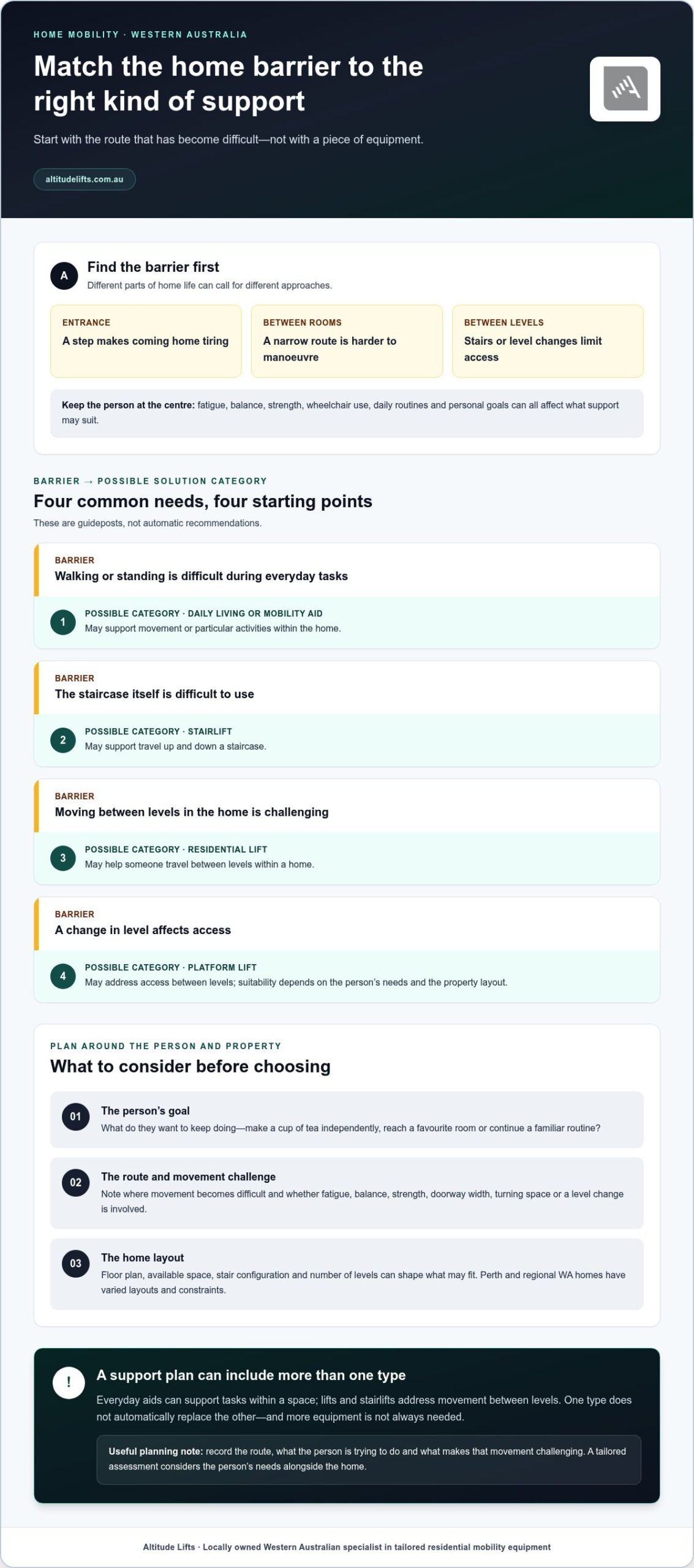
The barrier, not age alone, should guide the solution category. Use this comparison to identify where a type of support may fit:
| Barrier | Solution category | Typical use |
|---|---|---|
| Difficulty walking or standing during everyday tasks | Daily living or mobility aid | Support movement or particular activities within the home |
| Stairs are difficult to use | Stairlift | Support travel up and down a staircase |
| Moving between home levels is challenging | Residential lift | Travel between levels within a home |
| A change in level affects access | Platform lift | Address access between levels, depending on the person’s needs and property layout |
When might a stairlift, home lift or platform lift be relevant?
A stairlift may be relevant when the staircase itself is the barrier. A residential lift can address a different access need by helping someone move between levels in the home. Platform lifts can also support access between levels, with suitability shaped by the person’s requirements and the property. Explore the vertical platform lifts buying guide for more context on this equipment category.
These are starting points, not automatic recommendations. The route, available space and the person’s mobility all matter. Altitude Lifts assesses residential lift, stairlift and platform lift options in relation to the home and the individual’s access needs. For a tailored view of residential vertical mobility options, explore Altitude Lifts’ home lift solutions.
How do mobility aids and home-access equipment work together?
A walking aid or wheelchair may help with movement, but it doesn’t necessarily resolve a step or staircase between parts of the home. Similarly, equipment for changing levels doesn’t replace support for everyday activities. An individual plan can consider both without assuming that more equipment is always needed. For broader Australian aged-care information, My Aged Care government support is an official source for exploring available support pathways.
Think about the whole route: getting through the entrance, moving around the rooms used each day and reaching other levels if needed. Identify where access breaks down, then consider a suitable category of support. This keeps decisions about mobility solutions for elderly at home WA connected to real routines rather than a product list.
Do mobility solutions mean major renovations or loss of independence?
It’s understandable to picture builders, disruption and a home that no longer feels familiar when considering mobility equipment. But specialist equipment doesn’t automatically mean a major rebuild. Some residential lift solutions are designed to fit within existing structures without major renovations, although suitability and installation requirements depend on the property.
A project-specific assessment helps clarify what may be practical. The person’s access needs, the home’s layout and the space available all shape the options. Avoid assuming either that extensive work is inevitable or that no changes will be needed. The aim is to understand the requirements before making a decision.
What should families consider before changing the home?
Start with the spaces the older person wants to keep using and the routes between them. Consider how equipment could affect privacy, comfort and household routines, including how other residents use the same area. Tailored fitting takes the property into account, but the amount of work required depends on the specific home.
Useful questions to discuss together include:
- Which rooms or parts of the home matter most to the person?
- What would make a typical day easier or less tiring?
- Where might equipment need to sit, and how could that affect shared space?
- What needs to be understood about the property before planning installation?
These conversations bring practical considerations to the surface early, without treating the house as a problem to solve at any cost. A residential lift specialist can assess the property and consider how a tailored installation may fit its existing structure.
How can equipment support choice rather than take it away?
Mobility equipment can help maintain access to valued spaces; it isn’t a judgement about someone’s abilities. The older person should be involved in decisions about what support feels useful, where it would be placed and how it could fit their routines. Their preferences and consent matter at every stage.
Ageing and mobility changes don’t look the same for everyone. One person may prioritise reaching another level of the home; another may focus on a different part of daily life. A family discussion can begin with listening: what does the person want to continue doing, and what kind of change would feel acceptable?
Independence isn’t defined by doing everything without support. It can also mean having more choice about how to move through the home and which spaces to use. For families considering mobility solutions for elderly at home WA, a respectful plan weighs the person’s priorities alongside the property, available space and installation requirements. Start with a considered assessment, not an assumption about what equipment or building work will be involved.
How to assess home mobility needs and plan a practical next step in WA
A clear plan starts with real-life details, not a product shortlist. Use this five-step framework to organise what’s happening at home and identify what to discuss during an assessment. It helps families consider mobility solutions for elderly at home WA in a way that reflects the person’s routines, goals and property.
- Record the barrier. Note where movement is difficult, what the person is trying to do and when it happens. Include relevant changes, such as a routine they’ve stopped or a journey that now takes more effort.
- Map the route. Write down the entry points, stairs, levels and rooms involved. Consider the whole journey, including the space around doorways and where the person needs to turn or pause.
- Identify goals. Ask which activities and spaces the person most wants to access. Describe current and anticipated mobility needs in everyday terms, without trying to diagnose the cause.
- Consider support pathways. Funding and assessment options depend on personal circumstances and current programme rules. Explore the relevant aged-care or disability pathway without assuming a particular item will be funded.
- Plan an assessment. Bring your notes together so the person’s functional needs, home layout and preferred routines can inform the next discussion about suitable support.
What information helps clarify the home-access problem?
Be specific about the route: which steps, entrance, staircase or rooms are difficult to manage? Note whether the challenge changes at particular times or during certain activities, and what support the person currently uses. Include goals such as reaching a bedroom or continuing a familiar routine. These details describe the access problem without making a medical judgement.
Property context matters too. A home lift or other vertical mobility option may be relevant if the difficulty involves moving between levels, but the layout and available space influence what can be considered. A guide to NDIS-funded home lifts offers further context on funding considerations.
Where do assessment and funding fit into the plan?
An occupational therapist or other relevant professional may help document functional needs and inform recommendations. Aged-care and NDIS pathways have different access and eligibility requirements, which depend on individual circumstances and programme rules. My Aged Care is a starting point for aged-care support information; neither an assessment nor a funding pathway automatically means a lift or particular equipment will be approved.
Once the access need and pathway are clearer, a residential lift assessment can bring the person’s goals together with the property’s practical considerations. Altitude Lifts provides site assessment and custom fitting for residential projects in WA. For information on the process, see the home lift installation guide for Perth, or discuss a tailored home lift solution.
How Altitude Lifts supports tailored home mobility solutions in WA
Choosing equipment is only part of planning for easier movement at home. The person’s priorities, the access challenge and the home itself all need to inform the decision. Altitude Lifts is a locally owned and operated Western Australian specialist in residential compact lifts, stairlifts and platform lifts. Site assessment, tailored fitting and professional installation bring these considerations together.
A specialist approach shaped around the person and property
Start with the specific barrier. If stairs are difficult, a stairlift may be relevant; if the challenge is moving between levels, a residential lift or platform lift may be worth considering. A site assessment relates the person’s access needs to the home’s layout and the potential equipment fit. Altitude Lifts designs solutions to fit existing structures without major renovations, but suitability and any work required depend on the individual property.
That connection matters. A considered project looks at where the equipment may fit and how it relates to the route the person wants to use. The aim is not to select a lift in isolation, but to identify an option that responds to the person’s needs and the practical conditions of the property.
A considered next step for older people and families
Before discussing options, gather a simple picture of the home and the access challenge. Note the levels, stairs or entry points involved, which spaces the person wants to reach and what they hope to keep doing independently. Include household routines and the older person’s preferences. This gives the discussion a useful starting point and keeps their priorities central.
The project can then progress through a practical sequence:
- Discuss the mobility need: Describe the route that’s difficult and what the person wants to achieve.
- Assess the property: Consider the home’s existing structure and how it may accommodate a suitable solution.
- Tailor the fit: Align the equipment choice and fitting with the person’s needs and the property.
- Arrange professional installation: Complete the installation as part of the residential project.
Altitude Lifts also provides NDIS-registered services. NDIS registration doesn’t mean funding is automatic; funding decisions depend on individual circumstances and applicable programme requirements. For families exploring mobility solutions for elderly at home WA, keep equipment planning and funding eligibility as related but separate parts of the process.
With notes on the home layout, access concerns and mobility goals ready, you can take a clear next step. Discuss a tailored home mobility solution with Altitude Lifts.
Let the next step reflect what matters most
Start with one change the older person would value in daily life. It might be reaching a particular room more comfortably or feeling less hesitant about moving around the home. Focusing on that priority can make planning more manageable and keep everyone centred on the person, not just the equipment.
You don’t need to have every detail decided before exploring options. A useful next conversation can begin with the person’s goals, the part of the home they want to access and what they’d like daily life to look like. From there, a tailored discussion can help clarify whether specialist equipment belongs in the plan. For mobility solutions for elderly at home WA, the right direction is the one that makes sense for the person and their home.
Discuss a tailored home mobility solution with Altitude Lifts and take a considered next step towards access that supports the life the person wants to lead at home.
Frequently Asked Questions
How do I make a two-storey home easier for an older person to use?
Start by identifying which rooms they need to reach regularly and what makes the route difficult. If stairs are the main obstacle, a stairlift or residential lift may be worth exploring; if the challenge is elsewhere, another type of support may be more relevant. Consider how the person currently moves between floors, who else uses the space and what changes would feel comfortable. For mobility solutions for elderly at home WA, both the home and the individual’s needs matter.
Is a stairlift suitable for every staircase?
No. Whether a stairlift can suit a home depends on the staircase and the person using it. Its shape, surrounding space and access at the top and bottom all form part of the assessment. The person’s mobility and ability to use the equipment are also relevant. A site assessment can help determine whether a stairlift is appropriate for that home or whether another approach to moving between levels should be considered.
Can a home lift be installed in an existing house?
Yes, a residential lift can be considered for an existing home, though the property’s layout and structure affect what may be suitable. A project-specific assessment helps establish how a lift could fit within the home and whether structural work is needed. Altitude Lifts designs solutions intended to fit existing structures without major renovations, but this doesn’t guarantee that every property will need no changes. The home itself determines the practical options.
Does the NDIS fund home mobility equipment for older people?
It may, if the person is an NDIS participant and the equipment relates to their disability and meets the scheme’s funding requirements. Eligibility and funding decisions depend on individual circumstances and current NDIS rules, so being older or having difficulty moving at home doesn’t automatically mean equipment will be funded. Altitude Lifts provides NDIS-registered services, but registration doesn’t guarantee that a lift or other equipment will receive funding.
Do I need an occupational therapist assessment before choosing a home lift?
Not every person must have an occupational therapist assessment simply to explore a home lift. However, an OT can assess how mobility affects everyday activities and help document functional needs. An assessment may also be required as part of a funding pathway, depending on the person’s circumstances and the type of modification being considered. Discussing both the access need and the home layout can help make any assessment more useful.
What should a family do first when an older person finds stairs difficult?
First, ask the person which stair journey is difficult and what they’d like to keep accessing. Note when the difficulty occurs, which levels are involved and whether their usual routine has changed. Include the older person in deciding what to explore next. If the change in mobility is sudden or causing concern, seek advice from an appropriate health professional. These notes can help guide a practical discussion about options in a WA home.