
Could a different lift option make it easier for an older person to keep living comfortably at home? If stairs are becoming tiring or difficult, it’s understandable to wonder whether a stairlift, home lift or platform lift would suit your household. This guide to home lifts for seniors Perth families are considering starts with the person’s daily routines and the home’s layout, not a product catalogue.
The right choice depends on practical details: how the person moves around, which levels they need to reach, whether they use a mobility aid and the space available for installation. You’ll find a plain-language comparison of the main options, plus points to consider before arranging a home assessment.
We’ll also look at how an existing Perth home may affect lift placement and what to discuss when exploring a suitable solution. Altitude Lifts is a locally owned Western Australian specialist that assesses, supplies and installs residential lifts, stairlifts and platform lifts. A site assessment can help you understand the possibilities and plan a considered next step towards more comfortable living at home.
Key Takeaways
- Notice when stairs, carrying items or fatigue are making everyday routines harder, and consider whether travel between levels needs a safer, easier alternative.
- Compare stairlifts, residential home lifts and platform lifts by how they move and what the person and home may require.
- For home lifts for seniors Perth households, the best fit depends on the person’s mobility, daily routes and available space, not simply the lift type.
- Before an assessment, note the main challenges, map regular routes around the home, identify who will use the lift and gather any available plans.
- Learn how a site assessment from Altitude Lifts can help Perth families explore options such as the Alpha Stairlift, Swift Home Lift Lite or Liftboy 5.
When are home lifts for seniors in Perth worth considering?
Stairs can become more demanding when balance, strength, endurance or mobility changes. You might notice that climbing leaves you tired, carrying washing or groceries upstairs feels awkward, or reaching an upstairs bedroom takes more planning than it used to. These experiences vary from person to person, and they don’t automatically mean a lift is needed. They can, however, be a prompt to look at how the home is working for you now.
A home lift is a way to travel between levels within a residence, helping make movement between floors more accessible. For people exploring home lifts for seniors in Perth, the appropriate response depends on the individual, the layout of the home and the routines they want to maintain. A lift may support ageing in place, but it isn’t a substitute for individual clinical advice about mobility or safety.
What changes can make stairs harder to manage?
Stair use can feel different if someone is less steady on their feet, has reduced leg strength, tires more quickly or finds movement less comfortable. A handrail may help with some routines, but it may not address every difficulty. Consider how often stairs are used and what happens when the person is carrying something, feeling fatigued or moving between floors during a busy day.
For example, if the main bedroom and bathroom are upstairs, stairs may be part of the daily routine several times over. Carrying laundry, meals or personal items between levels can add another challenge. Ask the older person which parts of the day feel difficult, whether the issue is climbing or carrying, and what would make home life more comfortable.
How can a lift support ageing in place?
Improving access between floors may help someone keep using familiar rooms and maintain routines that matter to them. This is one practical expression of accessibility principles: considering how a space can better support people with differing needs. A lift is one possible option, alongside other home modifications. The right approach depends on the person’s priorities and the home, rather than age alone.
A considered assessment can help clarify whether a lift is worth exploring and what the home may require. For more detail about the broader process and residential lift options in Western Australia, see Home Lift Installation Perth: The Complete 2026 Guide to Residential Lifts in WA.
Which home lift options may suit seniors in Perth homes?
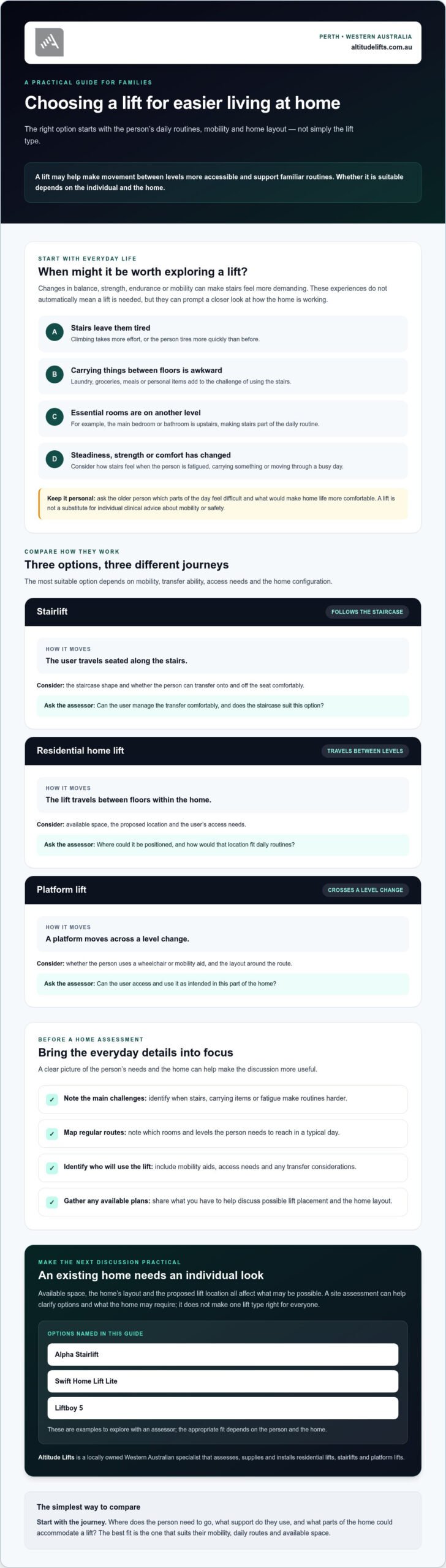
The main options work in different ways. A stairlift follows a staircase, a residential lift travels between floors, and a platform lift may help someone move across a level change, including when wheelchair or mobility-aid access is relevant. None is automatically the right choice. Suitability depends on the person’s mobility, ability to transfer, access needs and home configuration.
These choices can also shape how comfortably someone continues familiar routines at home. The Australian Housing and Urban Research Institute discusses the broader considerations involved in ageing in place in Australia. For families comparing home lifts for seniors in Perth, begin with the older person’s preferences and the journeys they need to make each day, then consider which lift type could accommodate them.
| Option | Movement type | Fit considerations | Questions for an assessor |
|---|---|---|---|
| Stairlift | Follows the staircase, with the user seated. | Staircase shape and the person’s ability to transfer onto and off the seat. | Can the user manage the transfer comfortably? Does the staircase suit this option? |
| Residential home lift | Travels between levels within the home. | Available space, the proposed location and the user’s access needs. | Where could it be positioned, and how would it fit daily routines? |
| Platform lift | Moves a platform across a level change. | Whether the person uses a wheelchair or mobility aid, and the layout around the route. | Can the user access and use it as intended in this part of the home? |
When might a stairlift be worth discussing?
A stairlift may be worth exploring when the main difficulty is using a staircase. The person needs to be able to get onto and off the seat safely, so discuss transfers as well as comfort and confidence. The staircase shape and the user’s needs both require assessment. Altitude Lifts’ range includes the Alpha Stairlift as an option to discuss, not a recommendation before the home and user have been assessed.
When might a residential or platform lift be considered?
A residential lift may suit someone who needs to travel between floors; a platform lift may be relevant where access across a level change is needed. Raise wheelchair or mobility-aid access with an assessor, who can consider the person’s requirements alongside the proposed location and route. Altitude Lifts offers residential lift options, including the Swift Home Lift Lite, and platform lift options, including Liftboy 5.
What should families compare before choosing?
Talk with the older person about which journeys matter, how much independence they want and whether anyone else will use or assist with the lift. Consider the journey from the person’s usual starting point to the lift, how they will enter and exit, and where they need to go afterwards. Treat product names as starting points, not proof of fit: placement and suitability need to be confirmed for the home. A site assessment with Altitude Lifts’ lift options can help explore what may work for the person and property.
Is a home lift too disruptive or unsafe for an existing Perth home?
It’s reasonable to wonder what installation could mean for your home and whether a lift will be suitable for the person using it. Not every lift requires the same work, and one home’s installation needs can’t be assumed to apply to another. Requirements depend on the product, the building and the proposed location. A site assessment can turn general concerns into specific questions about your property and daily routines.
A site assessment is needed to confirm whether a home lift is suitable for your home and what work may be required. Safety also involves more than choosing equipment: the lift needs to be appropriate for the intended user, correctly installed and considered in light of how that person will use it. For families exploring home lifts for seniors in Perth, discuss both the physical layout and the user’s comfort and abilities.
How much building work might an existing home need?
Possible considerations include whether a floor opening is needed, how the lift and its users will reach the proposed location, and whether there’s enough available space for the selected option. The answers depend on the home and the lift being considered. Some compact lift solutions are designed to fit within existing structures without major renovations, but that does not establish what a particular Perth home will require. Only a site assessment can confirm the building work needed for your property.
Before an assessment, think about the levels the person needs to access and where a lift might fit with normal household movement. Ask which areas may be affected and what needs checking before a proposal can be confirmed. This helps clarify the likely scope without making assumptions about structural suitability or how disruptive the work will be. It can also help to read about residential lift regulations in WA, since approvals and safety checks depend on the building and the proposed work.
What safety questions should seniors and families ask?
Bring the older person into the conversation. Their preferences and everyday needs should inform decisions about entry, exit, controls and how the lift will be used. Ask the supplier and installer to explain the product-specific safety information and emergency procedures in plain language. If family members or carers may need to help, discuss how they could access the lift and support the user.
- Can the intended user enter and exit comfortably, independently or with the assistance they expect to need?
- Are the controls clear and manageable for that person?
- What should the user or household do if the lift stops or an emergency arises?
- Does the proposed location work for the user, household members and any carers?
Confirm the answers for the particular lift and home, rather than relying on assumptions about all residential lifts. Altitude Lifts provides site assessment, custom fitting and professional installation, allowing the proposed option to be considered alongside the property and the person’s requirements.
How should Perth families prepare to assess a home lift?
A little preparation can make a home assessment more useful. Start with the older person’s experience, then gather practical details about the home. Their comfort, priorities and preferred routines should guide the conversation, with family, carers or health professionals involved if the person wants their input.
- Describe the challenge. Note what feels difficult, such as reaching a particular level, managing an entry or moving between rooms.
- Map daily routes. Record which floors and rooms the person uses most, and when they travel between them.
- Note the people involved. List who may use the lift and whether anyone might assist.
- Gather home information. Bring available floor plans and note access constraints, possible lift locations and any known building plans.
- Request an assessment. Ask a lift specialist what details would be useful before a site visit and what the assessment can confirm.
Who can help assess mobility and home suitability?
The older person can explain what matters in everyday life and which routines they want to preserve. Family or carers may add helpful observations, with the person’s agreement. An occupational therapist can provide input on functional needs and clinical considerations. A lift specialist can assess the proposed location and discuss equipment options. These roles are distinct: one person’s input shouldn’t be treated as confirmation of every clinical, building or funding question.
If funding is part of your planning, see NDIS Funded Home Lifts Perth: The 2026 Resource Guide to Home Modifications for further context. Funding depends on individual circumstances, so don’t assume a particular lift or installation will be covered.
What should you ask a Perth lift specialist?
For families exploring home lifts for seniors in Perth, useful questions focus on the person and the property, not just product features:
- Which lift categories might suit the person’s needs, and why?
- What will the site assessment examine, and what would need further confirmation?
- How do entry, exit and controls work for the intended user?
- What product-specific safety information, installation details and ongoing support should we understand?
Clear answers help you distinguish what’s known from what still needs checking. Altitude Lifts is a locally owned Western Australian specialist that assesses, supplies and installs residential lifts, stairlifts and platform lifts. Request a home lift assessment to discuss the person’s needs and the home’s layout.
How can Altitude Lifts help seniors explore home lift options in Perth?
Choosing a lift is a personal decision, shaped by how someone moves around their home and what they want to keep doing independently. Altitude Lifts’ range includes options such as the Swift Home Lift Lite, Alpha Stairlift and Liftboy 5. These are examples to explore, not recommendations before the person’s needs and home have been assessed.
What can a local lift assessment help clarify?
An assessment considers how the person uses their home, which routes matter most and what access needs the lift may need to support. The layout and proposed location also help inform which categories may be worth discussing. An assessment can highlight details that need further technical or clinical input, but it can’t confirm a suitable solution before the home and individual requirements are reviewed.
This is especially useful for families comparing home lifts for seniors in Perth, as it shifts the conversation from general product claims to the person’s real routines. Altitude Lifts provides site assessment, custom fitting and professional installation, connecting the proposed equipment with the requirements of the home and intended user.
What happens after you make an enquiry?
The first conversation can focus on the main mobility challenge, the levels the person needs to access, who may use the lift and any priorities around comfort or independence. Sharing relevant information about the home can help frame the discussion. You can ask which options may warrant closer consideration and what a site assessment would examine.
Specific product details and installation scope should be confirmed directly for the lift and property being considered. Ask for clear explanations of how the proposed option suits the user, what remains to be checked and what support is included. This gives the older person and their family a clearer basis for deciding what to do next, without assuming a particular model will be suitable.
Altitude Lifts also provides NDIS-registered services for people with restricted mobility. Registration doesn’t mean a specific lift or installation will be funded. Before making funding decisions, check the provider’s current registration scope and confirm eligibility and requirements with the relevant funding body or professional involved in the person’s plan.
If you’re ready to explore the possibilities, discuss your home lift needs with Altitude Lifts. A conversation about the person’s priorities and home can help identify an appropriate next step.
Take a confident next step for your home
The right solution starts with the older person’s needs, daily routines and home layout. A stairlift, residential lift or platform lift may suit different situations, and an assessment can help clarify which options are worth exploring and what the home may require. There’s no need to settle on a product before understanding how it would work for the person and household.
If you’re considering home lifts for seniors in Perth, Altitude Lifts is a locally owned and operated Western Australian specialist offering residential lifts, stairlifts and platform lifts. Its site assessment, custom fitting and professional installation help connect the chosen option with the home and intended user. Product suitability and installation requirements should be discussed individually.
Start by sharing what’s becoming difficult, which areas of the home matter most and what the older person wants to continue doing comfortably. A thoughtful conversation can make the next step clearer. Talk with Altitude Lifts about options for your home and explore what may suit your needs.
Frequently Asked Questions
Can a home lift help an older person stay in their Perth home?
A home lift may make it easier to move between levels when stairs have become difficult, but it won’t suit every person or property. The right option depends on mobility, daily routines, access needs and the home’s layout. A site assessment can help clarify what may be practical. The older person should guide decisions about comfort and independence, with any clinical advice considered separately.
What is the difference between a stairlift and a home lift for seniors?
A stairlift carries a seated user along a staircase, while a residential home lift travels between levels within a home. A platform lift may suit some people who use a mobility aid, subject to assessment. The right category depends on whether the person can transfer safely, the staircase or available space, and the property layout. Discuss the user’s needs and routines before comparing options.
Can a home lift be installed in an existing Perth house?
It may be possible to install a lift in an existing Perth home, but requirements vary with the lift type, property and proposed location. An assessment may consider available space, access, structure and possible building work. Don’t assume a product described as compact or suitable for retrofitting will fit every house. Ask a local lift specialist to assess the site and explain what needs confirming.
How do I choose a home lift for an elderly parent?
Start with your parent’s priorities and the specific tasks or routes they find difficult. Consider who will use the lift, whether transfers are comfortable and whether a mobility aid needs to travel with them. Compare lift categories only after clarifying these needs, then arrange a home assessment. Involve family, carers or an occupational therapist if your parent wants their input. Keep their comfort central to the decision.
Does the NDIS pay for home lifts in Perth?
NDIS funding for a home lift depends on individual circumstances, plan requirements, the purpose of the support and current funding decisions. A provider’s NDIS registration doesn’t mean a specific lift or installation will be funded. Check current guidance with the NDIS and relevant professionals involved in the person’s plan. You can also ask the provider what documentation or assessment information may be needed for your situation.
What should I expect during a home lift assessment?
A specialist will need to understand who will use the lift, their access needs, the home layout and possible lift locations. The discussion can identify options worth considering and questions that need further confirmation. To prepare, gather any available house plans and note daily routines or difficult areas. Ask what the assessment covers, including the proposed installation scope and product-specific safety information.
Is a home lift suitable if a senior uses a wheelchair?
Some platform or residential lift options may accommodate a wheelchair, but suitability depends on the specific equipment, the person’s requirements and the property. Ask the specialist to confirm access dimensions, entry and exit arrangements, controls and whether assistance may be needed. An occupational therapist can help describe the person’s functional requirements. Don’t rely on a general product category to establish that a particular model will suit.