
A home lift isn’t automatically the best answer when stairs become difficult. For some households, a stairlift may address the immediate challenge; for others, a home lift may better support wheelchair access or changing needs. The right choice for multi story home mobility depends on who uses the home, its layout and how you expect those needs to change.
If you’re weighing up stairs, a stairlift and a home lift, it’s understandable to wonder which option will make daily life easier without changing your home more than necessary. You’ll want a solution that works for current routines and remains practical over time. This guide compares the strengths and limitations of each option, with factors to discuss before choosing an approach.
We’ll look at the occupant’s mobility, stair layout, available space and the building work a lift may involve. You’ll also find out what to prepare for a discussion with a qualified local mobility specialist who can consider your home and household needs.
Key Takeaways
- Good multi story home mobility starts with identifying which essential rooms need to remain accessible, not simply focusing on the stairs.
- Compare stairs, stairlifts and home lifts by considering who will use them, how they travel between floors and the space available.
- A lift isn’t automatically necessary, and the building work involved can vary. Assess your home before assuming what’s practical.
- Prepare for a mobility assessment by noting the floors, regular routes, household users and access concerns.
- A qualified local specialist can help you explore options that suit your Western Australian home and household needs.
Multi-Storey Home Mobility: What Makes Moving Between Floors Difficult?
Multi-storey home mobility means being able to get between the levels of your home and reach the rooms you use. It’s about more than whether stairs feel difficult: the key question is whether you can access essential areas in a way that works for you and your household. Bedrooms, bathrooms, entrances and shared living spaces may all be on different floors.
The challenge varies from home to home. Someone may manage a staircase but find frequent trips tiring, or have difficulty carrying items while using it. Visitors may also have different access needs. Mapping these everyday patterns helps you compare options based on real use, rather than assuming every home needs a lift or that stairs will suit everyone.
Which everyday tasks become harder between floors?
Think through a typical day. Does someone need to go upstairs to reach a bedroom or bathroom, then return downstairs to use the kitchen or living area? In another home, the main bedroom and bathroom may already be on the entry level, so the upper floor is used less often. The frequency and purpose of each trip matter.
Consider practical tasks as well. Carrying laundry, shopping or personal belongings on stairs can be awkward, even when walking between floors is manageable. A stairlift or lift may change how people and items move through the home, but each option has different space and access considerations. A Stair lift article outlines common types and components; whether one suits your staircase depends on the layout and intended user.
Is the goal immediate access or planning ahead?
Separate what’s difficult now from what you’d like to plan for. Perhaps a particular set of stairs is already limiting access to a frequently used room. Or you may be considering how the home could remain practical if household needs change. Planning ahead doesn’t mean predicting an individual’s mobility or choosing equipment before you understand the options.
Include the person who will use the solution in the discussion. Ask which routes matter most, what feels challenging and what would make daily routines easier. Household preferences, available space and the property itself all shape the decision. A professional assessment can help clarify what may be suitable in the actual home. That’s a more useful starting point for multi story home mobility than choosing equipment by category alone.
How Stairs, Stairlifts and Home Lifts Support Different Needs
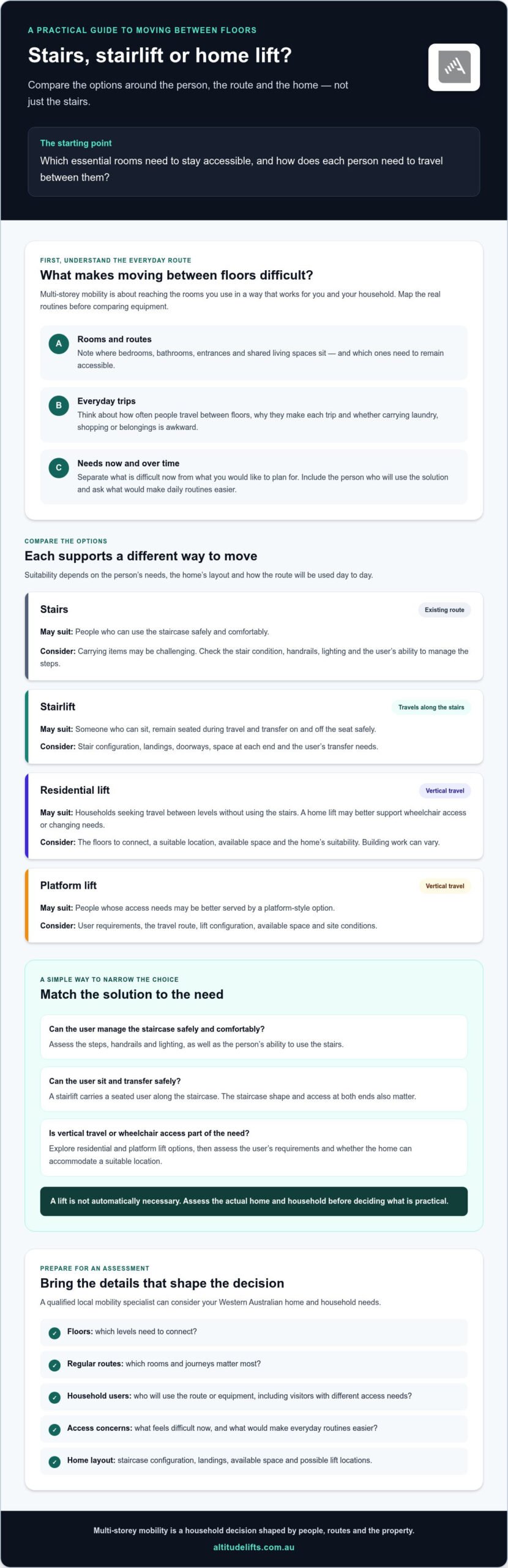
Each option supports a different way of moving between floors. Stairs remain the usual route in many homes, but they may not work for every person or situation. A stairlift carries a seated user along the staircase, while residential and platform lifts provide vertical travel between levels. The best fit depends on the person’s needs, the home’s layout and how the route will be used day to day.
| Option | May suit | Travel and space considerations | What to assess |
|---|---|---|---|
| Stairs | People who can use the existing staircase safely and comfortably. | Uses the home’s existing route; carrying items may be challenging. | Stair condition, handrails, lighting and the user’s ability to manage the steps. |
| Stairlift | Someone who can sit and transfer on and off the seat safely. | Follows the staircase; the stair configuration and available space affect suitability. | Staircase layout, landings, access at each end and the user’s transfer needs. |
| Residential lift | Households seeking vertical travel between levels without using the stairs. | Requires a suitable location within the home; space and property conditions need assessment. | Floors to connect, proposed location and the home’s suitability for the chosen lift. |
| Platform lift | People whose access needs may be better served by a platform-style option. | Configuration and space depend on the lift and the property. | User requirements, travel route and site conditions. |
When might a stairlift be worth exploring?
A stairlift moves a seated user along a staircase, so the person needs to be able to sit down, remain seated during travel and transfer at the top and bottom. A straight or turning staircase can affect what may be suitable, as can the space around landings and doorways. A specialist assessment can help clarify these factors. For more background, see this guide to stairlift prices in Western Australia.
When might a home lift or platform lift be worth exploring?
A residential lift or platform lift may be worth discussing if the stairs aren’t a workable route for the intended user. These are different equipment categories, and suitability depends on the person’s access needs, the floors involved and the property. Don’t treat them as interchangeable or assume either option will meet every requirement. Explore vertical platform lifts for homes for further context. The US National Institute on Aging’s Preventing Falls at Home guide also offers room-by-room safety suggestions; it isn’t a substitute for Australian advice or a property assessment.
For multi story home mobility, compare how each option fits the person’s routines now and what may matter if needs change. A local specialist can assess the home and discuss possible equipment. You can also review Altitude Lifts’ lift options.
Do You Need a Lift? Compare the Trade-Offs for Your Household
A multi-storey home doesn’t automatically need a lift, and a residential lift doesn’t always mean major renovation. The work involved depends on the property and the equipment being considered, so don’t assume either way before an assessment. The aim is to make important rooms accessible while taking the household’s routines, preferences and home into account.
Keeping the stairs as the main route may make sense if the intended user can manage them comfortably and reach the rooms they need. A stairlift may be worth considering if the user can sit and transfer safely and the staircase is suitable. A residential lift offers another way to travel between floors, but its location, space needs and installation requirements must be checked for the specific property. For example, learn more about wall-mounted residential elevators and the factors that can affect their suitability.
What should you weigh before choosing between stairs and equipment?
Start with the household. Who will use the stairs or equipment, how often will they travel between levels, and which rooms do they need to reach? Consider whether an option is for one person or shared by household members, and how people feel about equipment being part of the home. Privacy, convenience and possible disruption during installation are useful topics to raise, rather than outcomes to assume in advance.
Then look at the property. Staircase shape, available floor space, the route between levels and the proposed equipment location may all affect what’s practical. A qualified specialist can assess the home and explain potential installation requirements. This helps avoid assuming that a stairlift needs no changes or that every lift requires extensive building work. The user’s comfort and preferences should guide the discussion.
How can changing needs affect the decision?
Some households need to solve an access difficulty now; others want to consider what may help the home remain usable if circumstances change. Future needs are uncertain, so planning ahead means discussing possibilities, not treating a particular change or outcome as inevitable. Involving the person who’ll use the solution can clarify what matters most to them.
To explore this balance further, read the practical guide to home lifts for seniors in Perth. A conversation with a local specialist can help you understand the options in the context of your home. For information about residential lifts and stairlifts, visit Altitude Lifts’ mobility options.
Plan a Multi-Storey Mobility Assessment for Your WA Home
A little preparation can make a discussion about multi story home mobility more useful. Before contacting a specialist, map out the routes that matter and note what’s difficult now. You don’t need to know which equipment is right; clear information about the household and home gives the assessment a practical starting point.
What information should you prepare before an assessment?
Write down which levels and rooms need to be accessible, who may use the equipment and how often they travel between floors. Note concerns with stairs, carrying belongings, reaching a landing or moving through doorways. If you’re planning ahead, describe what you’d like the home to accommodate without assuming how someone’s needs will change.
It can also help to note details that may affect space and daily routines, such as the staircase layout, nearby doors and how the proposed route connects with shared areas. You might ask:
- Which rooms and floor-to-floor routes are priorities?
- Who will use the equipment, and what are their preferences?
- Where could equipment potentially fit, and what access questions need checking?
- What disruption or changes to household routines should we discuss?
Where appropriate, invite the person who’ll use the equipment to share their priorities directly. Family members or carers can add helpful context, but the user’s comfort and preferences should remain part of the conversation.
What can a local specialist help you explore?
A site assessment can consider the home’s layout, available space and potential fitting requirements. It gives a specialist a chance to discuss residential lift, stairlift or platform lift options in the context of the property and the people who’ll use them. At Altitude Lifts, site assessment and custom fitting support that tailored discussion, but the suitable option and any required work depend on the individual home.
Western Australian building requirements may depend on the proposed equipment and work involved. Don’t assume an installation is automatically exempt from approvals or that a particular approval will be required. Check the details for your project with the relevant professionals and local authority. The guide to residential lift regulations in WA offers a starting point for understanding what to ask.
Once you’ve noted the routes, users and questions that matter, you can discuss a home mobility assessment with Altitude Lifts and explore options for your WA home.
Explore Tailored Multi-Storey Mobility Options with Altitude Lifts
Choosing an option for multi story home mobility starts with the access challenge, not a product name. Consider who needs to move between floors, which rooms matter most, how often the route is used and what feels comfortable to the person who’ll use the equipment. Then weigh those priorities against your home’s layout and available space.
Stairs may remain practical for some households. A stairlift could be worth exploring if the user can sit and transfer safely and the staircase is suitable. A residential lift or platform lift may warrant discussion if vertical travel is a better fit for the user’s needs and the property. No category is right for everyone, and an assessment is needed before considering a specific model.
How can Altitude Lifts help you explore suitable options?
Altitude Lifts is a locally owned Western Australian specialist supplying residential lifts, platform lifts and stairlifts. Its range includes the Swift Home Lift Lite and Swift Lift Pro, as well as the Alpha Stairlift. These examples can help you understand the available categories, but they aren’t recommendations for a particular home. Suitability and configuration need to be considered in light of the user’s needs and property.
A site assessment and custom fitting bring the discussion into the context of your home. The specialist can consider the floors involved, available space and potential fitting requirements, then help clarify which product category may be worth exploring. This is a practical way to discuss options with the relevant details in view, not a promise of a particular match or outcome.
What is a sensible next step for your household?
Before contacting a provider, note the routes that are difficult, the rooms that need to remain accessible, who may use the equipment and any concerns about space or disruption. Include the intended user’s preferences. A short list of questions can help keep the conversation focused on what would make everyday access more workable.
If NDIS support is relevant to your circumstances, Altitude Lifts provides NDIS-registered services. Check how your individual plan and circumstances apply before making decisions about funding or equipment.
When you’re ready, contact Altitude Lifts to discuss your household’s priorities and request a tailored assessment. There’s no need to decide on equipment in advance. A considered conversation can help you understand what may suit your home and what to explore next.
Choose a More Practical Way Between Floors
The right multi story home mobility option isn’t decided by the number of levels in your home. It depends on the person using it, the rooms they need to reach, household routines and what the property can accommodate. Stairs may remain suitable, while a stairlift or residential lift could be worth exploring when access needs or priorities differ.
Before choosing equipment, note the routes that matter and involve the person who’ll use it in the conversation. A site assessment can help clarify the possibilities in your home. Altitude Lifts is a locally owned Western Australian specialist offering residential and platform lifts, stairlifts, site assessment and custom fitting. NDIS-registered services may also be relevant for eligible participants, depending on their circumstances.
To discuss multi-storey mobility options for your home, contact Altitude Lifts and explore what may suit your household.
Frequently Asked Questions
Is a stairlift or a home lift better for a multi-storey home?
Neither option is universally better; the right choice depends on the user, staircase and property. A stairlift carries a seated person along a suitable staircase, so sitting and transferring safely are important considerations. A home lift travels vertically between levels and may suit different access needs, but requires suitable space and a property assessment. For multi story home mobility, compare daily routines and household priorities before settling on equipment.
Can you install a lift in an existing two-storey home?
A lift can be considered for an existing two-storey home, but suitability and installation requirements depend on the building and chosen equipment. Available space, the route between floors and the home’s structure all need to be assessed. Don’t assume installation will require major renovation, or that it can be completed without building work. Ask a qualified local specialist to assess the property and check any applicable approvals with the relevant authority.
What is the difference between a stairlift and a platform lift?
A stairlift carries a seated user along a staircase on a rail. A platform lift moves vertically between levels, with suitability depending on the user’s needs, the route and the property. They’re different equipment categories, so don’t assume one can replace the other. A specialist can discuss the intended user, access requirements and home layout to help determine which option may warrant further assessment.
How do I know which mobility option suits my home and family?
Start by identifying who needs access, which rooms they use and how often they travel between floors. Consider whether the user can manage stairs or transfer to a stairlift, whether other household members will use the equipment, and how much space is available. A site assessment can help compare these priorities with the property’s layout. The person using the equipment should be included in the discussion and decision.
Do I need a home lift if I can still use the stairs?
Not necessarily. If the stairs remain comfortable and practical for reaching the rooms you use, you may not need a lift now. You might still consider how often you travel between floors, whether carrying belongings is difficult and what you’d like to plan for. Future needs can’t be predicted with certainty, so there’s no single right answer. Discuss your current priorities and possible options without feeling pressured to choose equipment.
Can a mobility lift be assessed for an existing home in Western Australia?
Yes. A specialist can assess an existing WA home to explore whether a residential or platform lift may be suitable. The assessment can consider the floors involved, available space and potential fitting requirements, but it can’t guarantee a particular product or outcome. Building work and approvals may depend on the equipment and property. Ask the specialist what needs checking and contact your local council about any applicable requirements.
What should I prepare before requesting a home mobility assessment?
Note which floors and rooms need to be accessible, who may use the equipment and which routes cause difficulty. Record useful details about the staircase, nearby doors, available space and household routines. Write down questions about comfort, access and possible disruption, too. Where appropriate, include the intended user’s preferences, along with relevant input from family or a carer. This gives the WA specialist practical context for discussing options and next steps.
One Response