
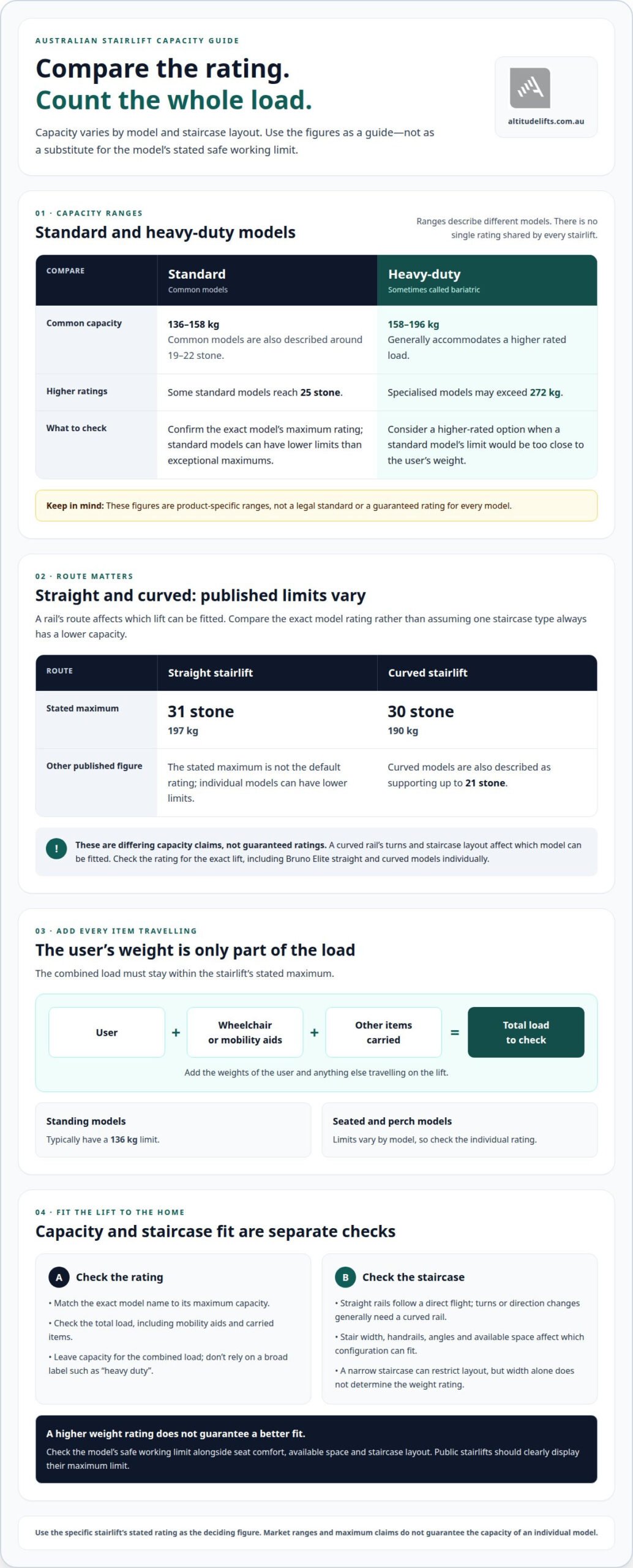
The right stairlift isn’t always the one with the highest weight limit. Standard stairlifts commonly support 136-158 kg, while heavy-duty models generally accommodate 158-196 kg. The weight capacity of home stairlifts also depends on the model and staircase layout, particularly where turns or restricted space affect the rail design.
It makes sense to start by checking whether a stairlift can support the person who will use it. But the rated weight limit is only part of the decision: staircase layout affects which model may suit, and exceeding its rating can affect performance.
This guide explains how standard and heavy-duty limits compare, why straight and curved staircases can lead to different options, and what the staircase’s design means for capacity. You’ll come away with a clearer understanding of the figures and how they relate to choosing a stairlift suited to your home and needs.
Key Takeaways
- Factor in mobility aids and anything carried, not just the user’s body weight, when considering the total load.
- A straight stairlift’s stated maximum can reach 31 stone (197 kg), but capacity depends on the specific model.
- Don’t assume a curved stairlift has a lower limit simply because the rail follows a turn; models differ.
- Staircase shape and available space help determine which lift configuration can suit the home.
Stairlift weight limits: What is the weight capacity of a stairlift?
The weight capacity of home stairlifts varies by model and staircase layout. Straight and curved stairlifts may have different rated limits, so consider the route as well as the user’s weight.
Curved stairlift capacity limits
A curved stairlift follows bends or changes in direction. Its capacity depends on the specific model and staircase, because the rail’s turns and layout affect which lift can be fitted.
Published figures vary: curved models are often described as supporting up to 21 stone, while the stated maximum for a curved stairlift can reach 30 stone, or 190 kg. These are different capacity claims, not a guaranteed rating for every curved stairlift. Bruno Elite straight and curved models also need to be judged by their individual rated capacities, rather than assuming one version matches the other.
Australian models and safety rules
There isn’t one capacity that applies to every stairlift sold in Australia. Standard models commonly support 136-158 kg, while a stated maximum for a straight stairlift reaches 31 stone, or 197 kg; model ratings remain decisive.
Australian capacity selection should follow the stairlift’s own stated safe working limit, rather than treating market ranges as a legal standard. Standing stairlifts typically have a 136 kg limit; seated and perch models vary by model, so their own ratings matter. A public stairlift should display its maximum limit clearly, helping users avoid loads above that rating.
Straight stairlifts use a rail along a direct flight, while curved stairlifts follow stairs with turns. A narrow staircase can affect the available layout, but width alone does not determine a lift’s weight capacity.
For a straight stairlift, the stated maximum can reach 31 stone, or 197 kg. Curved models have a stated maximum of 30 stone, or 190 kg, though other market figures describe curved capacity up to 21 stone. Those figures show why the exact model rating matters more than a broad straight-versus-curved comparison.
Standard and heavy-duty stairlift capacity ranges
Standard and heavy-duty stairlifts cover different rated loads, with specialised options extending beyond common ranges. The key is to compare the model’s maximum weight with the total load it will carry.
Heavy-duty and bariatric options
Heavy-duty, sometimes called bariatric, stairlifts are designed for users who need a higher weight rating. Consider one if a standard model’s limit would be too close to the user’s weight, while checking the specific model’s stated capacity.
Common standard models are rated around 19 to 22 stone, and some reach 25 stone. Specialised models may exceed 272 kg. These figures describe different models, not a single rating shared across straight and curved options.
A user weighing more than 25 stone should look for a high-weight-capacity model. Leave some capacity for mobility aids or items carried on the journey, rather than selecting a lift based only on body weight. Choosing a rating with additional headroom can also allow for future changes.
Carrying wheelchairs and heavy items
The total load includes the user and anything else travelling on the lift. If the user remains in a wheelchair, include the wheelchair’s weight as well as the user’s.
For example, the user and wheelchair together must stay within the stairlift’s stated maximum weight. The same applies to mobility aids and other carried items: add their weights to the total. A model rated for the user alone may not have enough capacity for the combined load.
Capacity matters whether the stairlift is straight or curved; the specific model’s rating is the deciding figure. A higher weight rating does not automatically mean the seat or available space will suit every user. Check comfort, fit and staircase layout alongside the maximum load.
Maximum weight limits for straight stairlifts
Straight stairlifts travel along a direct rail, and their rated capacities vary by model. These are product-specific ratings, not one universal limit for all stairlifts.
The highest stated capacity for a straight stairlift is 31 stone, or 197 kg. That maximum is not the default rating: standard models can have lower limits, and the individual model’s stated capacity determines its safe working load. A wide range of ratings means two straight lifts designed for similar staircases may not accommodate the same user weight.
A heavy-duty straight stairlift may suit someone whose weight exceeds a standard model’s limit. Don’t treat the highest rating as a general allowance for every heavy-duty stairlift. Check that the specific model’s capacity covers the user and any mobility aids or items carried.
A reference to “1100” alone doesn’t establish a stairlift’s capacity. For a practical comparison, match the exact model name to its maximum rating, then assess the combined load it needs to carry.
For example, a user weighing 25 stone needs a model whose rated limit accommodates that weight, plus any carried load. A straight stairlift’s maximum might be higher, but that doesn’t make every model suitable. The capacity label and model specification are more useful than a broad description such as “heavy duty”. This distinction helps you assess straight stairlift weight limits accurately, without confusing an exceptional maximum with a standard model’s rating.
Staircase design and weight capacity
A stairlift’s rated capacity and the staircase layout both matter. A higher weight rating alone does not mean a model can be fitted to every staircase.
On a straight flight, the rail follows a direct route. A landing or change in direction generally requires a curved rail shaped to the staircase. Its turns and other features affect which curved stairlift options are suitable, so capacity depends partly on the model designed for that route.
A narrow staircase can limit space for the seat, rail and access. Handrails, stair width and angles also affect which configuration will fit. These features do not change a model’s stated weight rating, but they can affect which suitable model can be installed.
This is especially important when you need a higher weight capacity. The staircase must accommodate a lift with the appropriate rating; choosing a high-capacity model without considering its rail route and fit is not enough. Keep the combined load within the model’s limit and make sure the rail suits the staircase.
Using a stairlift beyond its rated load can affect performance, cause mechanical failure or lead to sudden stops. Excess weight can also contribute to rail wear. A home assessment considers the staircase dimensions, handrails, angles and available space to identify suitable options. The model’s weight limit is the same whichever side of the staircase it is fitted on.
For example, a turning staircase with limited width presents two linked questions: can the rail follow the route, and can the chosen model carry the required load? Resolving both together is more useful than choosing by capacity alone. Explore stairlift options for your staircase as you consider how layout and load requirements fit together.
Altitude Lifts: Alpha Stairlift
If you’re considering a stairlift for your home, Altitude Lifts’ Alpha Stairlift is one option. The model’s rated capacity and your staircase layout both matter; labels such as standard or heavy-duty alone do not establish the right fit.
When considering the Alpha Stairlift, compare its model-specific capacity with the person’s weight and any mobility aids or items they will carry. Also consider whether the staircase is straight or turns. This focuses the decision on the actual load and route, not a general market maximum.
If you’d like to discuss the Alpha Stairlift and your home’s mobility needs, contact Altitude Lifts.
Choose a solution that fits your next steps
Choosing a mobility solution involves more than getting between floors. Consider how you’ll use it day to day, whether you need to travel seated, and how the staircase fits into your home. These priorities help identify a practical solution instead of focusing on capacity figures alone.
The weight capacity of home stairlifts is one part of the decision, alongside the user’s needs and the route through the house. If a stairlift is not the right type of solution, Altitude Lifts also offers the Swift Home Lift Lite, Swift Lift Pro and Compact Elegance Home Lift. Each serves a different purpose, so start by considering the movement your home needs to support.
You can take the next step without having every detail settled. Discuss your home mobility options with Altitude Lifts and consider which solution may suit your everyday routine. A clearer fit can make planning feel more manageable.
Frequently Asked Questions
What If You’re Over 25 Stone?
If you weigh more than 25 stone, look for a high-weight-capacity stairlift rather than assuming a standard model will suit. Compare your weight with the specific model’s rated limit, allowing for mobility aids or belongings you’ll carry. For example, a walking aid adds to the travelling load. The important figure is the model’s own maximum, not a general category label.
Does the Weight Limit Include the Chair Itself?
The rated limit concerns the load the stairlift carries, not the installed chair as an additional passenger weight. Count the person using the lift, plus mobility aids or other items travelling with them. For instance, if someone carries a bag on every trip, include it in the load assessment. Keep the combined passenger load within the model’s stated limit.
How much weight can straight stairlifts hold?
Straight stairlifts have different capacities depending on the model. These ratings describe individual products, so don’t assume every straight rail has the highest capacity. The model’s stated maximum is the useful figure when assessing a person’s needs.
What Happens If the Weight Limit Is Exceeded?
Exceeding the rated limit can affect performance, contribute to mechanical failure or cause a sudden stop. Modern stairlifts have safety systems that prevent operation when the load exceeds the safe working limit, but this isn’t a reason to test the limit. Include mobility aids and carried items in the load, and keep use within the model’s rating.
What is the typical weight capacity of a home stairlift?
A home stairlift’s capacity varies by model, so check the specific model’s rated limit. Treat that as a broad range, not a promise about a particular lift. If your weight is near the upper end, the exact model rating and any additional load, such as a mobility aid, become especially relevant.
What is the maximum weight capacity of straight stairlifts in Australia?
The highest stated maximum for a straight stairlift is 31 stone, or 197 kg. That figure applies to the maximum reported for a model, not every straight stairlift available in Australia. Other models have lower limits. Compare the exact model’s rated capacity with the passenger and anything carried, rather than choosing by the maximum figure alone.