
Choosing an indoor stairlift in Perth starts with the person who’ll use it, not just the staircase. If you’re exploring indoor stairlifts perth, you may be wondering whether a stairlift will fit your home, feel comfortable to use and avoid disruptive building work.
An indoor stairlift carries a seated user between levels, helping make everyday movement around home more manageable. Suitability depends on the person’s mobility and routines as well as the staircase shape, available space and layout. In many installations, the rail is attached to the stair treads rather than the wall, so major structural changes may not be needed.
This guide explains how indoor stairlifts work, what a professional assessment considers and how to compare a stairlift with alternatives such as a residential lift or platform lift. You’ll also learn how Altitude Lifts’ local site assessment and installation can help you plan, including whether the Alpha Stairlift may suit your home. The aim is to help you make an informed decision that supports independence at home.
Key Takeaways
- Understand how an indoor stairlift may support day-to-day movement at home, with the user’s needs and routines at the centre of the decision.
- Use practical staircase details, including its direction, landings and access at either end, to prepare for an assessment for indoor stairlifts perth.
- Compare stairlifts, residential lifts and platform lifts by the type of movement they support and how they may fit your home.
- Plan from identifying the user’s needs through to a site assessment and installation, considering the staircase and household layout together.
- Find out how Altitude Lifts’ local assessment and installation can help you explore the Alpha Stairlift as a potential fit.
Indoor stairlifts in Perth: how they support movement around the home
Stairs can become harder to manage as mobility changes, whether gradually or after an injury. This can affect more than getting between floors. It may make it difficult to reach a bedroom, bathroom or other familiar part of the home. For households considering indoor stairlifts perth, the key question is how well a stairlift could support the user’s everyday movement in their particular home.
An indoor stairlift is a mobility aid that carries a seated user along a staircase between floors.
It differs from a residential lift, which travels vertically between levels, and a wheelchair platform lift, which carries a person on a platform, often while they remain in their wheelchair. Each option supports a different kind of movement. The right one depends on the person’s mobility, the home layout and how the space is used.
What does an indoor stairlift do?
The user sits on the stairlift at one end of the stairs, travels along the staircase and gets off at the other level. This can make it easier to reach rooms upstairs without walking the full flight. For example, someone who relies on an upstairs bedroom may be able to keep using that familiar space as their needs change. A stairlift supports travel on the stairs, rather than general movement around the home.
Who might consider a stairlift at home?
A stairlift may be worth exploring for someone with restricted mobility who finds stairs difficult, or for a family planning for changing needs. It may help the person maintain established routines, such as getting to a bedroom or spending time in an upstairs living area, rather than reorganising daily life around one floor. A professional assessment is essential because a general recommendation can’t account for the individual’s needs or the home’s layout.
Suitability involves more than whether a staircase looks straightforward. The user needs to be able to use the stairlift as intended, and the arrangement must work with the stairs and surrounding space. A local site assessment considers how the person moves around at home, which rooms they need to reach and how the stairlift could fit the layout. This helps compare a stairlift with a residential lift or platform lift based on the household’s actual needs.
Will an indoor stairlift suit your Perth home and staircase?
A staircase can look simple at first glance, but its turns, landings and entrances may affect how a stairlift could work in your home. A professional site assessment considers the full route, the person who’ll use it and the household’s everyday routines.
Which staircase details matter?
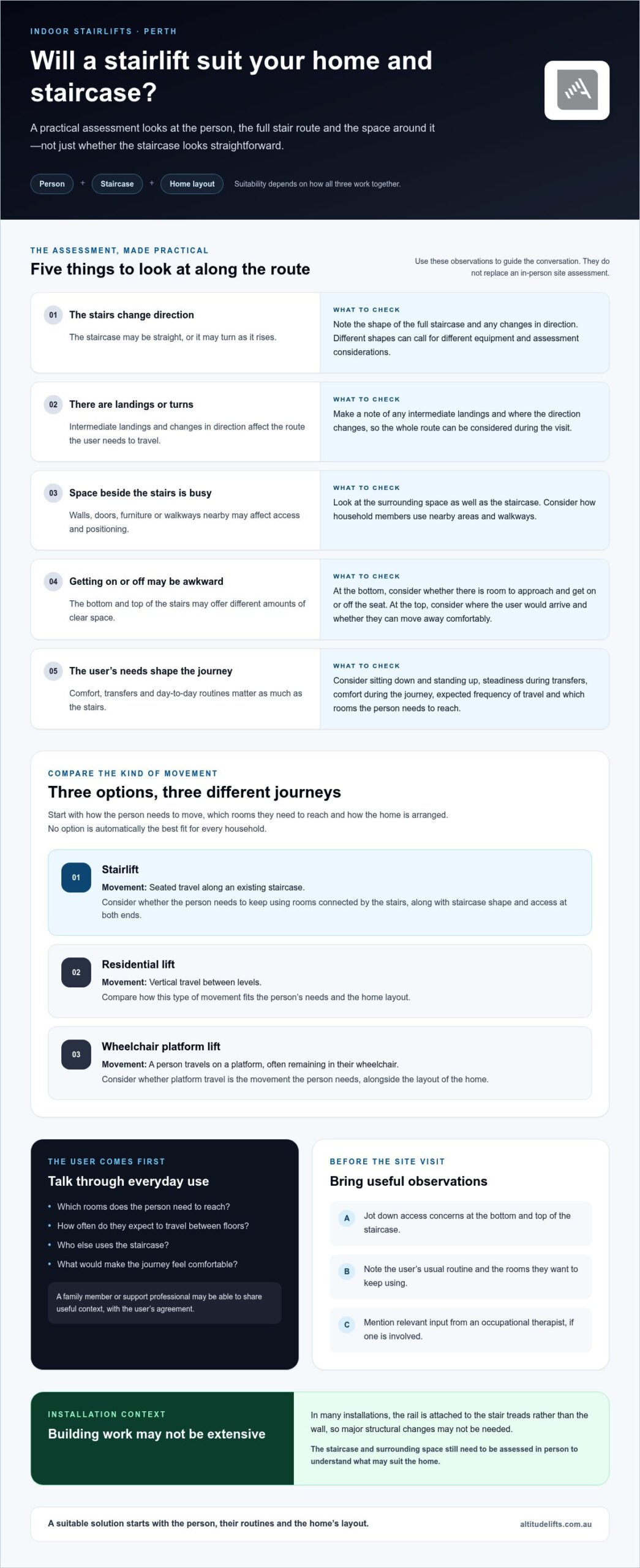
Before an assessment, note the staircase shape and what’s around it. These observations can help guide the conversation, but they don’t replace an in-person assessment.
- Direction: Is the staircase straight, or does it turn as it rises?
- Landings: Are there intermediate landings or changes in direction?
- Space beside the stairs: Are there nearby walls, doors, furniture or walkways that may affect access and positioning?
- Access at the bottom: Is there enough clear space to approach and get on or off the seat?
- Access at the top: Where would the user arrive, and can they move away from the stairway comfortably?
Consider both ends of the staircase. There may be room to approach at the bottom but a narrower or busier exit at the top. Different staircase shapes and surrounding spaces can call for different equipment and assessment considerations, so don’t assume one arrangement will suit every home. A site visit allows the staircase and access points to be considered together.
How do the user’s needs shape the assessment?
The user’s experience matters as much as the stairs. Consider whether they can sit down and stand up from a seat, how steady they feel during transfers, what would make the journey comfortable and how often they expect to travel between floors. Also note which rooms they need to reach and who else uses the staircase. A family member or support professional may be able to share useful context, with the user’s agreement.
If an occupational therapist is involved, their perspective on how the person interacts with the home can help inform planning. Astrid describes the value of a professional home safety assessment for considering a person’s needs alongside their environment.
Before arranging a visit, jot down access concerns and the user’s usual routine. Altitude Lifts’ stairlift site assessment considers those details in the home. Suitability depends on how the user’s needs, the staircase and the surrounding layout work together.
Indoor stairlift or another mobility solution: what should Perth households compare?
The main difference is the type of journey each option supports. A stairlift follows the staircase with a seated user, while residential lifts and platform lifts travel vertically between levels. Start by considering how the person needs to move, which rooms they need to reach and how the home is arranged. No option is automatically the best fit for every household.
| Option | Movement supported | Home context to consider | Assessment considerations |
|---|---|---|---|
| Stairlift | Seated travel along an existing staircase. | A home where stairs connect rooms the person wants to keep using. | Staircase shape, access at both ends, ability to transfer to and from the seat, and intended daily use. |
| Residential lift | Vertical travel between floors. | A household considering lift access between levels as part of how it uses the home. | Available space, the home layout, access to the lift and the user’s mobility needs. |
| Platform lift | Vertical travel on a platform, which may be relevant for wheelchair access. | A home where the person needs to travel between levels on a platform rather than transfer to a stairlift seat. | Wheelchair access, the route between levels, space and how the person will use the lift. |
When might a stairlift be worth exploring?
A stairlift may be worth discussing if the person can transfer onto a seat and wants to travel along the staircase while seated. Being able to get on and off comfortably, and use the equipment in a way that suits their needs, are important parts of the assessment. A personalised assessment considers the individual and the home together, rather than relying on a checklist alone. For an overview of platform options, see the Vertical Platform Lifts buying guide.
When might a lift or platform lift be considered?
If the person needs to remain in their wheelchair while moving between levels, a platform lift may be relevant to compare. A residential lift may also be worth exploring when vertical travel between floors better suits the household’s needs. The home’s layout and the person’s routines help shape the comparison. If you’re considering whole-home lift options, the Perth home lift installation guide offers a related perspective.
When comparing indoor stairlifts perth options, focus on the movement the user needs, the space available and what feels manageable for them. A professional assessment can help clarify which solution aligns with those needs and the home layout.
Planning an indoor stairlift assessment and installation in Perth
A clear plan starts with the person’s everyday needs, then considers how the home can support them. Preparing a few details in advance can make a professional site assessment more focused and help the household understand the steps from initial discussion to installation.
What to prepare before a site assessment
Think through a typical day. Which floors and rooms does the person need to reach, and when do the stairs matter most to their routine? Note any turns, landings or tight access points, along with anything that could affect getting on or off at the top and bottom.
It may also help to write down questions about how the stairlift is operated, what daily use involves, how installation is planned and what ongoing support looks like. If family members or support professionals are involved, their observations can add useful context, with the user’s agreement.
What happens as the project moves towards installation?
Each project is shaped by the home and the person’s requirements, but the planning journey generally follows these steps:
- Identify the need. Describe the movement the person wants help with and the rooms they need to access.
- Arrange a site assessment. A professional evaluates the staircase, access at both ends and the household’s requirements in the home.
- Plan a suitable approach. The assessment findings inform the proposed stairlift solution and the project details.
- Complete the installation. Professional installation puts the agreed plan into place. The work involved depends on the property and the requirements identified.
- Become familiar with use. The user can build an understanding of operating the stairlift as part of their day-to-day routine.
Every home follows its own path. Staircase layout, access and individual needs all inform the project, making the assessment an important opportunity to discuss practical questions before moving ahead. For further background, see the Perth stairlift installer guide.
If you’re exploring indoor stairlifts perth, Altitude Lifts provides local site assessment and professional installation to help make planning specific to your home. Arrange a stairlift site assessment to discuss the staircase, access and the user’s everyday requirements.
Explore an indoor stairlift in Perth with Altitude Lifts
Choosing a stairlift is a personal decision. Start by understanding what the person needs from the home, which parts of the staircase and layout matter, and how the equipment may fit everyday routines. Altitude Lifts is a locally owned and operated Western Australian mobility specialist, supporting people with restricted mobility to remain at home.
Altitude Lifts offers the Alpha Stairlift and provides professional site assessment and installation. The planning process considers the home and the person who’ll use the stairlift, rather than relying on a product description alone. This brings practical questions about access, the staircase and daily movement into the same conversation.
A locally supported approach to stairlift planning
A site assessment is an opportunity to discuss how the user moves around the home and which rooms they want to keep reaching. It considers the staircase and access points alongside those needs, grounding the plan in the actual household. Professional guidance and installation then help move the project forward with a clearer understanding of what’s involved.
For example, a family might explain that the user’s main priority is reaching an upstairs bedroom, while noting a landing or limited space near a doorway. Sharing these details makes the discussion specific and gives the household an opportunity to ask about everyday use and installation before making decisions.
Taking the next step with Altitude Lifts
Before discussing indoor stairlift options, note the staircase shape, any turns or landings, access at the top and bottom, and the rooms the person needs to reach. Include what the user finds comfortable, any difficulty transferring to a seat, and how often they expect to travel between floors. Family members or support professionals can contribute useful context, with the user’s agreement.
Altitude Lifts provides NDIS-registered services. NDIS funding decisions depend on individual circumstances and scheme requirements, so registration doesn’t promise funding approval or eligibility.
If you’re considering indoor stairlifts perth, you don’t need to have every answer before getting started. Share what you’ve noticed about the home and what would make daily movement easier. Discuss your indoor stairlift options with Altitude Lifts and plan a suitable next step for your home and mobility needs.
Take the next step towards easier movement at home
The right solution starts with the person, their daily routines and the layout of the home. An indoor stairlift may help maintain access between floors, but the staircase and the user’s needs matter. Comparing stairlifts with residential and platform lifts can clarify which type of movement best suits the household.
If you’re considering indoor stairlifts perth, Altitude Lifts is a locally owned and operated Western Australian mobility specialist offering professional site assessment and stairlift installation. Its NDIS-registered services may also be relevant for some households, though funding decisions depend on individual circumstances.
Start with the rooms the person needs to reach, the staircase layout and any questions about everyday use. Talk with Altitude Lifts about an indoor stairlift for your Perth home and discuss a considered next step tailored to your home and mobility needs.
Frequently Asked Questions
What is an indoor stairlift and how does it work?
An indoor stairlift carries a seated user between floors along a staircase. The user gets on at one end, travels along the stairs and gets off at the other level. It can help someone who finds climbing stairs difficult reach rooms upstairs, provided they can use the seat and transfers suit their needs. A site assessment considers the person, staircase and access points before a suitable approach is planned.
Can an indoor stairlift be fitted to a curved staircase?
A curved staircase needs individual assessment because bends, landings and available space can affect the equipment and its layout. Don’t assume a stairlift will suit based on the staircase’s appearance alone. A professional site assessment examines the full route and access at both ends, then informs an approach for the home and user. Altitude Lifts offers the Alpha Stairlift, with planning guided by the specific project.
Will an indoor stairlift fit a narrow staircase?
It depends on the staircase dimensions, surrounding space and the stairlift arrangement being considered. A narrow flight may leave limited room to approach, get on or off, or use the stairs for other household movement. An assessment can consider the clear width and access at both ends, as well as who else uses the staircase. This is more reliable than judging fit from a photo or measurement alone.
Is a stairlift suitable for someone who uses a wheelchair?
A stairlift is designed for seated travel along the stairs, so the user generally needs to transfer from their wheelchair onto the seat and back again. If they need to remain in their wheelchair between floors, a platform lift may be more relevant to compare. The person’s transfer ability, mobility needs and home layout all matter. A professional assessment can help the household consider these options without assuming one solution suits everyone.
How is an indoor stairlift installed in a Perth home?
Installation follows a site assessment that considers the staircase, access and the user’s household requirements. The proposed approach is planned around the property, then the stairlift is professionally installed and the user can become familiar with its operation. The work and project details depend on the home and individual needs. For indoor stairlifts Perth households are considering, Altitude Lifts provides local site assessment and professional installation in Western Australia.
Can NDIS funding help with an indoor stairlift in Perth?
NDIS funding may help with a stairlift for an eligible participant, but approval isn’t automatic. The NDIS makes eligibility and funding decisions based on the participant’s circumstances and plan. Altitude Lifts provides NDIS-registered services, but registration doesn’t guarantee that a particular stairlift will be funded. Include the person’s mobility needs and home access requirements in planning, and consider seeking guidance through their NDIS support arrangements.
What happens if the power goes out while someone is using a stairlift?
Power-outage operation depends on the stairlift model and its power system. Many stairlifts use batteries that charge from a nearby power supply, but don’t assume how a particular unit will operate during an outage or how long it may continue to run. Include this question in the assessment and discuss the model’s operating instructions with the installer. The household should understand what to do if power is interrupted while the user is travelling.