
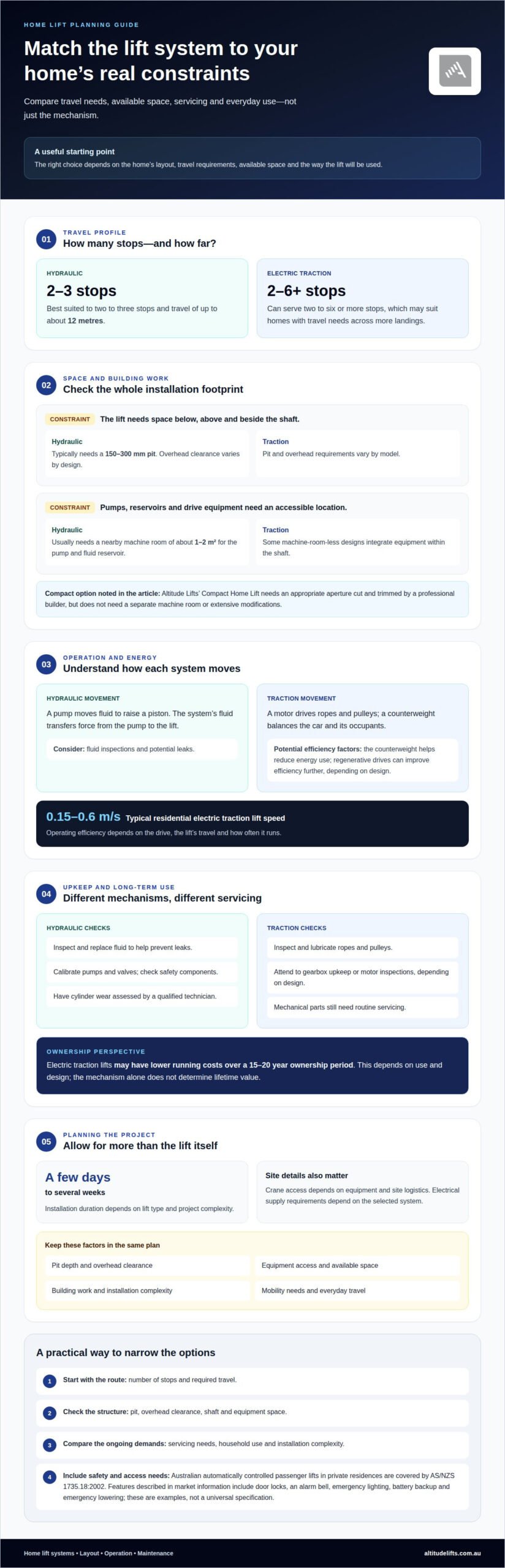
The better home lift isn’t automatically the faster one; it’s the system that suits your home’s layout and travel needs. To weigh the pros and cons of a hydraulic vs traction home lift, start with the number of stops: hydraulic lifts are best suited to two to three stops and travel of up to about 12 metres, while electric traction lifts can serve two to six or more stops. The right choice depends on more than the mechanism alone.
It’s understandable to focus on space, disruption and how a lift will feel in everyday use. The mechanism affects the lift’s layout and operation, so the differences between hydraulic and traction systems are practical as well as technical.
This guide explains how hydraulic and traction lifts work and compares their typical requirements and trade-offs. It also outlines a practical way to choose a lift for your home and mobility needs, including compact options available from Altitude Lifts in Western Australia.
Key Takeaways
- Allow for the lift pit, overhead clearance and equipment space when assessing how each system could fit your home.
- Compare installation and ongoing maintenance needs, not just the lift mechanism, when considering long-term suitability.
- Understand how a traction lift’s ropes and counterweight work together to move the car and influence energy use.
- Use your home’s layout, travel requirements and available space to narrow down the lift type that best suits everyday needs.
Do hydraulic home lifts need a machine room?
Hydraulic lifts usually need a nearby machine room for the pump and fluid reservoir. Pit depth, overhead clearance and equipment access also affect the installation.
Pit and overhead requirements
A hydraulic home lift typically needs a pit 150-300 mm deep beneath the lowest landing. This space accommodates the lift’s base and piston, so existing floors may need building work. Overhead clearance depends on the lift design and the top-floor layout; it should be considered alongside the pit, not as a separate afterthought. Traction models can have different pit requirements.
Machine-room requirements
The hydraulic pump unit is usually placed in a machine room beside the shaft, at the lowest landing. Allow a utility space of about 1-2 square metres for the pump and fluid reservoir. This is a distinct space requirement: some modern machine-room-less traction designs integrate equipment within the shaft. Hydraulic systems still need access to their machinery for inspection and maintenance.
For Australian automatically controlled passenger lifts in private residences, AS/NZS 1735.18:2002 applies. Residential lifts described in the available market information include features such as door locks, an alarm bell, emergency lighting, battery backup and emergency lowering. These examples shouldn’t be treated as a universal specification for every lift.
Traction lifts use ropes and counterweights, and can offer faster, smoother travel with lower energy use. Their drawbacks can include operating noise and equipment-space demands, depending on the design.
Environmental and accessibility needs matter too. A hydraulic system uses fluid, so potential leaks are a consideration; either lift type must suit the user’s mobility needs and the home’s available space.
Installation can take from a few days to several weeks, depending on lift type and complexity. Crane access depends on the equipment and site logistics; electrical supply requirements also depend on the selected system. These details shape construction planning, alongside pit and overhead work.
| Option | Pit and overhead | Equipment space |
|---|---|---|
| Hydraulic | Typically 150-300 mm pit; overhead varies by design | Nearby machine room, usually 1-2 square metres |
| Traction | Requirements vary by model | Some designs integrate machinery within the shaft |
Choose by matching the lift’s layout requirements to your home’s structure and available space.
Is an electric or hydraulic home lift better?
Neither system is automatically the better choice for every home. A useful hydraulic vs traction home lift pros and cons comparison considers installation demands, maintenance and how the lift will be used.
Hydraulic installation and maintenance costs
Installation and upkeep depend on the chosen lift design and the work required in the home. Hydraulic systems use a pump, cylinder and control equipment; traction systems use a drive, ropes and counterweight. Rather than comparing mechanisms in isolation, consider the lift’s footprint, any building work, servicing and how well it meets your access needs. Altitude Lifts’ Compact Home Lift requires an appropriate aperture cut and trimmed by a professional builder, but does not need a separate machine room or extensive modifications.
Hydraulic fluid and maintenance
Hydraulic fluid transfers force from the pump to the lift’s piston. Maintenance includes inspecting and replacing fluid to help prevent leaks, as well as calibrating pumps and valves. A leak can affect operation and needs attention. Traction lifts don’t use hydraulic fluid, avoiding fluid-related leak concerns, but their mechanical parts still require routine servicing.
Lifespan and maintenance costs
Hydraulic pumps and fluid can wear over time, while traction systems rely on durable mechanical components. That difference affects the type of maintenance each system needs, but the mechanism alone doesn’t determine lifetime value. Consider how often the lift will operate, the upkeep involved and installation complexity together. Electric traction lifts may have lower running costs over a 15-20 year ownership period.
Servicing and ongoing maintenance
Hydraulic servicing can include inspecting fluid, calibrating valves and pumps, and checking safety components. If a hydraulic cylinder shows wear, its condition should be assessed by a qualified technician. Traction maintenance instead includes inspecting and lubricating ropes and pulleys, plus gearbox upkeep or motor inspections depending on design. Reviewing the hydraulic vs traction home lift pros and cons against these service demands can clarify which arrangement better matches your priorities.
For a closer look at options suited to your home, explore compact home lift options.
HOW DOES A TRACTION ELEVATOR WORK?
A traction lift moves its car using ropes, pulleys and a counterweight. The motor drives the system, while the counterweight balances the car and its occupants. Hydraulic lifts work differently, using fluid to raise a piston. For a home, the practical choice depends on the available space, the building and the intended use.
Residential electric traction lifts typically travel at 0.15-0.6 m/s. Their operating efficiency depends on the drive, the lift’s travel and how often it runs. A counterweight helps reduce energy use during movement, while regenerative drives can improve efficiency further by recovering energy during operation. Not every model uses the same drive technology, so these benefits vary with design.
Running costs also reflect household use. A lift making frequent trips between several levels will operate differently from one used occasionally between two floors. Electric traction lifts can serve two to six or more stops, making them an option for homes where travel needs extend beyond a small number of landings. Over a 15-20 year ownership period, they may have lower running costs.
Noise is another practical consideration. Noise can be a consideration when choosing a home lift, particularly if quiet rooms are close to the shaft. Some models use a separate machine room; machine-room-less designs integrate components within the shaft, which can change how equipment fits into the building.
For a useful comparison, weigh expected trips, travel distance and the location of bedrooms or living areas alongside energy efficiency. A custom choice should also account for available space and the lift’s intended use. Traction’s counterweight and drive can support efficient operation, but the best fit depends on how the lift will serve your home day to day.
Hydraulic and traction lift mechanisms
A hydraulic home lift raises its car using a piston connected to the lift inside a shaft. A pump moves fluid into a cylinder, extending the piston and lifting the car. This differs from a traction lift, which moves the car through ropes and pulleys. Altitude Lifts’ Compact Home Lift offers an alternative that does not need an existing shaft or a separate machine room.
In a traction system, a motor turns a drive sheave that moves the ropes. The ropes connect the car to a counterweight, which offsets the car’s weight and helps balance movement. In a geared design, a gearbox drives the wheel; in a gearless design, the sheave attaches directly to the motor. These arrangements change how components are positioned and integrated.
That difference matters during construction. Hydraulic systems need space for the cylinder and pump equipment, while traction systems need room for ropes, pulleys and a counterweight. Modern machine-room-less traction designs place components within the shaft. The best arrangement depends on the home’s structure, available space and required travel, rather than the mechanism alone.
Emergency operation also differs. A hydraulic lift can descend during a power outage by opening an emergency valve, allowing fluid to flow back into the tank. Traction lifts rely on their drive and braking arrangements, so emergency operation depends on the model’s design. These mechanisms should be understood as part of the lift’s overall safety system, not as interchangeable features.
For a home with a small number of stops, the hydraulic piston offers a straightforward lifting method. A traction system’s ropes and counterweight may suit different travel or layout needs. Compare how the cylinder, motor and supporting structure fit your building before choosing; those physical requirements are the practical takeaway from the mechanism comparison.
Explore home lift options to consider how a lift could fit your home’s layout and access needs.
Altitude Lifts: Liftboy 5
Liftboy 5 is one option from Altitude Lifts when you’re considering how to improve access between levels at home. The right lift depends on your layout, travel needs and the space available, so the mechanism comparison is a useful starting point, not the only consideration.
Altitude Lifts offers the Swift Home Lift Lite, Swift Lift Pro and Compact Elegance Home Lift, as well as stairlifts and platform lifts. The right option depends on your home’s design, construction and access needs. Its team can provide advice and a quote at no cost to help you understand the available solutions.
Contact Altitude Lifts to discuss your home lift needs and the available options.
Choose a lift around the life you want at home
The best choice is the one that supports your daily routines without making your home feel designed around machinery. Think beyond today’s access needs: consider how different rooms are used, who may rely on the lift, and how the installation will sit within the home over time. That practical view makes weighing the pros and cons of hydraulic versus traction home lifts more personal and useful.
Altitude Lifts offers the Swift Home Lift Lite, Swift Lift Pro and Compact Elegance Home Lift, alongside stairlifts and platform lifts. The right solution depends on your home’s layout and access needs. Contact Altitude Lifts for free advice and a quote, and discuss which type of lift may suit your home in Western Australia.
Contact Altitude Lifts to discuss your options, and take a confident step towards easier movement at home.
Frequently Asked Questions
Does a hydraulic lift work in a power failure?
A hydraulic lift can descend during a power failure through its emergency lowering valve, which releases fluid so the car can move down. Traction lifts may remain inoperative until power returns, depending on their design. Altitude Lifts’ lifts include a standard battery backup that allows descent to the lower level during an outage, giving occupants a clear way to exit.
Are electric lifts quieter than hydraulic lifts?
Not necessarily. Electric traction lifts may produce more operating noise than hydraulic lifts, although the sound depends on the model and where its motor and other equipment sit. In a home with bedrooms beside the lift, equipment placement can matter as much as lift type. Consider how noise may carry into nearby living spaces when comparing designs.
Are hydraulic lifts suitable for residential homes?
Yes. Hydraulic lifts can suit residential homes, particularly where the lift serves a low-rise layout and its pump equipment can be accommodated. They may be a practical option when the planned travel and available building space suit the system. Also consider access needs and ongoing fluid maintenance, since those can shape how well the lift fits everyday household use.
Which type of elevator is best?
There isn’t one best type for every home. A useful starting point is to map the floors the lift must serve, then consider available space, expected use, noise preferences and maintenance priorities. For example, a home with several landings may favour different design considerations from one needing occasional access between fewer levels. The best fit is the one that meets your household’s needs.
What are the key benefits and considerations when opting for a hydraulic elevator system?
A hydraulic system uses a pump, fluid and piston to raise the car, and can offer smooth operation in a low-rise setting. Its practical trade-offs include space for equipment and ongoing attention to fluid, pumps and valves. The installation’s suitability also depends on the building structure and lift travel, so assess those alongside access requirements and servicing needs.
What is a traction lift?
A traction lift is an electric lift that moves its car using ropes running over a driven pulley. A counterweight balances the car and its occupants, helping the motor move the system. Some designs include a machine room, while machine-room-less models integrate components into the shaft. This arrangement is commonly considered where the home’s layout and travel needs suit traction operation.