
Moving isn’t the only option when home becomes harder to manage. Alternatives to moving house for seniors in Perth include adapting the current home, arranging practical support or moving to a more suitable property. The right choice depends on what would make everyday life safer and more manageable. Staying may preserve familiar routines, while relocating can involve weeks of planning, sorting and organising.
It’s understandable to feel torn between the comfort of home and the work involved in making a change. Before deciding, consider what’s difficult now, whether changes to the home could address those challenges, and how each option fits your needs over time.
This guide explores ways to stay or move, factors that can shape your decision, and the time and effort relocation can involve. Use it to weigh your choices at your own pace, with your comfort, independence and priorities in mind.
Key Takeaways
- Allow for the time and effort of relocating: Perth moving plans can begin 10 or more weeks ahead, with tasks continuing through the final week.
- Before deciding to move, consider whether practical home modifications could make everyday routines easier and support staying in familiar surroundings.
- Assess safety at home by considering fall risks, access between levels, social connection and how help could be reached in an emergency.
- Compare the physical demands of a move with the support available to sort, pack and transport belongings, and choose an approach that feels manageable.
- If stairs are a barrier to staying at home, explore whether a lift solution such as the Swift Home Lift Lite could suit your home.
2. Time and effort involved in moving
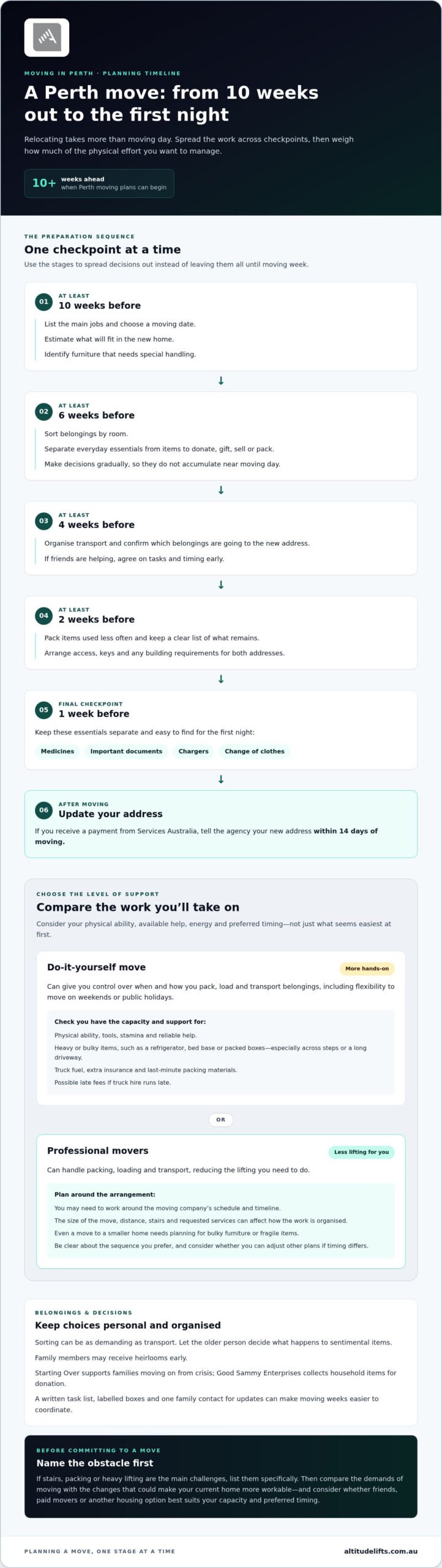
A move in Perth takes more than moving day. The planning checklist begins at least 10 weeks ahead, giving you time to sort belongings, organise transport and prepare your new housing. For someone weighing alternatives to moving house for seniors in Perth, this workload matters: the decision includes both where to live and what the move will demand.
Break the preparation into stages, rather than trying to manage every task at once. Perth moving checklists include milestones at least 6 weeks, 4 weeks and 2 weeks before moving, followed by a final stage 1 week beforehand. These checkpoints help you spread decisions across the retirement transition.
- At least 10 weeks before: List the main jobs, such as choosing a moving date, estimating what will fit in the new home and identifying furniture that needs special handling.
- At least 6 weeks before: Start sorting belongings by room. Separate everyday essentials from items to donate, gift, sell or pack, so decisions don’t accumulate near moving day.
- At least 4 weeks before: Organise transport and confirm which belongings are going to the new address. If friends are helping, agree on tasks and timing early.
- At least 2 weeks before: Pack items used less often and keep a clear list of what remains. Arrange access, keys and any building requirements for both addresses.
- 1 week before: Keep medicines, important documents, chargers and a change of clothes separate. This makes essential items easier to find during the first night.
A do-it-yourself move gives you control over when and how you pack, load and transport your belongings. It can also offer flexibility, including the option to move on weekends or public holidays. This approach works best when you have the physical ability, tools, stamina and reliable help to manage each task safely.
Think through the heavier jobs before choosing DIY. A refrigerator, bed base or packed box can be difficult to lift, carry and position, especially across steps or a long driveway. Handling bulky furniture without proper training can increase the risk of injury. Truck fuel, extra insurance and last-minute packing materials can add tasks and expenses. If truck hire runs late, late fees may apply, adding pressure beyond the planned day.
Professional movers can handle packing, loading and transport, reducing the lifting you need to do. However, you may need to work around their schedule and timeline. The size of the move, distance, stairs and requested services can all affect how the work is organised. Even a move to a smaller home needs careful planning if it involves bulky furniture or fragile items.
Sorting belongings can be as demanding as transport. Let the older person decide what happens to sentimental items rather than making those choices on their behalf. Family members may receive heirlooms early, while Starting Over supports families moving on from crisis and Good Sammy Enterprises collects household items for donation.
Allow time for practical follow-through, too. If you receive a payment from Services Australia, tell the agency your new address within 14 days of moving. A written task list, labelled boxes and one family contact for updates can make the weeks around moving day easier to coordinate.
Before committing to a move, compare its demands with the changes that could make your current home more workable. If stairs, packing or heavy lifting are the main obstacles, list those specific challenges first. A clear task list can help you decide whether friends, paid movers or another housing option best suits your capacity and preferred timing.
That trade-off is worth considering alongside the work you want removed from your own list. When hiring movers, clients may need to adapt to the moving company’s schedule and timeline. Before deciding, think about which parts of the move you want help with and how much flexibility you can allow around the day. If a particular sequence matters to you, make that preference clear when discussing the arrangement, and consider whether you are comfortable adjusting other plans if the company’s timing differs from your ideal.
Weigh the convenience of handing over demanding tasks against the value you place on controlling each stage yourself. List the tasks you would rather not manage, then consider whether a more supported move suits your energy and priorities. The right approach is the one whose demands feel manageable, not simply the one that seems easiest at first.
2. What home modifications help seniors age in place in Perth, and how much do they cost?
Before deciding to move, consider whether assistance or home modifications could make your current home more manageable. Start with the task that causes difficulty, such as getting into the shower, carrying laundry between floors or entering through the front door. Identifying the specific problem points towards a practical modification, rather than changes that may not improve daily life.
Walk through the home and note where effort, discomfort or uncertainty arise. In the bathroom, stepping over a bath edge may be difficult; at the entrance, a raised threshold may catch a walking frame. In the kitchen, reaching for plates on a high shelf can make preparing a meal harder. Record the room, task and obstacle for each issue.
Bathroom changes can make movement and access easier. Options include grab rails beside a toilet or shower, a shower seat, a handheld showerhead and a non-slip floor surface. The best arrangement depends on how you use the room. Position a rail where it can be reached during the movement that feels difficult.
For hallways and entrances, consider whether clearer paths, improved lighting or a ramp could help with everyday access. Remove loose mats and keep frequently used routes clear of clutter. If a step at the front door is the main barrier, assess that entrance first. A well-placed modification can address a daily obstacle more directly than broad cosmetic work.
Assess stairs separately if bedrooms, bathrooms or laundry facilities are on another level. Consider whether you can manage the stairs comfortably now and whether essential routines could be moved onto one floor. If stairs remain central to daily life, improving access may require more than fitting a rail or upgrading the lighting.
Costs depend on the type and scope of work, materials, existing layout and installation access. Adding a grab rail is a smaller task than altering a bathroom layout or building a ramp, so one estimate cannot describe every home. Consider the work involved, the surfaces affected and whether several changes need to be coordinated.
Plan a budget by grouping changes according to priority, rather than treating every idea as equally urgent. Separate immediate access concerns, such as a difficult shower entry, from future improvements, such as adapting a spare room. Then list the work each change involves and compare it with the benefit it could bring to your routine.
- Start with the daily task: Note whether the problem is bathing, cooking, using the toilet or entering the home.
- Identify the barrier: Record the exact obstacle, such as a high shelf, narrow route or step.
- Set a priority: Put changes that affect essential routines ahead of cosmetic updates.
- Consider the whole layout: Check whether a modification supports access to the rooms you use regularly.
Consider how home modifications fit your longer-term plans. They may help you stay in familiar surroundings, but won’t solve every difficulty. If daily tasks increasingly require help, include that support in your decision alongside physical changes. For example, easier bathroom access may address one challenge, while meal preparation or transport could need separate arrangements.
Keep the decision practical. Compare the effort and disruption of modifying your current home with the demands of moving to a smaller property. If a few targeted changes address the obstacles you identified, staying may remain workable. If the home’s layout continues to make essential routines difficult, factor that into your decision about moving.
5. What safety risks should seniors consider when remaining at home, including falls, isolation, and emergency access
Assess how the home works during ordinary routines, not just for obvious hazards. A loose mat beside the bed, a dark path to the bathroom or a slippery entrance can create problems during everyday movement. Walk through the home at different times and note where someone needs extra effort, balance or assistance.
Everyday tasks, such as stepping into a shower, reaching for a high cupboard or carrying laundry, can be difficult. Identify the exact action that causes trouble, then consider whether the route, lighting or layout contributes. For example, moving frequently used kitchen items to an accessible shelf can reduce repeated reaching. Clear walkways also make it easier to move between rooms with a walking aid.
Pay particular attention to stairs when essential rooms are on different levels. Consider the trip between the bedroom and bathroom at night, or carrying meals from the kitchen to an upstairs living area. A handrail, better lighting or moving daily activities to another area may help with a specific issue. If travelling between floors remains difficult, include that when assessing whether the home still suits daily life.
Emergency access is another practical consideration. Think through what would happen if someone fell alone in a room, felt unwell while gardening or couldn’t reach the front door. Keep a phone within reach in frequently used rooms, and agree with a trusted family member or neighbour on regular check-ins. Make sure the house number is visible from the street so visitors can find the property.
Social isolation can develop when driving, walking to shops or using public transport becomes harder. Someone may stop attending a local group because the journey feels tiring, even if they remain comfortable at home. Identify the activities and relationships that matter, such as a weekly visit with friends, a community group or appointments in nearby suburbs. Then consider how to keep those connections part of the routine.
Use a home safety review to turn broad concerns into practical actions:
- Walk each route: Check paths between the bedroom, bathroom, kitchen and front entrance for clutter or awkward turns.
- Test everyday tasks: Notice whether showering, preparing a cup of tea or answering the door creates difficulty.
- Plan contact: Agree who will make routine visits or calls, and what happens if a scheduled check-in is missed.
- Review access: Consider whether a visitor or support person can reach the entrance and move through the home.
Review these points after a change in mobility, a recent fall or a new difficulty with routine tasks. A home that worked well before may feel different after an injury or when stairs become harder to manage. Record what has changed, which rooms are affected and what support is already available. This gives family discussions a clear starting point.
Remaining at home is not a single safety decision. It involves weighing hazards, personal priorities and the support available for daily activities. If access between floors is the main obstacle, explore ways to improve access between levels as part of your home assessment. If isolation or emergency access is the greater concern, focus first on stronger social connections and a clear check-in plan.
When deciding whether to stay or move, consider whether assistance or modifications could help someone remain in their current home. If moving is under consideration, compare the practical demands with the person’s physical capabilities. For a DIY move in Perth, consider whether there is enough help, equipment and stamina to manage the work safely. This keeps the focus on what is manageable, rather than treating moving as the only response to changing needs.
For a new home, the Western Australian Seniors Housing Checklist recommends identifying essential and desirable features when researching a property. It also advises considering proximity to hospitals, shops and other services. Before signing a major housing contract in Western Australia, people are advised to speak with a lawyer and financial advisor. Those considering downsizing are advised to account for ongoing and exit fees, as these may reduce funds available for alternative accommodation or residential aged care. Weigh these points alongside daily safety, social contact and emergency access to clarify which option better fits a person’s needs.
Altitude Lifts: Swift Home Lift Lite
Altitude Lifts’ Swift Home Lift Lite may help if stairs make it harder to use every level of your home. A residential lift can support movement between floors, making it an option to consider before relocating. Whether it suits you depends on your home’s layout and how you want to use its spaces.
If stairs are the main obstacle, compare a home lift with a stairlift, such as the Alpha Stairlift. The Swift Lift Pro and Compact Elegance Home Lift are other options in Altitude Lifts’ range. Consider which areas you need to access and how a lift could support your plans to stay at home.
Contact Altitude Lifts to discuss whether the Swift Home Lift Lite could suit your home.
Choose the next step that fits your home
The right decision supports the life you want to lead, not simply the option that feels easiest today. Write down the change that would make the greatest difference to your independence, then discuss that priority with someone you trust. This can turn a difficult decision into a practical next step.
If moving between floors is central to your decision, Altitude Lifts offers the Swift Home Lift Lite, Swift Lift Pro and Compact Elegance Home Lift. These options are a starting point for discussing whether a home lift could address your access needs. Alternatives to moving house for seniors in Perth can include changes that make staying more workable, depending on the home and your priorities.
Contact Altitude Lifts to discuss your options and consider whether a lift could suit your home. Take the decision at a pace that lets you weigh your needs clearly. A thoughtful next step can help you move towards a home that feels right for you.