
The lift that follows your stairs isn’t automatically the best fit for your home. Choosing an outdoor platform lift for steps WA residents can rely on starts with the route: an inclined platform lift travels along the stairs, while a vertical platform lift rises beside them to reach a landing. Each suits different layouts, and the space at the top and bottom matters as much as the steps.
Rain and other outdoor exposure, safe everyday use, and whether existing stairs can accommodate a lift are all practical considerations. A tailored site assessment helps clarify these details before you select a solution. It also considers how you approach the steps and where you need to arrive, so the lift works with your daily routine.
This guide compares inclined and vertical platform lifts, explains site conditions that can affect fit and installation, and outlines how to plan for outdoor use. Altitude Lifts is a locally owned Western Australian specialist offering site assessment, custom fitting and installation. Its range includes the Delta and Stratos Platform Lifts, both inclined platform lift options. The goal is a considered solution for everyday access at your WA property.
Key Takeaways
- Compare inclined and vertical platform lifts by their travel paths and the access levels they connect.
- Understand which stair and landing details affect whether an outdoor platform lift for steps WA suits your property.
- Use a practical checklist to describe your access needs, mobility device, outdoor exposure and site constraints.
- See how a tailored site assessment can guide installation planning and identify a suitable configuration.
- Explore Delta and Stratos as inclined platform lift options within Altitude Lifts’ range.
What is an outdoor platform lift and who is it for?
A platform lift is a powered platform that carries a person, wheelchair or other mobility device between access levels. Outdoors, the challenge may be a short but awkward change in height at an entrance, rather than travel between storeys inside a home. The lift needs to connect the right arrival points while fitting the stair route, available space and movement around the entrance.
A platform lift may suit wheelchair users and people who find stairs difficult, tiring or impractical to manage. The aim is to make an entrance easier to reach without walking the steps. The right arrangement depends on the user’s mobility device and the property layout, not simply on the number of steps.
When can a platform lift help with outdoor steps?
Common situations include entry stairs leading to a front door, a raised verandah used every day, or a change in level between a path and an entrance. A platform can carry the user and, where suitable, their mobility device between those levels, avoiding the need to climb the steps. The route should include the approach to the lift and the space to move away at the top. A lift that reaches the landing but leaves little room to enter or exit may not provide the access the household needs.
What does “outdoor platform lift” mean?
An outdoor platform lift is a powered lift installed outside to carry a person or mobility device between access levels. It may travel along a stair route or move vertically beside the stairs. Outdoor suitability depends on the specific model and installation, so consider the lift’s intended use alongside the conditions at the site.
An inclined platform lift follows the line of a staircase; a vertical platform lift travels up or down between levels. These travel paths affect where the equipment sits and how it connects with the landings. For a general overview of Outdoor stair lifts, including outdoor adaptations, see Wikipedia’s discussion of stair lifts. This general information does not replace an assessment of a particular property.
Outdoor access isn’t simply a matter of moving an indoor lift outside. The entrance route, landing space and exposure to the elements all influence the arrangement. A site assessment can map these details and help match the lift type to the way you need to reach the entrance. Altitude Lifts provides site assessment and custom fitting in Western Australia to help shape a practical solution.
Inclined or vertical platform lift: which type suits outdoor steps?
The main difference is the travel path. An inclined platform lift follows the stairs, while a vertical platform lift rises between levels. Neither is automatically better for an outdoor entrance. The route, landing space, approach and the way you use your mobility device determine what may work at your property.
| Lift type | Travel path | Likely layout | Questions to consider |
|---|---|---|---|
| Inclined platform lift | Follows a rail aligned with the stair route. | May suit a stairway with usable space along its length and suitable arrival points at each end. | Are there turns or intermediate landings? Will the platform have clear passage, and is there room to board and exit? |
| Vertical platform lift | Travels up or down between levels. | May suit a level change where a rail along the stairs is impractical, provided the lower and upper areas can accommodate the arrangement. | Is there space at both landings? Can you approach, enter and leave the platform comfortably? |
How does an inclined platform lift work on stairs?
The platform travels along a rail fitted to follow the stair route. Suitability depends on more than the straight sections: turns, landings, clearances and the positions where you board and arrive all matter. The route needs to be assessed at the property before a configuration is recommended. Altitude Lifts’ Delta and Stratos Platform Lifts are inclined options, and site assessment and custom fitting help inform how they may fit the site.
When might a vertical platform lift be a better fit?
Vertical travel may suit a raised entrance where a rail following the stairs is impractical. It has different space requirements: the lower area needs to allow access to the platform, and the upper landing needs to provide a workable arrival point. Consider both levels, not just where the lift starts. For broader home applications, see this vertical platform lift buying guide.
For an outdoor platform lift for steps WA, match the travel path to the site and everyday access needs. A tailored assessment of the stair route and arrival points can help clarify the options. Explore tailored lift options with Altitude Lifts.
Will an outdoor platform lift fit my steps and handle WA conditions?
Fit depends on the property. An outdoor platform lift for steps WA homes can use needs to work with the full route, including the stair dimensions, space at each landing and the approach and exit. A site assessment establishes whether the layout is suitable and what configuration may work.
A stairway can look straightforward from the front but present constraints at the top or bottom. Narrow passageways, a turn near the entrance or limited manoeuvring space can affect where a lift can go. The surface around the equipment, drainage and access to power also form part of installation planning.
Which measurements and access points matter?
Assess the whole route, not just the stair width. Consider the stairs’ length and width, turns or intermediate landings, clear passage alongside the route, and usable space at both arrival points. The key question is whether you can approach, board and exit the platform comfortably at each level.
The mobility device and daily routine also shape the assessment. A wheelchair user may need space to turn and align with the platform, while the position of a doorway or path can affect the most practical arrival point. Mapping these details helps identify constraints before a configuration is recommended.
What outdoor conditions should be considered in WA?
Outdoor exposure varies across Western Australia and from property to property. Consider whether the lift will be exposed to rain or strong winds, and whether coastal salt air is relevant to the location. Don’t assume every site has the same conditions or that every lift model suits the same exposure. Outdoor suitability depends on the specific model and installation.
Check the surrounding surface as well. Water needs to drain away from the area, and the ground or structure where the lift will be installed must be considered. Power access and the size and condition of the destination landing matter too, because the lift needs to connect usefully with the route beyond it.
Current applicable standards, approval pathways and property-specific requirements should be reviewed for each project. These depend on the installation and location, so a general rule of thumb is not enough. Altitude Lifts’ site assessment and custom fitting relate the outdoor stair route and arrival points to the household’s practical access needs.
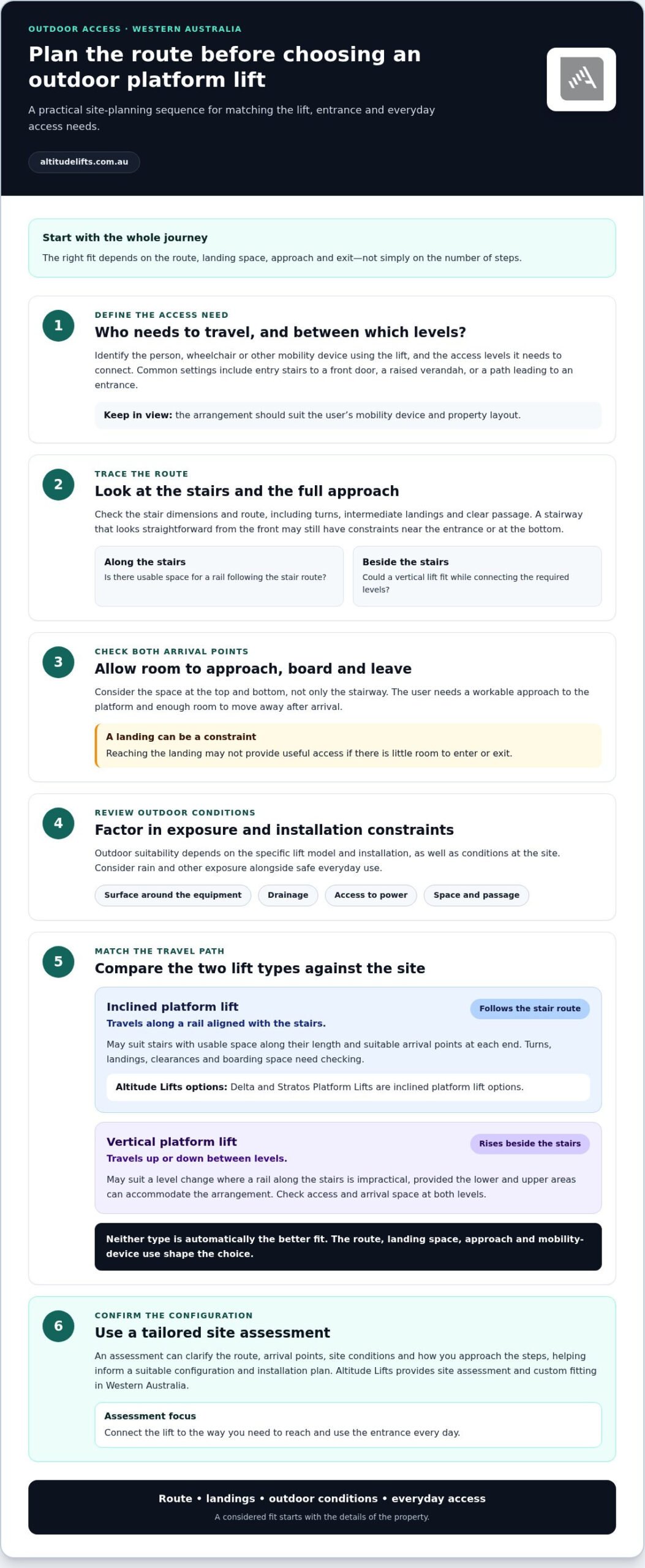
How to plan an outdoor platform lift installation in WA
Start with how you need to use the entrance, then work through the site and installation details. For an outdoor platform lift for steps WA homes, the recommendation should account for the stair route, arrival points and conditions at the property, rather than relying on a standard layout.
- Define the access need. Note who will use the lift, which mobility device they use and where they need to travel from and to. Consider the usual approach to the steps and what a comfortable exit looks like at each level.
- Assess the site. Review the full stair route, turns, landings, available clearances, power access, drainage and outdoor exposure. Altitude Lifts provides site assessment and custom fitting to understand how these factors relate to everyday access.
- Compare configurations. Use the site information to consider whether an inclined or vertical arrangement better matches the route and available space. The recommendation should reflect both the property layout and the user’s needs.
- Plan the installation. Work through the proposed position and layout, along with any technical checks and approval pathways that apply to the property and installation.
What happens during a site assessment?
The assessment considers how the lift will connect the lower approach with the destination landing. The stair route, boarding and exit positions, power access, drainage and local weather exposure all inform the proposed layout. The user’s mobility device and regular access routine matter too: reaching the landing is only useful if there’s a practical way to continue from it. For wider residential context, read the WA home lift installation guide.
To help make the assessment more useful, prepare recent photos of the stairs from the front and side, with clear views of the lower and upper landings. Include turns, nearby doors, paths or obstacles. A simple sketch showing the route and where you need to arrive can add context. Describe the mobility device and usual approach and exit, so the assessment reflects everyday use.
Which approvals and technical checks may apply?
Requirements depend on the property and proposed lift arrangement. Current Australian Standards, relevant approval pathways and site-specific technical requirements should be reviewed during installation planning. Don’t assume the same approval or compliance outcome applies to every home. A tailored assessment brings the site details together before the installation plan is settled.
To discuss a layout shaped around your outdoor stair route, arrange a site assessment with Altitude Lifts.
Choosing an outdoor platform lift in WA: tailored options and next steps
Start your shortlist with the journey you need to make every day, not a product name or headline feature. For an outdoor platform lift for steps WA properties, compare how each option fits the stair route, available space and the way you approach and leave the lift. A considered match can make access more practical for your household.
What should your final shortlist compare?
Use these points to organise your decision:
- Route: Does the lift need to follow the stairs or travel vertically between levels?
- Access points: Where will you board and exit, and is there enough room to move on at each landing?
- Mobility device: What device will use the platform, and how do you approach and manoeuvre it?
- Outdoor exposure: What rain, wind or coastal conditions affect the proposed location?
- Site constraints: Could turns, narrow passages, drainage, power access or nearby doors shape the layout?
Consider how the lift fits into the whole route, including the path beyond the destination landing. Altitude Lifts’ Delta and Stratos Platform Lifts are inclined platform lift options. The appropriate arrangement depends on the property and access requirements, so don’t choose on a product name alone.
What information helps start a tailored assessment?
Share the property’s location in WA and a brief description of the steps and the levels they connect. Note turns, intermediate landings, doors or tight spaces, and where you need to arrive. Photos from different angles can show the approach and available space. Include the mobility device you use and how you typically travel through the entrance.
Altitude Lifts is locally owned and operated in Western Australia, providing site assessment, custom fitting and installation support to shape a solution around the property. Its NDIS-registered services support people with restricted mobility. This does not guarantee funding eligibility or approval, as funding decisions depend on the relevant assessment and process.
You don’t need every detail worked out before taking the next step. A discussion about the stair route, daily access and site conditions can help clarify what to assess. Discuss an outdoor platform lift for your steps with Altitude Lifts.
Plan a lift around the way you use your entrance
The right outdoor platform lift suits both the stair route and your everyday access needs. An inclined lift follows the stairs; a vertical lift travels between levels. Landing space, your mobility device and local outdoor exposure all help determine which arrangement may fit your property.
Choosing an outdoor platform lift for steps WA homes can use starts with a site-specific view of the route, not a guess based on appearance. A tailored assessment helps clarify the practical options, while custom fitting and professional installation support a solution shaped around the property. Altitude Lifts is a locally owned and operated Western Australian specialist, with Delta and Stratos Platform Lifts among its inclined options.
To take the next step, describe your stairs, where you need to arrive and how you use the entrance. Discuss a tailored outdoor platform lift for your steps with Altitude Lifts.
Frequently Asked Questions
What is an outdoor platform lift for steps?
An outdoor platform lift for steps is a powered platform that carries a person or mobility device between levels where steps create an access barrier. Depending on the property, it may travel along the stair route or vertically between landings. The suitable arrangement depends on the route, available space, access points and individual needs. A site assessment helps establish how these factors apply at your Western Australian property.
Is an inclined or vertical platform lift better for outdoor steps?
Neither type suits every property. An inclined platform lift follows the stair route, while a vertical platform lift travels between levels. The stair layout, turns, landings and available space affect which approach may suit. Also consider where you need to board and exit and how you’ll use your mobility device. A site assessment can compare the practical fit of each option for your outdoor steps.
Can a platform lift be installed on existing outdoor stairs?
Existing stairs need to be assessed before a layout is recommended. The review should consider the route, width, turns, landings and clear space at both ends, as well as outdoor exposure and the mobility device the lift needs to accommodate. Altitude Lifts provides site assessment and custom fitting in Western Australia, so the proposed arrangement can be considered in the context of your property.
Can an outdoor platform lift operate in rain and coastal conditions?
Outdoor suitability depends on the equipment and conditions at the installation site. In WA, an assessment should consider exposure to rain, wind and coastal salt air, along with drainage and the surrounding surface. Don’t assume every model suits every environment. Consider the proposed configuration and applicable installation requirements for the particular property, including how exposed the lift will be to local weather.
What should be checked before installing a platform lift in WA?
Start with the stair route, landings, boarding and exit positions, available space, power access and outdoor exposure. The mobility device and everyday access routine matter too. Technical compliance and approval requirements can depend on the property and proposed installation. Review the current applicable Australian Standards and relevant approval pathways for the specific project, rather than assuming the same requirements apply to every home.
Do I need a site assessment for an outdoor platform lift?
A site assessment helps establish whether a lift can suit your steps and how the route, landings and arrival points affect the proposed layout. It can also consider outdoor exposure, drainage and power access. Because properties differ, an assessment is more useful than choosing by product category alone. Altitude Lifts provides site assessment and custom fitting in Western Australia to relate the property layout to your everyday access needs.
Can an NDIS plan fund an outdoor platform lift?
NDIS funding depends on the participant’s circumstances, goals, plan and applicable NDIS processes, so don’t assume a particular lift or project will be funded. Altitude Lifts provides NDIS-registered services supporting people with restricted mobility, but this does not guarantee funding eligibility or approval. For funding decisions, refer to current NDIS guidance and the participant’s relevant support team. Product suitability and funding approval are separate considerations.
How do I choose an outdoor platform lift for my home in WA?
Begin by describing the access challenge and identifying the mobility device used. Then consider the stair route, turns, landings, available space, outdoor exposure and where you need to arrive. Compare inclined and vertical travel based on those site details and your daily routine, rather than a single product feature. A tailored assessment from Altitude Lifts, a Western Australian lift specialist, can help connect the property layout with a suitable option.