
A spiral staircase doesn’t automatically rule out a stairlift. At Altitude Lifts, we know that a stairlift for a spiral staircase in Australia can suit stairs as narrow as 704 mm, using a curved rail designed to follow the staircase’s bends. Whether it will work in your home depends on the stair layout and the space available around the steps and landings.
It’s understandable to wonder whether a curved track can fit without changing the character or use of your stairs. The answer depends on more than width: the staircase’s shape, access at the top and bottom, and how the rail is designed all matter.
This guide explains what an assessment considers, what to expect from custom design and installation, and how to think about Australian compliance. You’ll also learn which stairlift features can help with tight spaces, so you can make a more informed decision about comfort, access and the home you want to keep living in.
Key Takeaways
- Learn which features of a spiral staircase, including its curves, landings and available width, shape whether a curved stairlift could fit.
- Understand what safety standards and Australian registration mean for assessing a stairlift installation.
- Explore how a custom rail, stair-tread mounting and battery charging can affect the installation and everyday use.
- Find out what to consider when investigating government funding or rebates for a spiral stairlift in Australia.
Are my stairs right for a curved stairlift?
A spiral staircase may suit a curved stairlift, but its shape and available space matter. An assessment considers each turn, landing and boarding point.
Suitability for curved and spiral stairs
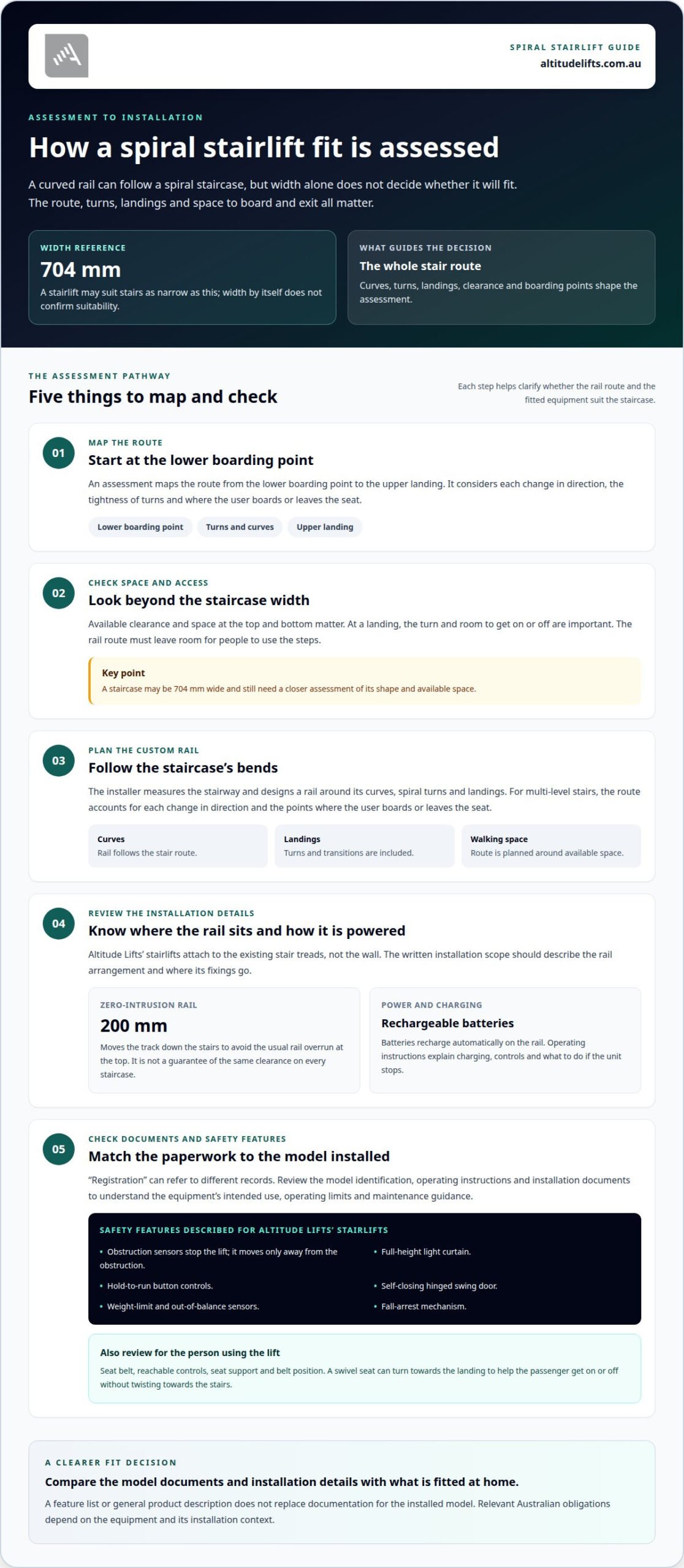
Curved stairlifts follow the staircase rather than relying on a straight rail. A stairlift for a spiral staircase in Australia can suit stairs as narrow as 704 mm. The width alone doesn’t decide suitability. The rail route must also follow the curve while leaving room for people to use the steps. At a landing, the turn and space to get on or off are important considerations.
Custom rails for winding staircases
A custom-made rail is designed around the staircase’s route, including its curves, spiral turns and landings. For multi-level stairs, the design must account for each change in direction and the points where the user boards or leaves the seat. The installer measures the stairway and uses those details to plan the rail. This tailored route ensures the track follows the stairs rather than cutting across the available walking space.
Comparing stairlifts with other access options
A stairlift carries a seated user along the stairs, while a home lift travels between floors and a platform lift carries a person standing or using a mobility device. Staircase modifications change the stairs themselves rather than adding a lift. For example, the Compact Elegance Home Lift may suit a home lift requirement, while the Delta Platform Lift or Stratos Platform Lift may suit a platform-lift requirement. Each option serves a different access need.
What the assessment needs to establish
An assessment maps the route from the lower boarding point to the upper landing. It considers the direction and tightness of turns, available clearance and where the rail can be fitted. A staircase with a curve and an intermediate landing needs a rail design that accounts for both. This helps establish whether a curved stairlift can follow the route and where the user can safely board and exit.
Safety standards and Australian registration
Australian registration and safety documentation matter alongside the stairlift’s fit. For a curved model, the key is understanding what equipment is installed and what its paperwork demonstrates.
Registration can refer to different records, so the term alone does not explain a stairlift’s safety status. Review the model identification, operating instructions and documents supplied for the installation. These details help clarify the equipment’s intended use, operating limits and maintenance guidance. A general product description cannot replace documentation for the model fitted in your home.
Altitude Lifts’ stairlifts include safety sensors that detect obstructions while the lift is moving. If an obstruction is detected, the lift stops and only moves in the direction away from it. The safety features also include a full-height light curtain, hold-to-run button controls, a self-closing hinged swing door, weight-limit sensors, out-of-balance sensors and a fall-arrest mechanism. A seat belt and reachable controls are also practical features to review for the person using the lift.
Seating features also affect comfort and access. A swivel seat can turn towards the landing, helping a passenger get on or off without twisting towards the stairs. Consider the seat’s support, belt position and how the controls work for the person using it. If a power cut is a concern, the operating instructions should explain what happens to the stairlift and how the user should respond.
The curved stairlift has a 24-month warranty against manufacturing defects. Maintenance and ongoing service costs depend on the equipment, its condition and the work required; pricing depends on the case and is provided after a quote request, with factors such as rail design and installation requirements shaping the quote.
For a considered mobility assessment, review the stairlift safety features relevant to your staircase and daily use.
Stairlift specifications and Australian compliance
For an Australian installation, distinguish measurable features from claims about compliance. A brochure can describe a rail or power system, but documentation for the installed model should identify the equipment and explain its operation. Review the model documents and installation details together to compare the stated features with what is fitted at home.
One useful specification is the zero-intrusion rail. It moves the track 200 mm down the stairs to avoid the usual rail overrun at the top. That detail affects how the stairlift finishes near the upper landing, so consider the approach and exit space as part of the layout. The measurement describes the track position, not a guarantee that every staircase has the same clearance.
Altitude Lifts’ stairlifts attach to the existing stair treads, not the wall. The rail is designed around the stair route, with fixings on the steps. This installation approach helps clarify where the supporting fixings go, and the written installation scope should describe the arrangement.
The stairlift runs on rechargeable batteries that recharge automatically on the rail. It is powered for travel, with charging built into its parked position. Ask how the operating instructions explain charging, controls and what to do if the unit stops. A seatbelt is another specification to review in the product documentation, alongside operating limits and passenger guidance.
For a clearer decision, compare the product information with the equipment identification and installation records. Check that the model, rail arrangement and controls described match the stairlift being installed. Australian compliance involves more than a feature list: relevant obligations depend on the equipment and its installation context. Clear documentation helps you understand the claims without treating a brochure as proof of every requirement.
Govt funding for spiral stairlifts in Australia
Government assistance for a stairlift depends on the funding pathway and its eligibility rules, not simply on whether the staircase is spiral. There is no single approval that applies to every Australian buyer. Start by identifying the scheme you are considering, then review its criteria for the applicant, equipment and intended use.
A stairlift’s design may matter when the equipment is assessed for suitability, but it does not establish funding eligibility by itself. A curved rail designed for a spiral staircase addresses the home’s layout. Funding is a separate decision that may consider the person’s circumstances and how the equipment supports access at home. Keep these questions distinct when planning a purchase.
Before discussing assistance, gather the stairlift’s product details, the installation scope and a description of the access difficulty it addresses. For example, explain whether the person needs help reaching an upper floor and how the staircase’s turns affect access. Written assessments or supporting documents may also be relevant, depending on the scheme’s requirements. This information helps connect the requested equipment to the person’s needs.
Tax treatment is different from a grant or rebate. In Australia, stairlifts are exempt from GST as accessibility aids. That exemption does not itself provide a payment towards the purchase or establish eligibility for other assistance. Treat funding, tax treatment and the supplier’s quote as separate parts of your budget planning.
Before committing, map the process: identify the funding pathway, review its eligibility criteria, gather the required supporting information, then establish how approval relates to purchasing and installation. Don’t assume an application will cover every part of a customised curved stairlift. Equipment, rail design and installation may be treated differently under individual arrangements.
For help relating a spiral-staircase layout to a stairlift solution, discuss your stairlift requirements.
Altitude Lifts: Alpha Stairlift
Altitude Lifts offers the Alpha Stairlift for people considering stairlift access at home. Once you understand how a curved stairlift works and what Australian compliance involves, relate those considerations to your staircase and daily mobility needs.
Details such as the staircase’s shape, its landings and the access needed on each floor can help guide that discussion. If a stairlift is not the right solution, a home lift such as the Compact Elegance Home Lift may suit a different layout.
For guidance on whether the Alpha Stairlift suits your home, contact Altitude Lifts.
Plan for the access you need next
Choosing a stairlift for a spiral staircase in Australia is part of a wider decision about how you want to move between levels at home. Consider both your current access challenge and the areas of your home you want to keep using comfortably. That perspective can help shape a practical conversation about the right mobility solution.
Altitude Lifts offers the Alpha Stairlift, as well as home lift options including Swift Home Lift Lite, Swift Lift Pro and Compact Elegance Home Lift. These are distinct options for different home access needs, not interchangeable products. A discussion about your stairs and priorities can help establish which direction suits your situation.
Take the next step at your pace. Discuss your stair access with Altitude Lifts and explore a solution that supports the way you want to live at home.
Frequently Asked Questions
How is the rail made for my stairs?
A curved rail is designed to match the staircase’s measured route. The design accounts for the direction of each turn, changes in slope and where the seat needs to start or finish. For example, a tight turn near an upper landing affects how the rail approaches the exit. This tailored layout helps the stairlift follow your staircase rather than a generic straight path.
What are my stairlift options?
For stair access, Altitude Lifts offers the Alpha Stairlift. If you need another way to move between levels, the range also includes Compact Residential Lifts and Platform Lifts. These options suit different access situations: a stairlift travels along the stairs, while a home or platform lift provides another way to move between floors. The right fit depends on the user and the home layout.
What happens in a power cut?
The curved stairlift runs on rechargeable batteries that recharge automatically on the rail. This means its travel system uses battery power, but the exact response during an outage depends on the model’s operating instructions. Before regular use, make sure the person riding it understands the controls and the guidance for interruptions. Keep those instructions accessible near the usual boarding point.
What staircase shapes can it handle?
Curved stairlifts can be designed for spiral, curved and winding stairs, including routes that pass a landing or change direction. A straight staircase presents a different rail-planning task from one that turns around a central column. The key is the full route from the boarding area to the destination, including obstacles and the space needed to get on and off.
Can a stairlift be installed on a spiral staircase in Australia?
Yes, a spiral staircase in Australia may be suitable for a curved stairlift. Suitability depends on the staircase’s dimensions, turns and available clearance, not its spiral shape alone. A narrow tread or restricted exit area, for instance, may affect the rail route. An assessment can establish how the seat will travel and where the rider can board at each end.
What types of stairlifts suit spiral staircases, including curved rail models?
A curved-rail stairlift is the relevant type for a spiral staircase because its track follows bends and changes in direction. A straight-rail model is designed for a straight route and cannot follow a spiral path. In Western Australia, Altitude Lifts offers the Alpha Stairlift. The rail design needs to suit the staircase and the passenger’s access needs, including how they approach the seat.