
A power cut doesn’t automatically stop a battery-backed stairlift. Most stairlifts run on internal batteries, and a fully charged battery can provide approximately 8-10 trips up and down the stairs during an outage, depending on the model and how it’s used. This guide explains how battery backup for stairlifts works in practice.
It’s understandable to want to know whether a stairlift will keep working when household power goes out. Its batteries charge from household electricity while the lift is parked at a charging point, usually at the top or bottom of the staircase.
Read on to learn how battery backup works, where charging happens and how everyday use helps keep the system ready. You’ll also find out what signs may indicate that a battery needs attention, so you can make informed mobility decisions at home.
Key Takeaways
- A power outage doesn’t necessarily stop a stairlift; how long it keeps running depends on the lift, battery condition and use.
- Parking the lift at its charging point helps keep its batteries ready, as they recharge from household electricity.
- Slower travel or unexpected pauses can signal that the batteries need attention.
- Learn what routine battery care involves and how Altitude Lifts’ Alpha Stairlift could fit your home mobility needs.
Will my stairlift work if there is a power outage?
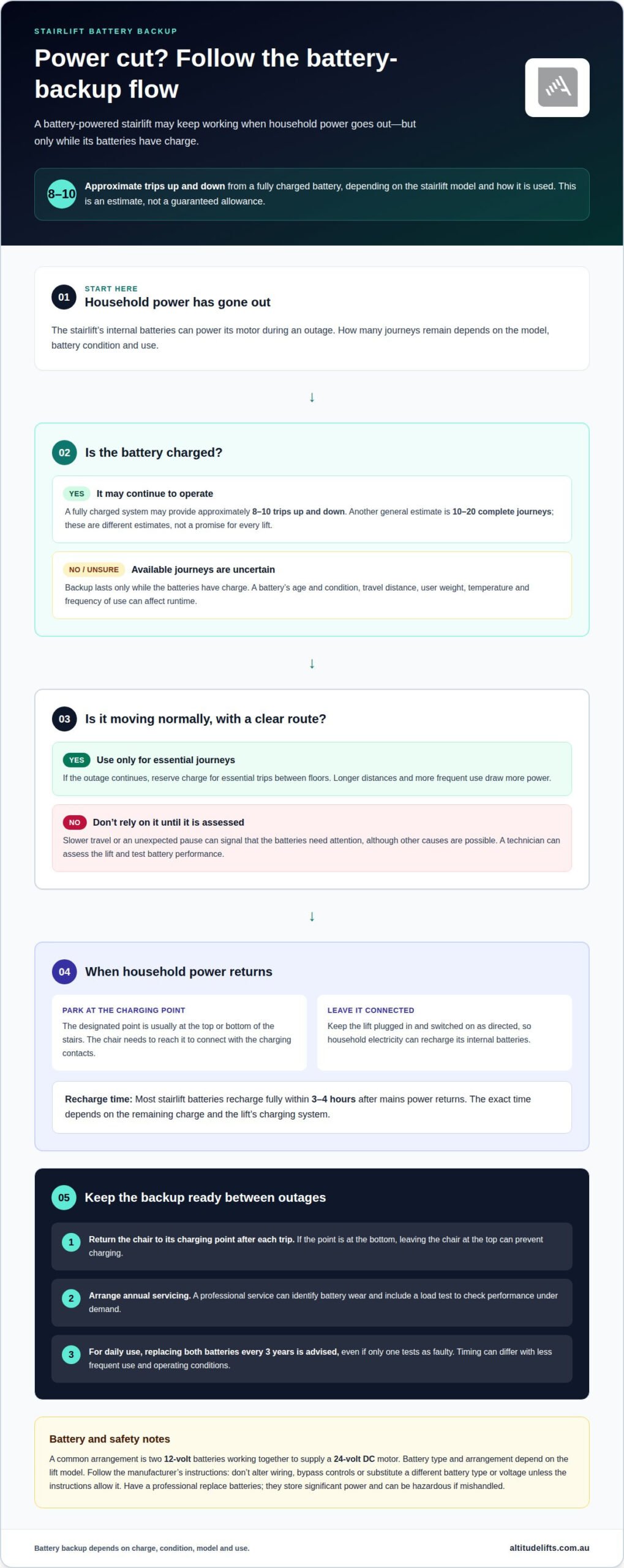
Usually, yes: a battery-powered stairlift can continue operating during a mains power outage, provided its batteries are charged. The number of journeys available depends on the model, battery condition and use.
Battery backup during power outages
A battery backup provides power to a stairlift when a power outage interrupts household electricity. The batteries charge from the home’s mains supply and power the lift’s motor during a cut.
This can allow the chair to travel between the bottom and top of the stairs while mains power is unavailable. Backup lasts only while the batteries have charge, so the lift’s position and charging routine matter.
Battery-powered drives and stairlift trips
A battery-powered drive uses stored electricity to run the stairlift’s motor along its installed rail. In a typical arrangement, two 12-volt batteries work together to supply a 24-volt DC motor.
Trip estimates vary by model and use. A fully charged system may provide approximately 8-10 trips up and down the stairs; another general estimate is 10-20 complete journeys. These figures describe different estimates, not a guaranteed allowance for every lift. Longer travel distances and more frequent use draw more power.
Battery runtime and stairlift use
Runtime means how many journeys a lift can make before its stored charge runs out. Battery age and condition, the model, travel distance, user weight and temperature can all affect how long it operates during an outage.
Use the lift only if it behaves normally and its route is clear. Don’t rely on the battery as emergency transport. If the outage continues, reserve charge for essential journeys between floors.
For Australian electrical safety, use the installed battery system as designed and follow the stairlift manufacturer’s instructions. Don’t alter wiring or bypass controls.
Battery types and voltages
Common stairlift battery arrangements use sealed lead-acid batteries, including valve-regulated lead-acid (VRLA) types. Two 12-volt batteries wired in series provide 24 volts for the motor.
The battery arrangement depends on the lift model. Use the system specified for that model: the batteries power the motor during a cut and recharge when mains power returns. Don’t substitute a different battery type or voltage unless the manufacturer’s instructions allow it.
Charging locations and routine charging
A stairlift recharges from household electricity at its designated charging point. Where the lift is parked after a journey determines whether it can recharge between uses.
Battery charging locations
The batteries are built into the stairlift, and charging happens at a designated point, usually at the top or bottom of the stairs. The chair needs to reach that point to connect with the charging contacts.
For example, if the charging point is at the bottom, leaving the chair parked at the top can prevent it from charging. Returning it to the correct end after each trip helps maintain charge for journeys between floors, including during an extended outage.
How stairlift batteries charge
Household mains electricity supplies the charger, which replenishes the stairlift’s internal batteries while the lift is parked at its charging point. Most straight and curved stairlifts can connect to a nearby household outlet without a special circuit.
Keep the stairlift plugged in and switched on as directed, so its charging system can maintain the batteries while it is parked. If the chair is left away from its charging point, the batteries may lose charge over time. Returning it to the designated point after each trip supports routine charging.
Recharge time and battery life
Most stairlift batteries recharge fully within 3-4 hours after mains power returns. The exact recharge period depends on the battery’s remaining charge and the lift’s charging system, so a short interruption and an extended outage may leave different amounts to replenish.
After a power cut, park the lift at its charging point and leave it connected to household power. Regular charging helps keep the batteries ready for ordinary use; parking away from the point can interrupt that routine. For a stairlift suited to your home’s layout, explore stairlift options.
Do stairlifts have battery backup systems?
Most stairlifts use rechargeable batteries, but their condition affects how reliably the lift performs during a power cut. A change in travel speed or an unexpected pause can indicate that the batteries need attention.
A stairlift that moves more slowly than usual may have batteries nearing the end of their lifespan. Another possible warning sign is stopping while travelling upstairs, then starting again after a few seconds. These symptoms can have other causes, so a technician can assess the lift and test battery performance rather than relying on symptoms alone.
Annual servicing helps identify battery wear before it affects everyday mobility. A professional service can include a battery load test to assess how the batteries perform under demand. This matters because a battery may appear charged but struggle to power the lift while travelling.
Replacement timing depends on use and condition. For daily stairlift use, replacing both batteries every 3 years is advised, even if only one tests as faulty. Replacing the pair together helps maintain consistent performance. A lift used less often may follow a different replacement pattern, since its battery lifespan depends on how frequently it operates and its operating conditions.
Have a professional replace stairlift batteries. They store significant power and can be hazardous if mishandled. The correct type and installation also matter for the lift’s operation. A technician can assess the model, replace the batteries safely and test the system afterwards.
Warranty terms vary between models and manufacturers. Many stairlifts come with a one-year battery warranty, so the warranty period can affect whether a replacement is covered. Keep the purchase and service records available, as they help establish the battery’s age and maintenance history. A replacement battery’s suitability depends on the stairlift model, while its lifespan is influenced by usage and condition.
Battery care and maintenance
Regular use helps a stairlift’s batteries function as intended. If the lift isn’t needed every day, operating it a few times a week cycles the batteries through charging and discharging. This gives the system routine use rather than leaving it idle for long periods.
Usage affects battery lifespan. Three or more daily round trips can reduce battery life to 1.5 years or less. A household using the lift less often may have a different pattern, but frequency alone doesn’t show whether the batteries are fully charged or working properly. Pay attention to changes in operation, such as slower travel or pauses, and arrange professional assessment if they appear.
Park the stairlift at its charging point and leave it switched on as directed by the manufacturer. This supports the usual charging routine and helps keep the batteries ready for use. If the lift is left away from that point, its charge may fall over time. After an extended period without use, return it to the designated point before relying on it.
Dispose of old stairlift batteries responsibly. Don’t put them in the household bin or mix them with dry recyclables. Batteries may contain lead-acid or lithium-ion materials, so use an appropriate battery-recycling route. Keeping spent batteries separate helps prevent them from entering ordinary household waste.
For independent reassurance about how a stairlift fits your home and mobility needs, explore stairlift options. Routine charging, regular use and correct disposal each play a distinct part in battery care. Together, these habits support reliable operation without treating a fully charged battery as a substitute for maintenance or safe handling.
Altitude Lifts: Alpha Stairlift
Altitude Lifts offers the Alpha Stairlift as a home mobility option for people who find stairs difficult to manage in Western Australia. When considering a stairlift, think about your staircase, everyday travel needs and what you need to know about battery backup.
Battery performance depends on the specific model and its use, so avoid assuming every stairlift has the same outage range or charging arrangements. A conversation about the Alpha Stairlift can help you understand how a stairlift option fits your home and mobility needs, alongside the practical details that matter to you.
If a vertical lift better suits your home, Altitude Lifts also offers the Swift Home Lift Lite, Swift Lift Pro and Compact Elegance Home Lift. Contact Altitude Lifts to discuss your home mobility requirements.
Plan for confident mobility at home
Choosing a stairlift is also an opportunity to consider how you want to move around your home over time. Understanding battery backup for stairlifts can help you identify the features that matter in your daily routine, including how a lift suits your staircase and mobility needs.
Altitude Lifts offers the Alpha Stairlift, as well as the Swift Home Lift Lite, Swift Lift Pro and Compact Elegance Home Lift. Each option meets a different home mobility need, so start by considering your layout and what you want to make easier.
Contact Altitude Lifts for stairlift advice to discuss your home and the solution that may suit it. Taking that step can help you move towards a more accessible home with greater confidence.
Frequently Asked Questions
Are all types of stairlifts protected against power cuts?
No. Backup arrangements can differ between stairlift models, so don’t assume every lift operates the same way during an outage. Altitude Lifts’ lifts all include standard battery backup, allowing descent to the lower level when power fails. This is worth considering when comparing a stairlift with another lift type, as backup functions vary by equipment and model.
Do I have to hire a professional technician or can I change the batteries myself?
Have a professional replace stairlift batteries because they store significant power and can be hazardous if handled incorrectly. A technician can fit batteries suited to the lift and assess its operation afterwards. If your lift slows or behaves differently, don’t open electrical components yourself. Arrange professional attention rather than attempting a repair that could affect safe operation.
How can you tell if your stairlift battery is working properly?
Changes in how the lift travels can suggest a battery problem, but they don’t confirm the cause. During annual servicing, a professional can perform a battery load test to assess performance under demand. Note when the lift behaves differently, such as after frequent use, so you can describe the circumstances clearly during servicing.
Should I switch off my stairlift to save the battery?
No. Leave the stairlift switched on and parked at its designated charging point, following the manufacturer’s instructions. The charging system is designed to maintain the batteries while the lift is parked, and switching it off may interrupt that routine. The usual charging position still matters when you’re away, particularly if someone may need to use the lift.
What happens if you’re halfway up the stairs during a power cut?
A charged battery system can keep a stairlift moving during a mains power cut, so an interruption doesn’t necessarily mean the chair will stop on the stairs. Stay seated and use the normal controls if the lift continues to operate as expected. If it stops or behaves unusually, follow the manufacturer’s instructions and don’t try to climb off onto the staircase.
How does a stairlift battery backup work?
Understanding battery backup for stairlifts means knowing that stored electricity powers the lift when household mains power is unavailable. The motor can then move the chair along its rail, subject to the remaining charge and model design. Altitude Lifts’ standard battery backup allows descent to the lower level during a power outage, providing a way down when mains power fails.