
A warranty’s headline duration is only part of the protection: in Australia, coverage typically depends on documented compliance with the lift’s maintenance schedule. In a home lift warranty comparison in Australia, the written terms matter more than a simple brand label, because the lift’s system and use affect servicing requirements, while the warranty sets out coverage, exclusions and transfer conditions. Servicing and warranty coverage are separate considerations.
It’s understandable to want to know whether the brand affects servicing and spare parts. Compare what the warranty covers and how ongoing servicing is handled, rather than relying on the warranty length alone.
This guide explains how to compare warranty duration, maintenance requirements, exclusions and transfer rules. Use these points to assess the terms and longer-term ownership responsibilities before choosing a residential lift.
Key Takeaways
- Compare the warranty and servicing agreement separately, including what each says about parts, labour, call-outs and exclusions.
- Follow the lift’s documented maintenance schedule and keep service reports and repair records together.
- Before a home sale, organise the lift’s paperwork so the new owner can understand its service history and any transfer conditions.
- Read the warranty’s exclusions and reporting process closely to understand which circumstances may affect coverage and how repairs are handled.
Servicing requirements to maintain warranty coverage
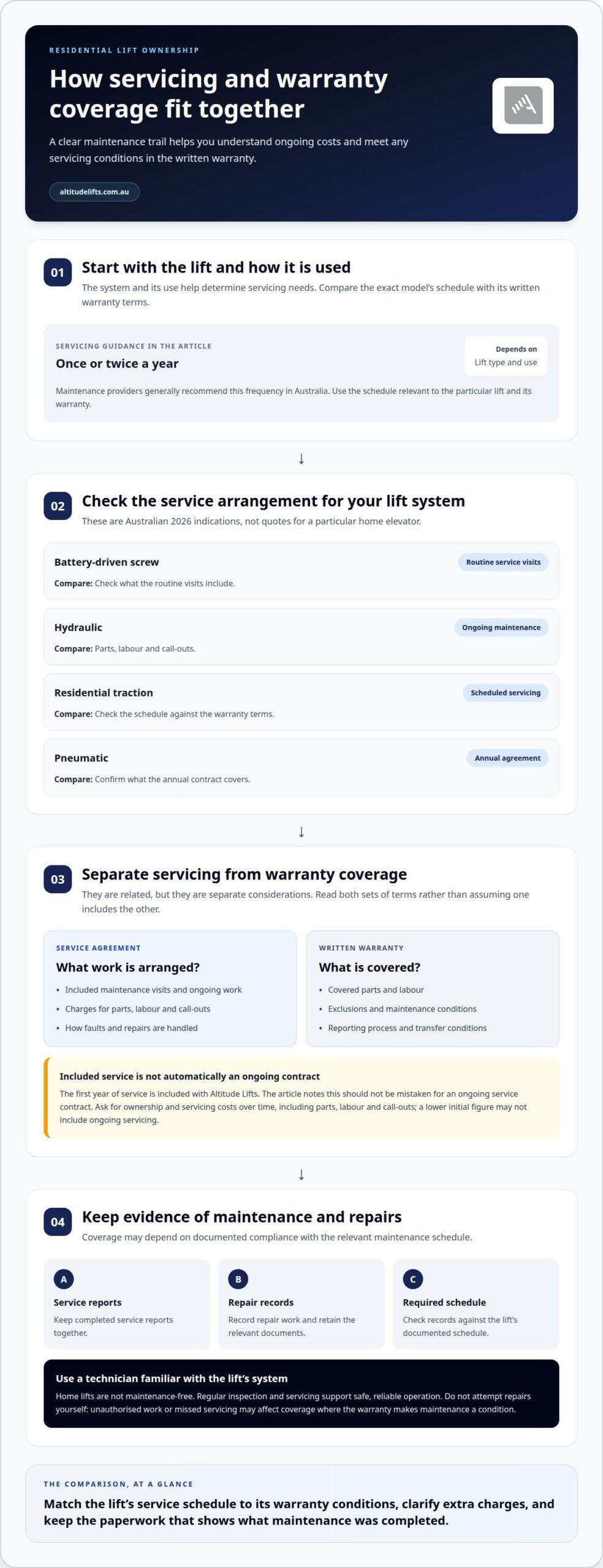
Warranty coverage and maintenance arrangements are separate, so compare their terms side by side. The lift’s system and how it is used help determine its servicing needs.
Included servicing and service-contract costs
An included service covers specified maintenance visits, while a service contract sets out ongoing work and charges. In Australia, maintenance providers generally recommend servicing once or twice a year, depending on lift type and use.
Compare those arrangements with the lift’s longer-term cost: a lower initial figure may not include ongoing servicing. Ask for ownership and servicing costs over time, including parts, labour and call-outs. The first year of service is included with Altitude Lifts, but this should not be mistaken for an ongoing service contract.
Warranty exclusions and servicing conditions
Warranty terms specify which parts and labour are covered; exclusions describe what falls outside that coverage. Read the warranty and service documents for call-out charges, repairs and required maintenance. Keep service reports and repair records, as coverage may depend on documented compliance with the relevant schedule.
Regular inspection and servicing support safe, reliable operation; home lifts are not maintenance-free. Use a technician familiar with the lift’s system, and don’t attempt repairs yourself. Unauthorised work or missed servicing may affect coverage where the warranty terms make maintenance a condition.
| Lift system | Annual service-contract indication | Comparison point |
|---|---|---|
| Battery-driven screw | Routine service visits | Check what routine visits include |
| Hydraulic | Ongoing maintenance | Compare parts, labour and call-outs |
| Residential traction | Scheduled servicing | Check schedule against warranty terms |
| Pneumatic | Annual agreement | Confirm what the annual contract covers |
These are Australian 2026 indications, not quotes for a particular home elevator.
Choose the arrangement that clearly separates included visits from extra charges, and matches the lift’s maintenance schedule. That clarity matters for budgeting, preserving coverage and protecting the lift’s operation, comfort and finishes.
Residential lift warranty duration and availability
For a home lift warranty comparison in Australia, compare the written terms for the exact brand and model. Check the start and end dates, covered components, labour, exclusions and transfer conditions instead of relying on the headline duration.
Australian Consumer Law consumer guarantees may apply separately from a manufacturer’s written warranty. Consider whether the lift and related services meet guarantees concerning acceptable quality, fitness for purpose and description. These guarantees are distinct from any additional warranty coverage.
The Australian Standard identified for automatically controlled passenger lifts in private residences is AS/NZS 1735.18:2002. Compare each model’s stated specifications and intended residential use. Commercial-style warranty terms are not automatically a useful benchmark for a residential lift, because the equipment may be designed for a different setting.
A home lift is a 15-to-20-year relationship, so the warranty is only one part of the decision. A home lift warranty comparison in Australia should also consider what the written terms say about coverage after the warranty period and the model’s servicing arrangements. For a hydraulic lift, for example, use its own warranty document rather than assuming its terms match another system.
For a practical comparison, record each model’s warranty duration, start date, covered parts, labour, exclusions, servicing conditions and transfer rules. Weigh those terms against the lift’s specifications and your home’s needs to understand what the coverage provides beyond a long headline period.
If you’re considering a residential model, explore residential lift options alongside the warranty terms that matter to your home.
Transferability of warranty and maintenance contracts
When a home changes hands, the lift’s warranty and service contract may have different transfer conditions. Treat them as separate documents: the warranty describes coverage, while the service contract sets out servicing and repair arrangements. Check whether either agreement continues for a new owner, requires notification or ends when ownership changes.
Warranty coverage may depend on documented compliance with the relevant maintenance schedule. Keep service reports, repair records and agreement documents together to show the lift’s history and completed maintenance. Before settlement, organise the model details, technician reports and current agreements so the incoming owner can understand the existing service arrangements.
Warranty terms alone don’t establish emergency repair coverage or response-time commitments. These apply only if the warranty or maintenance agreement expressly states them. Check how to report a fault, what information to provide and how charges are handled. A contract may cover scheduled servicing without promising emergency attendance or a particular response time.
- Before listing: assemble the lift’s warranty, maintenance agreement and service history.
- Before handover: identify any written transfer process and pass on model and repair records.
- After a fault: follow the agreement’s reporting steps and record the repair outcome.
Documented maintenance gives a prospective owner a clearer picture of the lift’s upkeep than its age or appearance alone. For example, a recently installed lift with a service contract may have different transfer terms from an older model covered only by a warranty. Read both agreements to see who arranges technicians and whether the new owner must take action to continue coverage.
Keep copies after the sale, too. A complete file helps the next owner understand the maintenance completed and the process for future repairs.
Circumstances that void warranty coverage
A warranty may limit coverage when its stated conditions aren’t met. Read exclusions alongside the list of covered components: a manufacturing fault, routine wear and damage after an unauthorised repair may be treated differently. The outcome depends on the wording, so don’t assume every fault is covered or excluded.
Check how the document treats parts, labour and drive components. It may specify which components are covered, for how long, and whether labour or a call-out is included. A drive-component fault, for example, may raise separate questions about the part, diagnosis and repair labour. These distinctions affect potential out-of-pocket costs.
- Wear items: find out how the warranty defines wear and whether replacement parts are excluded.
- Servicing: compare required maintenance with the schedule and keep completed service records.
- Alterations or repairs: read how work by someone other than an approved technician affects coverage.
Pay particular attention to emergency faults. A warranty may describe repair coverage without setting out emergency attendance or response times; those are separate commitments that should appear in the written terms. Follow the fault-reporting process, record the issue and keep any technician’s report. Clear records help document what happened before a claim.
Check whether exclusions depend on the cause of damage, not just the component involved. A covered part, for example, may be treated differently if the fault follows an alteration or missed maintenance. Warranty boundaries can affect later repair costs, so compare each exclusion with the lift’s expected use and maintenance requirements.
Before choosing, mark each document’s covered parts, labour, drive components, wear items, servicing conditions and emergency terms. Then compare those points side by side. Explore home lift options and consider how each model’s coverage fits your needs.
Altitude Lifts: Swift Home Lift Lite
Altitude Lifts’ Swift Home Lift Lite is one residential option to consider alongside the warranty terms. Use the model’s written warranty and servicing documents to assess coverage for parts, labour, maintenance and exclusions against your home’s needs.
Start with your priorities: how the lift will be used, where it will go in your home and which ownership terms matter to you. The Swift Lift Pro and Compact Elegance Home Lift are other residential options, while the Alpha Stairlift may suit a different access need. Compare relevant options against your requirements rather than choosing on warranty duration alone.
For a considered next step, contact Altitude Lifts to discuss the Swift Home Lift Lite and your home lift needs.
Choose coverage that supports your next move
Use a home lift warranty comparison in Australia as a starting point, then consider how your household’s needs may change over time. Think about who will use the lift, how it fits your home and which ownership arrangements could matter if circumstances change.
Before choosing, list your priorities and compare them with each option’s written terms. This gives you a clear basis for understanding how the lift and its coverage fit together, beyond the headline warranty period.
Altitude Lifts offers the Swift Home Lift Lite, Swift Lift Pro and Compact Elegance Home Lift. If you’re weighing a residential lift option against your coverage priorities, ask Altitude Lifts about warranty support.
A considered choice can help you move forward with greater clarity and confidence.
Frequently Asked Questions
Does the brand affect servicing and spare parts?
Yes, the brand and model can affect which parts and servicing expertise are relevant. A technician familiar with the system can identify model-specific components and maintenance needs. When comparing models, check whether the service arrangements explain parts supply, who performs repairs and how to report faults. The brand alone doesn’t tell you what the warranty covers.
What warranty periods do Australian home lift manufacturers and installers offer?
Warranty periods vary between Australian manufacturers, installers and lift models, so there is no single duration for every residential lift. Compare the written start and end dates, and check whether coverage applies to the whole lift or only specified components. Distinguish the manufacturer’s warranty from installer coverage or a separate service agreement, as each document may set different conditions.
What is covered under a home lift warranty in Australia?
A home lift warranty covers the components and work expressly included in its terms. It may distinguish parts from labour or specify different coverage for drive components and other parts. If a control fault occurs, for example, the terms determine whether diagnosis, replacement parts and repair labour are covered. Read the coverage alongside the exclusions instead of relying on the headline duration.
What parts, labour, call-outs and travel costs are excluded from home lift warranties?
Exclusions depend on the individual warranty and service agreement, so check parts, labour, call-outs and travel separately. A warranty might cover a replacement part but not related labour or attendance charges, if its terms say so. Look for itemised wording on each cost, including whether travel is charged separately, rather than assuming a covered repair includes every expense.
Are home lift warranties transferable to a new homeowner in Australia?
Transfer depends on the warranty’s written conditions; don’t assume coverage follows the property automatically. When selling, gather the lift’s warranty documents, model details and service history, then identify any transfer steps stated in the agreement. These records help a buyer understand the documented maintenance and remaining coverage without relying on verbal assurances or the lift’s age.
What maintenance is required to keep a home lift warranty valid?
Follow the maintenance schedule specified for the lift and keep dated service records. Australian warranties are typically contingent on documented compliance with the relevant maintenance schedule. Home lift providers generally recommend scheduled servicing once or twice a year, depending on lift type and use. For example, retain each technician’s report with the lift documents, so maintenance history can be matched to the warranty conditions.