
What if the safest next step isn’t simply asking whether a stairlift fits the staircase, but whether it suits your parent’s mobility and daily routine? If stairs are becoming difficult or worrying, it’s natural to consider whether curved stairlifts Perth could help, especially when the staircase turns or has a landing. A practical decision starts with understanding both the person and the space.
This checklist will help you notice everyday stair-related difficulties, identify the features that matter when assessing a curved stairlift, and prepare for a home mobility assessment. A turning staircase doesn’t have to make the options unclear: a tailored site assessment considers the home’s layout and your parent’s needs.
Start with simple safety observations, then consider the staircase, access points and daily movements. You’ll also learn what to note before an assessment, so you can discuss options with greater confidence and without rushing into changes that disrupt home life.
Key Takeaways
- Notice which parts of the stairs or daily routine are becoming difficult, so you can describe the practical barriers clearly.
- For curved stairlifts Perth, turns and landings matter because the rail is designed around the staircase route.
- Compare a curved stairlift, other stairlift configurations and a home lift by considering your parent’s mobility and how they move between levels.
- Before an assessment, note staircase features, access points and the movements your parent finds challenging.
- A tailored site assessment considers both the staircase and your parent’s needs, helping you understand suitable next steps for home mobility.
Curved stairlifts in Perth: start with your parent’s everyday safety
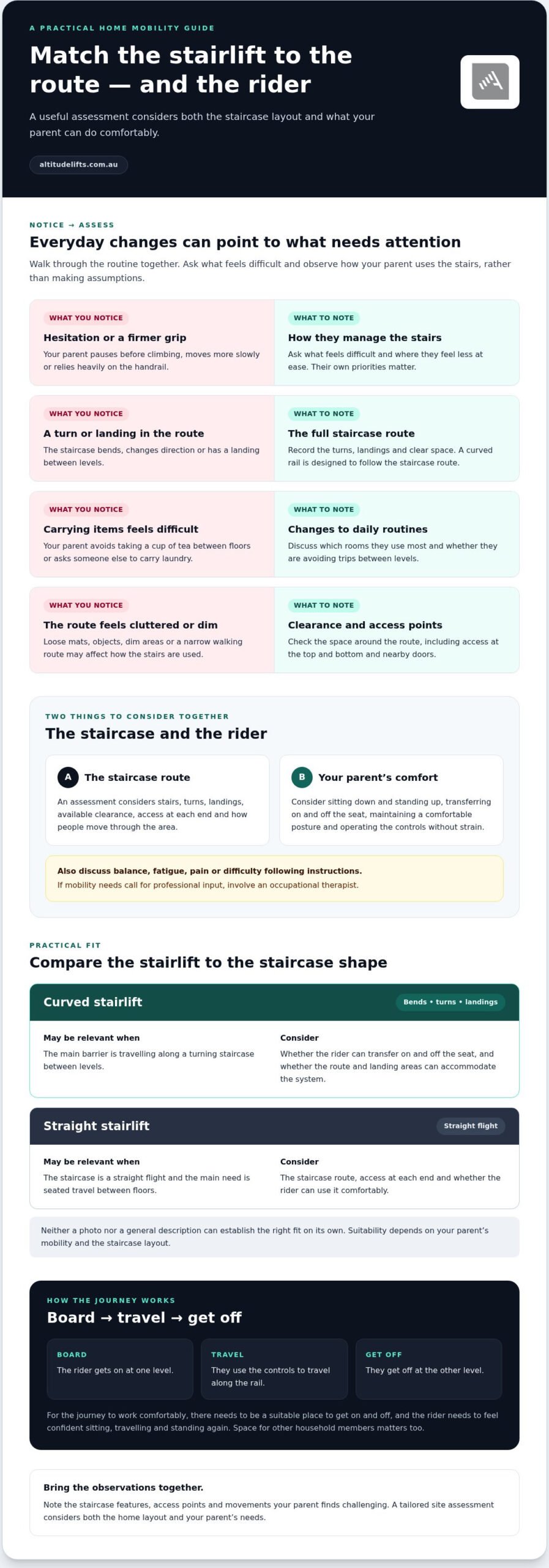
Stairs can become harder to manage gradually. Your parent might pause before climbing, grip the handrail more firmly or avoid carrying a cup of tea between floors. Notice these changes without assuming that one solution will suit every person or home. A stairlift may be one part of a plan to support more confident movement at home.
Start with a walk-through together. Ask what feels difficult and observe how your parent uses the stairs, rather than making assumptions on their behalf.
- Stairs: Notice whether your parent hesitates, relies heavily on the handrail or finds it difficult to carry everyday items.
- Landings: Note where the staircase turns and whether there is clear space to move comfortably.
- Lighting and obstacles: Look for dim areas, loose mats, clutter or objects narrowing the walking route.
- Daily routines: Discuss which rooms are used most and whether your parent is avoiding trips between levels.
Which changes around the stairs deserve attention?
Small changes can show where a routine has become uncomfortable. Your parent may take the stairs more slowly, stop partway or ask someone else to carry laundry. Ask what they’ve noticed and what might help them feel more at ease. Their priorities matter: access to a bedroom, bathroom or familiar living space may shape the next steps.
When might a curved stairlift be worth exploring?
Curved stairlift systems are designed for staircases with bends or landings, unlike rails intended for a straight flight. The route and available landing space are important, along with how your parent sits, transfers and uses the stairs. This stair lift overview explains the general difference between straight and curved-rail systems, but it can’t determine what will suit a particular home.
Searching for curved stairlifts Perth is a starting point, not a decision. Suitability depends on your parent’s mobility and the staircase layout, so both need to be considered in a site assessment. Altitude Lifts assesses the home and custom-fits stairlifts, helping connect what you’ve observed with the practical constraints of the space.
How curved stairlifts work on Perth homes’ turning staircases
A curved stairlift is a seated mobility device that travels along a rail designed to follow a staircase with a bend, turn or landing. The rail follows the staircase route rather than taking a straight path between floors. Because layouts differ from home to home, a photo or general description can’t establish the right fit on its own.
The basic journey is simple: the rider boards at one level, uses the controls to travel along the rail, then gets off at the other level. For this to work comfortably, there needs to be a suitable place to get on and off, and the person needs to feel confident sitting, travelling and standing again. Space around the route matters too, including how other household members use the stairs.
Simple diagram suggestion: Show a side-on staircase with the rail following the steps, turning across a landing and continuing to the upper level. Label the turn, landing, rail and clear walking route beside it.
What does the staircase assessment consider?
A site assessment looks at the full route, including stairs, turns, landings and available clearance. It also considers access at the top and bottom, nearby doors and how people move through the area. A landing that seems spacious when empty may be a busy passage in daily life. These details inform a tailored design and installation plan for the home.
For families researching curved stairlifts Perth, the rail needs to be considered as part of the actual staircase and its surroundings, not as a generic shape. Altitude Lifts’ site assessment and custom fitting take the home’s layout into account.
What should the rider be able to do comfortably?
Your parent’s needs matter as much as the staircase measurements. Consider whether they can sit down and stand up comfortably, transfer on and off the seat, maintain a comfortable posture and operate the controls without strain. Balance, fatigue, pain or difficulty following instructions may affect how manageable the journey feels. Talk these points through with your parent and involve an occupational therapist if their mobility needs call for professional input.
Considering the route and the rider together makes an assessment more useful. To discuss the staircase and your parent’s mobility needs, explore Altitude Lifts’ stairlift assessment.
Curved stairlift or another home safety option: compare the practical fit
Rather than asking which option is best in general, consider which one addresses the difficulty your parent experiences at home. Think about how they move now, what support they need, the staircase and available space, and which rooms they need to reach. This keeps the decision focused on everyday use, not equipment alone.
| Option | May be relevant when | Practical points to consider |
|---|---|---|
| Curved stairlift | The main barrier is travelling along a turning staircase between levels. | Consider whether the person can transfer onto and off the seat, and whether the route and landing areas can accommodate the system. |
| Straight stairlift | The staircase is a straight flight and the main need is seated travel between floors. | Its suitability depends on the staircase route, access at each end and the rider’s ability to use it comfortably. |
| Home lift | The household is considering a lift-based way to move between levels. | Assess the home layout, available space and the person’s mobility needs as part of the decision. |
| Platform lift | A platform-based option may be relevant to the person’s accessibility needs. | The person, mobility equipment and route through the home all matter when considering fit. |
This comparison is a starting point, not a recommendation. A site assessment relates the options to the staircase and household layout. For a broader look at the factors involved in evaluating value, read the stairlift prices guide.
When does a stairlift address the main barrier?
A stairlift helps a person travel between floors along the staircase. The person still needs to get on and off safely, so seating, transfers and access at both landings are part of the practical fit. If everyday activities can be arranged on one level, that may also reduce the need to use the stairs. Consider the household routine alongside the equipment.
When might a different mobility solution be relevant?
A home lift offers a different way to move between floors, while a platform lift may be relevant for some accessibility needs. Neither is automatically the right answer: the person’s mobility and the home’s layout should guide the assessment. For more background, see the home lift installation guide. The aim is to identify an option that supports everyday movement and fits the household’s needs.
Perth home safety checklist: prepare for a curved stairlift assessment
Preparing a few observations can make a home mobility assessment more useful. Note the staircase and your parent’s everyday movement. You don’t need to measure or diagnose anything yourself; clear notes help explain what’s working, what’s difficult and what matters most to the person using the stairs.
What should the family observe and record?
Use this checklist to organise what you’ve noticed. Include ordinary routines, not just moments when a problem is obvious. If helpful, take clear photos of the staircase and landings to show the route and surrounding space. These notes give a Western Australian home assessment a practical starting point.
- Map the staircase: Note where it starts and ends, where it turns, the position of each landing and any nearby doors or narrow areas.
- Describe the difficulty: Record where your parent slows down, hesitates, needs support or avoids the stairs, and which daily tasks are affected.
- Check the surroundings: Note lighting, handrails, loose mats, clutter and anything that narrows the walking route or landing space.
- Consider transfers and use: Write down any concerns about sitting, standing, balance, comfort or operating the controls.
- Include mobility equipment: List any walking aid or other mobility equipment your parent uses, and note how it affects movement around the home.
- Describe household routines: Identify busy times, shared access and whether family members or carers regularly use the same staircase.
Who can contribute to a well-informed plan?
Start with your parent. Ask what independence and comfort mean to them, which parts of the home they most want to access and what concerns they have about using mobility equipment. Family members or carers can add context about daily routines and practical support, while keeping the older person’s preferences central.
If transfers, balance or access needs call for professional advice, consider involving an occupational therapist. Their input can help clarify how mobility needs relate to everyday activities. This checklist isn’t a substitute for an assessment, but it can make the conversation more specific, whether you’re exploring curved stairlifts Perth or other ways to move around the home.
Altitude Lifts provides stairlift site assessments and custom fitting in Western Australia, considering the home layout and the person’s needs. Learn about arranging a stairlift assessment.
Plan a safer-at-home next step with a Perth stairlift assessment
Once you’ve identified what makes the stairs difficult, consider the person and the home together. A practical decision path is to describe the barrier, assess the older person’s mobility and the staircase, then consider which options may support everyday access. Searching for curved stairlifts Perth can begin the process, while a tailored assessment grounds the decision in the actual layout and intended use.
What happens after you decide to explore a stairlift?
A site assessment considers the staircase route, turns, landings and access at each end, alongside how the person expects to use the equipment. For example, it looks at where they need to board and get off, and how other household members use the stairs. The findings guide a suitable mobility solution and fitting plan for the home.
Altitude Lifts supplies and installs stairlifts, with site assessment and custom fitting as part of its work. As a locally owned Western Australian specialist, the team considers the home’s layout and the individual’s mobility needs together. An assessment builds a clearer picture of practical options rather than assuming one configuration suits every turning staircase.
How can families consider funding and wider access needs?
Funding is separate from whether a stairlift appears suitable for the home. Altitude Lifts provides NDIS-registered services, but NDIS funding depends on individual circumstances and applicable plan processes. Families can read the NDIS home modification resource for more information about home mobility and funding considerations.
Keep your parent involved as you explore options. Their priorities, daily routines and comfort using the equipment should inform the discussion, alongside relevant professional advice about mobility or transfers. This helps you weigh stairlift options against other ways of moving around the home and plan for the access needs that matter now.
Talk with Altitude Lifts about a home mobility assessment to discuss the staircase, your parent’s needs and a considered path towards safer movement at home.
Take a confident next step towards safer movement at home
Start by identifying what makes the stairs difficult, then consider your parent’s mobility, the staircase layout and daily routine. A curved stairlift may be an option for a turning staircase, but an assessment helps determine whether it suits the person and the home. The aim is a practical plan that supports comfort, access and independence.
If you’re exploring curved stairlifts Perth, Altitude Lifts is a locally owned Western Australian specialist providing stairlift supply, site assessment and professional installation. Its NDIS-registered services support people with restricted mobility. Any funding decision depends on individual circumstances and applicable processes.
To discuss your parent’s needs and the staircase, talk with Altitude Lifts about a home mobility assessment. A considered first step can help your family move forward with greater clarity.
Frequently Asked Questions
Can a curved stairlift fit a staircase with a landing or turn?
Curved stairlift systems are designed to follow staircases with turns or landings, but whether one suits a particular home depends on its layout. An assessment considers the route, landing space, access at the top and bottom, and how the stairway is used. Your parent’s mobility and ability to board and leave the seat comfortably are important too. A site assessment establishes the practical fit.
Are curved stairlifts suitable for older people living at home?
A curved stairlift may suit an older person whose main difficulty is travelling between levels on a turning staircase, but age alone doesn’t determine suitability. Consider whether they can sit, stand and transfer comfortably, use the controls and feel at ease during the journey. Their preferences matter too. An assessment considers mobility alongside the staircase and daily routine, helping the family understand whether a stairlift may form part of a wider home safety plan.
How is a curved stairlift assessed for a Perth home?
A Perth home assessment considers the staircase route, including bends, landings, clearance and access at each end. It also takes account of nearby doors, household movement and how the person would board, travel and get off. Altitude Lifts provides stairlift supply, site assessment and installation in Western Australia. The findings inform a tailored fitting plan that reflects both the home’s layout and the person’s mobility needs.
Can a stairlift make an older person’s home completely safe?
No single piece of equipment can make a home completely safe. A stairlift may help address the challenge of travelling between floors, but other risks can remain, such as poor lighting, clutter, loose mats or difficulty moving around rooms. Consider it as one possible part of a wider safety plan. Reviewing everyday routines, access needs and the person’s mobility can help identify other practical concerns to discuss with relevant professionals.
What should I check before arranging a curved stairlift assessment?
Note where the stairs feel difficult, which everyday activities are affected and whether your parent relies on a handrail or another person for support. Record the staircase turns, landings, nearby doors, lighting and any obstructions. Include concerns about sitting, standing, transfers, comfort and controls, as well as mobility equipment and household routines. Photos of the staircase and landings can help explain the layout. Ask your parent what they most want to maintain or improve.
Can the NDIS fund a stairlift in Western Australia?
NDIS funding depends on the person’s circumstances and applicable plan processes, so funding shouldn’t be assumed. Altitude Lifts provides NDIS-registered services supporting people with restricted mobility, but this doesn’t guarantee that a particular stairlift will be funded. Families can discuss the person’s access needs through the relevant NDIS process and review how home mobility supports are considered. The equipment and individual needs may require assessment as part of that process.
Is a curved stairlift better than a home lift for an older parent?
Not necessarily. A curved stairlift supports seated travel along a turning staircase, while a home lift provides another way to move between levels. The suitable option depends on your parent’s mobility, transfers, access needs and the home’s layout. Consider which rooms they need to reach and how they move through the house each day. A tailored assessment can help compare practical options without assuming one solution is best for every family.