
Financing a home lift in Western Australia involves more than choosing how to pay for the equipment. Installation, the home’s layout and any project-specific preparation can all affect the scope you need to plan for.
If the overall cost is difficult to plan for, or you’re unsure whether public funding or personal finance could help, start by separating what the project involves from how you might fund it. Funding rules and application steps can be complex, and eligibility or approval isn’t guaranteed.
This guide compares potential pathways, including disability and aged-care funding options, personal savings and borrowing. You’ll learn which project details to account for and what information can help you prepare for a funding or financial decision, without assuming you’ll qualify for a particular scheme.
Altitude Lifts helps Western Australian homeowners plan residential lift solutions and installation. A site assessment connects your access needs with your home’s layout and the project scope, giving you a clearer basis for considering your next steps.
Key Takeaways
- Plan financing a home lift in Western Australia around the full project scope, not just the lift equipment.
- Understand how disability and aged-care funding pathways differ, and why eligibility depends on individual assessment and current program rules.
- Compare potential public funding, savings and borrowing by weighing each option’s conditions, risks and repayment obligations.
- Prepare for funding discussions by gathering details about access needs, the home, the proposed work and relevant assessments.
- Use a site assessment to clarify how your home layout and access requirements can shape a suitable lift solution and project plan.
Financing a home lift in Western Australia: plan for the whole project
Start by considering the full project, not just the lift itself. The lift type, your home’s layout and the installation requirements all affect what you need to plan for financially. A solution that suits one property may involve a different scope in another, so begin with the access need and the specific home.
Home lift financing means planning how to fund the lift and related project requirements. It doesn’t confirm that a funding program will approve or cover those costs. Choosing a suitable lift and defining its scope are separate from meeting a program’s eligibility rules or receiving finance approval. For a basic overview of the equipment, see What is a home lift?
What should a home lift funding plan include?
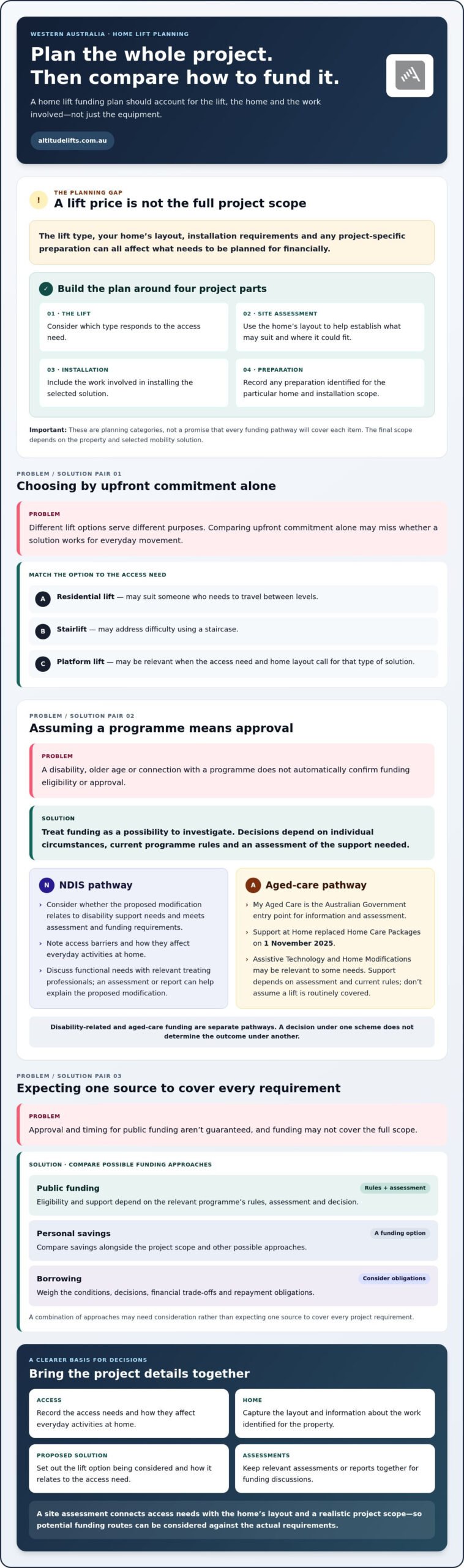
List the main parts of the project, then refine the plan once the home and mobility requirements have been assessed:
- The lift: Consider which type of lift responds to the access need.
- Site assessment: The home’s layout helps establish what may be suitable and where it could be fitted.
- Installation: Include the work involved in installing the selected solution.
- Project-specific preparation: Record any preparation identified for the particular home and installation scope.
These are planning categories, not a promise that every funding pathway will cover each item. The final scope depends on the property and the selected mobility solution. For a fuller picture of the process, read the home lift installation guide.
Why the right lift solution matters to affordability
A residential lift may suit someone who needs to travel between levels, while a stairlift may address difficulty using a staircase. A platform lift may be relevant when the access need and home layout call for that type of solution. These options serve different purposes, so comparing them on upfront commitment alone can overlook whether the lift will work for everyday movement.
A site assessment connects your access needs with the home’s layout and a realistic project scope. Altitude Lifts assesses and fits residential lifts, stairlifts and platform lifts. Once the scope is clearer, you can compare potential funding routes with the actual project requirements, rather than assuming a particular pathway will meet the whole cost.
Can NDIS or aged-care funding help with a home lift in WA?
Potentially, but a home lift isn’t automatically funded because someone has a disability, is older or is connected with a particular program. A program name alone doesn’t establish funding eligibility or approval. Decisions depend on individual circumstances, the relevant program’s current rules and an assessment of the support needed.
Disability-related funding and aged-care funding are separate pathways with different eligibility requirements and assessment processes. A decision under one scheme doesn’t determine the outcome under another. When financing a home lift in Western Australia, treat funding as a possibility to investigate, not a confirmed contribution to the project.
How NDIS funding may relate to a home lift
For an NDIS participant, the key question is whether the proposed modification relates to disability support needs and meets the scheme’s assessment and funding requirements. A lift may be considered in the context of home access, but approval depends on individual circumstances and evidence. The NDIS explains its process in its guide to NDIS funding for home modifications.
Before exploring an application, note the access barriers and how they affect everyday activities at home. Discuss these functional needs with relevant treating professionals. An assessment or report can help explain why a modification is being considered and how the proposed solution relates to those needs. Altitude Lifts’ NDIS funded home lifts guide provides further information about this pathway.
What to know about aged-care funding pathways
For people seeking aged-care support, My Aged Care is the Australian Government entry point for information and assessment. The Support at Home program replaced Home Care Packages on 1 November 2025. Its Assistive Technology and Home Modifications scheme may be relevant to some home-modification needs, but the type of support and funding available depend on the person’s assessment and current program rules. Don’t assume a lift is routinely covered.
For either pathway, keep your access needs, proposed lift solution and information about the work identified for the home together. This makes discussions with the relevant funding body clearer and helps you consider other options if funding isn’t approved or doesn’t cover the full scope. Altitude Lifts’ site assessment and tailored lift planning can clarify the practical project scope for your home.
Compare home lift financing options without assuming funding approval
Once you have a clearer project scope, compare how you might fund it. Public funding, personal savings and borrowing each involve different conditions, decisions and financial trade-offs. You may need to consider a combination of approaches rather than expect one source to cover every project requirement.
Public funding, savings or borrowing: how do they differ?
| Option | What to consider |
|---|---|
| Public funding | Eligibility and support depend on the relevant program’s rules, assessment and decision. Approval and timing aren’t guaranteed, and funding may not cover the full project scope. For older Australians, the government’s My Aged Care AT-HM scheme outlines its home-modification pathway. |
| Personal savings | You don’t need program approval to use your own savings. Consider how doing so would affect household budgeting, emergency reserves and other planned expenses. |
| Borrowing | Loan approval, terms and repayments depend on the lender’s assessment and your circumstances. Consider interest, fees, repayment obligations and the effect on your budget. |
These options aren’t interchangeable. A funding application involves program-specific criteria and assessment, while using savings means deciding what your household can comfortably allocate. Borrowing is a personal financial decision, not a financing service offered by Altitude Lifts. If you’re weighing a loan, consider the full repayment commitment and seek independent financial advice if you need help assessing what’s suitable for you.
How to weigh affordability against access needs
Before comparing payment routes, clarify the access problem you need to solve. Note the immediate mobility need, how the lift is likely to be used, who in the household may rely on it and what matters for daily life at home. These priorities help you compare options against a defined solution, rather than focusing only on the upfront commitment.
A lower initial outlay doesn’t necessarily mean a more affordable project overall if the solution doesn’t address the access need or leaves project requirements unclear. Compare proposed solutions on the same basis, including installation and any preparation identified for the home. The home lift prices in Australia guide explains factors that influence project planning. With the scope in view, you can make a more grounded comparison of financing a home lift in Western Australia without treating potential funding as approved money.
Prepare a home lift funding application and project plan
A clear sequence can make funding and installation planning easier to manage. Start with the access need, establish what may suit the home, document the proposed scope, then compare that information with the requirements of any funding pathway you’re considering. This gives you a more useful basis for decisions than assuming what a program might cover.
What information can help clarify your project?
Note who will use the lift, which levels they need to reach and any mobility requirements that affect everyday access. Include practical details about where movement around the home is difficult and what the person needs to do independently. If a health professional has assessed these needs, keep relevant reports or recommendations together.
A site assessment connects those requirements with the home’s layout and potential installation scope. Altitude Lifts’ home lift site assessment guide explains how assessment fits into residential lift planning. Useful materials to organise may include:
- an assessment or report describing access and functional needs
- notes on the home layout and the levels requiring access
- a written project scope identifying the proposed lift solution and installation requirements
- relevant funding documents, correspondence or application information for the pathway you’re exploring
Keep the documents consistent. If the proposed lift or project scope changes, update the information used in funding discussions so the application reflects the project you’re actually considering.
How to keep funding decisions and installation planning aligned
Compare the documented project scope with the rules and evidence requirements of the funding pathway. The funding body determines eligibility and makes its own decision. An assessment or lift scope doesn’t guarantee approval, and Altitude Lifts can’t guarantee a funding outcome. Treat the assessment, funding decision and installation planning as separate processes, and don’t commit to a schedule on the assumption that they’ll happen at the same time.
Program criteria and timeframes can change. Before relying on a particular requirement or expected decision date, check the latest official guidance for the relevant scheme. This helps distinguish confirmed information from estimates and plan your next step accordingly.
With your access needs and project details organised, you’ll be better prepared to discuss financing a home lift in Western Australia. Discuss your home lift project with Altitude Lifts to explore how a site assessment and tailored fitting can clarify the practical scope for your home.
Plan your next steps with a Western Australian home lift specialist
You’ve considered possible funding routes and how to prepare project information. Now bring those decisions back to the practical goal: improving access at home. Describe the barriers you want to address, then clarify the home’s layout and the lift project scope. With those details in hand, you can compare potential funding routes against a defined solution rather than a guess.
What happens when you plan a lift project with Altitude Lifts?
Altitude Lifts can begin planning with a site assessment to understand the home and the person’s mobility requirements. That context helps shape a tailored fitting and professional installation plan. Depending on the access need and layout, the solution may be a residential lift, stairlift or platform lift. Each serves a different purpose, so an assessment helps focus the project on what could work in your home.
Before a project discussion, it can help to note:
- which levels or areas need to be accessible
- who will use the lift and what their mobility needs involve
- any details from a health or functional assessment that may inform the project
- the funding route you’re exploring and any documents or criteria you need to address
This information connects your access goals with the property and the practical work involved. It also gives you a clearer project scope for your own funding or financial discussions. Financing a home lift in Western Australia is easier to approach when lift planning and funding decisions are treated as related but separate steps.
A clear next step for WA homeowners and families
Share your access goals and home context as you begin planning. A site assessment and tailored fitting can help define the lift solution and installation scope. Funding bodies make their own eligibility and approval decisions, so a lift assessment doesn’t guarantee funding. Keep current rules and requirements in view for any pathway you’re considering, while progressing the practical design and installation planning separately.
You don’t need every answer before you start. A considered discussion can help identify what information is still needed and the next project step. Talk to Altitude Lifts about your home lift.
Take the next step towards easier access at home
Financing a home lift in Western Australia starts with a clear picture of the whole project: the access needs, the home layout and the installation scope. From there, you can compare public funding, savings and borrowing without assuming that any pathway will cover the full project or be approved.
A site assessment connects your mobility requirements with a suitable residential lift, stairlift or platform lift. Altitude Lifts is a locally owned and operated Western Australian specialist, providing tailored fitting and professional installation for residential mobility equipment. Its NDIS-registered services support people with restricted mobility, while funding decisions remain with the relevant funding body.
When you’re ready to discuss your home and access goals, discuss your home lift needs with Altitude Lifts. A practical conversation can help clarify the project and its next steps.
Frequently Asked Questions
Can NDIS funding pay for a home lift in Western Australia?
It may, if the lift is assessed as meeting an NDIS participant’s disability-related needs and the scheme’s funding requirements. Home lifts may be considered as complex home modifications under Capital Supports, but eligibility and approval depend on individual circumstances and evidence. An assessment can help explain the access barriers and why a proposed solution is relevant. Altitude Lifts is NDIS-registered, but registration doesn’t guarantee that a participant’s lift will be funded.
Does Support at Home cover a home lift in WA?
Support at Home may help with some home modification needs, but a home lift isn’t automatically covered. The program replaced Home Care Packages on 1 November 2025 and includes an Assistive Technology and Home Modifications scheme. Available support depends on current program rules and an individual assessment. Check My Aged Care’s current guidance before relying on eligibility or assuming a lift is an approved support.
What financing options can I consider for a home lift?
Potential options include an eligible public funding pathway, personal savings or borrowing, depending on your circumstances. Public funding requires assessment and approval, while savings don’t require program approval but still need careful household budgeting. Borrowing involves lender approval, repayment obligations and terms that vary by person and product. Compare each option with the documented project scope, and consider independent financial advice if you’re unsure whether borrowing suits your circumstances.
How do I prepare for a home lift funding assessment?
Describe the access difficulties and how they affect everyday life at home. Record who will use the lift, which levels they need to reach and any relevant mobility requirements. Discuss these functional needs with an occupational therapist or other relevant treating professional, who may help document them. A site assessment can clarify how the home layout relates to the proposed lift and project scope. Funding approval remains the funding body’s decision.
Can I combine funding support with personal savings or borrowing?
Whether you can combine sources depends on the funding program’s rules, its decision and your personal finances. Don’t assume a scheme will cover the full project or allow other funds to be applied in a particular way. First establish the proposed scope, then check the relevant program guidance and approval conditions. If you’re considering borrowing or using savings to cover a gap, weigh repayments and household priorities carefully.
What information may be needed when applying for home lift funding?
Requirements vary by funding pathway, but useful preparation may include an assessment or report describing functional access needs, details of the home layout and a project scope outlining the proposed lift and installation requirements. Keep relevant funding documents and correspondence together, too. These materials can help explain how the proposed work relates to the person’s needs. Check the current official application guidance for the specific evidence required. Preparing documents doesn’t guarantee approval.
Does home lift funding cover installation as well as the lift?
It depends on the funding program’s rules and the approved scope. Some pathways may assess a home modification as a project, while others may limit eligible supports. Don’t assume installation, preparation work or every project component will be funded. Check how the relevant funding body’s current criteria apply to the documented scope, and keep lift assessment and installation planning distinct from the funding decision.