A lift’s power rating isn’t the same as the electricity it will use. If you’re comparing home lift power consumption costs Australia-wide, that distinction matters: a rating in kilowatts (kW) describes power at a moment in time, while your bill reflects energy used over time, measured in kilowatt-hours (kWh).
It’s understandable to wonder whether a lift will make a noticeable difference to your household bills, especially when specifications are presented in different ways. A useful estimate depends on how often the lift runs, how much energy it uses while moving and whether it draws power in standby mode.
This guide explains the main factors behind lift electricity use and shows how to estimate running costs using your own electricity tariff. You’ll also learn what operating and standby consumption figures to request, and how to compare models on a like-for-like basis. Altitude Lifts, a locally owned Western Australian specialist, can help you ask informed questions about options such as the Swift Home Lift Lite, Swift Lift Pro and Compact Elegance Home Lift, without making assumptions about their energy use.
Key Takeaways
- Estimate lift electricity use from model-specific operating and standby data, then account for how often and how far it travels.
- Compare residential lifts, stairlifts and platform lifts using consistent information about intended use and operating patterns, rather than assuming one type costs less to run.
- To estimate a usage charge, multiply estimated energy use in kWh by your applicable electricity usage rate in A$ per kWh.
- When comparing home lift power consumption costs Australia, ask each supplier for the exact model’s data, the assumptions behind it and the tariff basis used.
- Discuss your home layout, mobility needs and expected use during a site assessment, so lift options and energy information can be considered together.
What Determines Home Lift Power Consumption Costs in Australia?
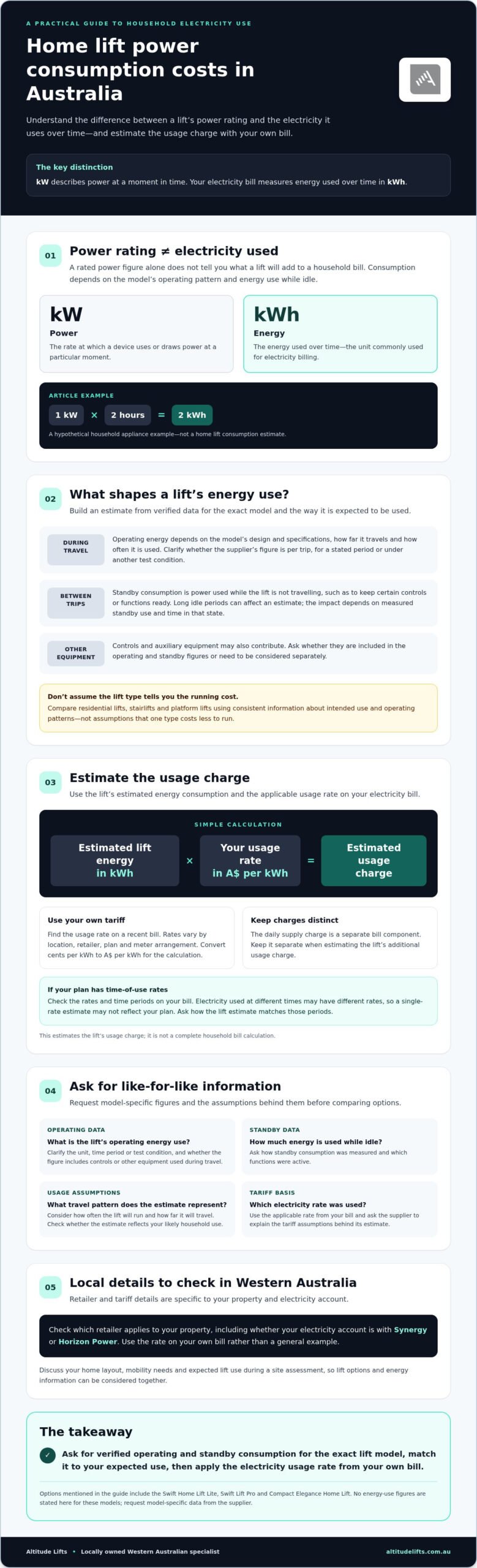
Home lift power consumption costs Australia households face depend on the specific model’s energy data, how often it travels, its standby use and the electricity tariff for the property. A power rating alone won’t tell you what the lift will add to a bill. To estimate that, you need to know how much energy it uses over time and the rate you pay for each kilowatt-hour.
Power rating and electricity consumption are not the same
Kilowatts (kW) measure the rate at which a device uses or draws power at a particular moment. Kilowatt-hours (kWh) measure energy used over time, which is the unit commonly used for electricity billing. For example, a hypothetical 1 kW household appliance running for two hours uses 2 kWh.
A lift’s rated power describes its power requirement under specified conditions. It doesn’t show how much electricity the lift will use across a billing period. That depends on its operating pattern, including the number and length of trips, as well as energy used while idle. General information about elevator energy use also highlights why it’s worth considering both movement and standby periods.
Ask the supplier for current, model-specific operating and standby consumption data. Check what conditions and time period the figures represent. If the information is provided only as a power rating, ask how it can be translated into expected kWh for your likely use. Without those details, model comparisons may not be like-for-like.
Why Australian household tariffs change the estimate
The same energy use can produce different usage charges because electricity rates vary by location, retailer, plan and meter arrangement. On a recent bill, look for the usage rate, usually shown in cents per kWh. Convert cents to A$ for your calculation: multiply the lift’s estimated kWh by the applicable rate in A$ per kWh.
If you’re on a time-of-use plan, check the rates and time periods shown on your bill. Electricity used at different times may be charged at different rates, so a single-rate estimate may not reflect your plan. Check whether the lift’s estimated usage can be matched to those periods, or ask the supplier to explain the assumptions behind its estimate.
In Western Australia, check which retailer applies to your property, including whether your electricity account is with Synergy or Horizon Power. Use the rate on your own bill rather than a general example. The daily supply charge is a separate bill component, so keep it distinct from the usage charge when estimating the lift’s additional consumption.
How a Home Lift Uses Electricity Between Trips and During Travel
A lift’s electricity use isn’t limited to the moments it moves. To understand its full operating pattern, consider energy used during travel alongside any power drawn while the lift is idle. Controls and auxiliary equipment can also contribute, depending on the model and the equipment fitted.
What happens to electricity when the lift is moving?
The drive system moves the lift between levels, but the energy required depends on the design and specifications of the exact model. Travel distance and frequency of use also affect total consumption. Don’t infer efficiency or energy recovery from the lift type alone. Check operating energy figures against the manufacturer’s documentation for the model you’re considering.
When asking for operating data, clarify whether it relates to a single trip, a set period or another stated test condition. This helps you judge whether the figure reflects your household’s likely pattern of use. Also ask whether the data includes controls or other equipment that operates during a journey.
Does a home lift use power while it’s idle?
Standby consumption is the electricity a lift may use while it’s not travelling, for example to keep certain controls or functions ready. It’s separate from the energy used during a journey. Ask the supplier for standby consumption data and how it was measured, including which functions were active.
Long idle periods may affect an estimate because standby use can accumulate between trips. The impact depends on the model’s measured standby consumption and how long it remains in that state, so avoid applying a generic figure to every lift. If the lift has auxiliary equipment, ask whether its consumption is included in the figures or needs to be considered separately.
Annual use can only be estimated by combining verified data for the exact lift model with a realistic estimate of your household’s trips and idle periods.
For a useful household estimate, note how often you expect to travel, which levels you’ll use and whether the lift may sit idle for long stretches. These details are more informative than a broad assumption based on lift category. The same model can have different estimated annual use in homes with different routines.
- Movement: request model-specific operating energy data and how it was measured.
- Standby: ask what remains powered between trips and how long the measurement period was.
- Controls and auxiliary equipment: confirm what’s included in the figures and identify any separately powered equipment, where fitted.
If you’re considering a residential lift, stairlift or platform lift, you can discuss your expected lift use with Altitude Lifts as part of a conversation about your home and requirements.
Comparing Home Lifts: Which Factors Matter More Than the Lift Type?
Lift categories describe different ways of supporting movement around the home, but they don’t provide a reliable energy-cost ranking. A higher rated power figure also doesn’t automatically mean higher annual consumption: total use depends on how long and how often the equipment operates, plus any standby demand. For a useful comparison, focus on verified data for the exact models and whether each option suits your mobility needs and home layout.
Residential lift, stairlift or platform lift: what should you compare?
These categories support different mobility needs. A residential lift travels between levels in a home; a stairlift carries a user along a staircase; a platform lift moves a user on a platform between levels. The right fit depends on the person using it, the building and the intended travel pattern, not an assumed energy profile.
| Category | What to check for a fair comparison |
|---|---|
| Residential lift | Operating and standby data for the exact model, intended journeys and expected travel frequency. |
| Stairlift | Operating data for the expected trips along the staircase, plus standby use and measurement conditions. |
| Platform lift | Model-specific operating and standby figures, intended use and the travel pattern assumed in the estimate. |
Altitude Lifts offers residential lifts, stairlifts and platform lifts, including the Swift Home Lift Lite, Alpha Stairlift and Delta Platform Lift. These are options to discuss based on your requirements, not claims about relative energy performance. Request operating and standby figures for each exact model you’re considering, and check that the supplier has used comparable definitions and test conditions.
How to make an apples-with-apples comparison
Ask for estimates based on the same household scenario. Use consistent assumptions about trips, travel pattern and the applicable electricity tariff. If a specification is missing, mark it as unknown rather than filling the gap with an industry average or a figure from another model.
A simple comparison checklist can keep the information clear:
- Operating data: What energy figure is supplied, and what does it measure?
- Standby data: What functions were active, and under what measurement conditions?
- Use assumptions: How many trips and what travel pattern underpin any estimate?
- Suitability: Does the option suit the user’s mobility needs and the home’s layout?
Keep electricity estimates separate from purchase, installation and maintenance considerations. These are distinct parts of assessing an option. This consistent approach makes home lift power consumption costs Australia comparisons more meaningful, while helping you weigh energy information alongside practical suitability.
How to Estimate Home Lift Electricity Costs Using Your Australian Bill
You can build a practical estimate without guessing a tariff or assuming every lift uses the same amount of energy. Start with data for the exact model, match it to a realistic household usage pattern, then apply the usage rate on your electricity plan. The result is an estimate of the lift’s usage charge, not a promise of what your bill will be.
The information to collect before calculating
Gather three inputs first: model-specific operating and standby energy information, an estimate of household trips, and the applicable electricity usage rate. Ask the supplier what each energy figure measures and what conditions it assumes. If the information is in kW rather than kWh, ask for the operating time or model-specific calculation needed to estimate energy use.
- Obtain model data. Request operating and standby figures for the exact lift model. Confirm the units, measurement period and which controls or auxiliary equipment are included.
- Estimate household use. Choose a representative period, such as a typical day or week, and estimate the number of journeys and travel pattern. Record the period so it’s clear what your estimate covers.
- Calculate energy use. Use the supplier’s figures to estimate operating energy over that period, then account for standby energy separately if it isn’t already included. Convert the result to kWh and scale it to the period you want to compare, such as a month or year.
- Apply your tariff. Find the usage rate on a recent electricity bill or in your retailer account. Multiply estimated kWh by the applicable rate in A$ per kWh.
Estimated usage charge = estimated kWh × applicable usage rate
For example, if a supplier provides energy per journey, multiply that figure by the estimated number of journeys in your chosen period. Add any separately calculated standby energy for the same period, taking care not to count it twice. No lift energy figure or tariff is assumed here, so your calculation will depend on the information you obtain and your current plan.
Turning an estimate into a useful comparison
Use the same travel assumptions and tariff when comparing models. If your household may use the lift differently at various times, calculate separate scenarios rather than relying on one pattern. For a time-of-use plan, check the relevant rates and periods on your account. In Western Australia, verify your current plan and provider, including whether Synergy or Horizon Power applies to the property.
The estimate covers the lift’s calculated electricity usage, not fixed daily supply charges or other bill components. Consider those charges separately, and remember that actual bills can vary with use and tariff changes. For help requesting model-specific information and considering lift options for your home, contact Altitude Lifts about lift energy data.
Choosing a Home Lift with Clear Energy Information and Local Support
Choosing a lift involves more than comparing an estimated electricity charge. The option needs to suit the person using it, the home’s layout and the journeys it will make. Clear, model-specific energy information helps you understand likely use, while a site assessment can bring these practical considerations together.
Questions to ask before choosing a model
Ask for operating and standby consumption data for the exact model, including the units, measurement conditions and any equipment covered. If a supplier provides an estimated usage or cost, ask how it was calculated: what trip pattern, idle time and electricity tariff were assumed? Check that the proposed lift type also suits the property, access needs and expected household use.
- Exact model: Which model does the information apply to?
- Operating and standby data: What does each figure measure, and under what conditions?
- Estimate assumptions: How many journeys, what travel pattern and what idle periods were used?
- Tariff basis: Which usage rate and plan were used, and does that match your current electricity account?
- Suitability: How does the option fit the home, mobility needs and intended use?
Discussing options with a Western Australian lift specialist
Altitude Lifts is a locally owned Western Australian specialist offering residential lifts, stairlifts and platform lifts. Its residential options include the Swift Home Lift Lite, Swift Lift Pro and Compact Elegance Home Lift. Depending on your access needs, the Alpha Stairlift, Liftboy 5, Delta Platform Lift or Stratos Platform Lift may also be relevant to discuss. Confirm current model-specific energy information directly, as consumption figures can’t be assumed from a model name or category.
A site assessment gives you an opportunity to discuss the home’s layout, mobility requirements, expected journeys and installation considerations together. Altitude Lifts offers site assessment and custom fitting, helping you consider which options may suit your space. Bring a recent electricity bill or your retailer’s tariff details, along with the supplier’s operating and standby figures, so you can check the assumptions behind any estimate against your circumstances.
For a clearer picture of home lift power consumption costs Australia, compare options using the same usage pattern and your applicable tariff, while keeping energy estimates distinct from other purchase and installation considerations. A measured next step is to Talk with Altitude Lifts about your home lift requirements and ask what model-specific energy information is available.
Choose a Lift with Confidence
Understanding home lift power consumption costs Australia-wide starts with looking beyond a model’s rated power. Ask for operating and standby energy data for the exact lift, then use your expected trips and current electricity tariff to build a practical estimate. Treat the result as a guide to usage charges, not a guarantee of your final bill.
Energy is only one part of choosing well. The lift should also suit your home’s layout, your mobility needs and the way you expect to use it. A site assessment can help bring these considerations together and clarify installation requirements.
Altitude Lifts is a locally owned and operated Western Australian specialist offering residential lifts, stairlifts and platform lifts, with site assessment and custom fitting as part of its service. You can discuss the options available for your home and ask what model-specific energy information can be provided.
Discuss your home lift options with Altitude Lifts. With clear information and advice grounded in your home and needs, you can take the next step with greater confidence.
Frequently Asked Questions
How much electricity does a home lift use in Australia?
There’s no single figure for home lift power consumption costs Australia-wide. Electricity use depends on the exact model, its operating and standby consumption, how far it travels and how often it’s used. Ask the supplier for model-specific energy data, then estimate usage based on your household’s likely trips and apply the usage rate on your electricity plan. Treat the result as a guide, not a guarantee of your bill amount.
How do I calculate the running cost of a home lift?
Start with verified energy-use data for the exact model and an estimate of how often the lift will operate over a set period. Convert the expected use into kilowatt-hours (kWh), then multiply that figure by your plan’s applicable usage rate in A$ per kWh. Keep fixed daily supply charges separate, and note the assumptions behind your estimate. A supplier can help clarify what the product data measures.
Does a home lift use electricity when it is not moving?
It may use electricity while idle for controls or standby functions, but the amount depends on the model and its configuration. Don’t assume standby use is zero or apply a generic figure. Ask the supplier for standby consumption data and the conditions under which it was measured, including which functions were active. Include standby energy separately in your estimate if it isn’t already included in the operating figure.
Are stairlifts cheaper to run than home lifts?
Not necessarily. Stairlifts and residential lifts serve different access needs and can have different operating patterns, so comparing categories alone may give a misleading result. Request verified operating and standby figures for the exact models you’re considering, then use the same assumptions for trips, idle time and electricity tariff. Energy is only one consideration: check that each option suits the user’s mobility needs and the home’s layout.
Does a home lift noticeably increase an Australian electricity bill?
The effect depends on the lift’s verified energy use, how frequently it operates and the usage rate on your household electricity plan. There’s no reliable bill increase that applies to every home. Ask for model-specific operating and standby information, estimate your likely usage over a clear period, then calculate the usage charge using your current rate. Keep fixed supply charges separate so you don’t attribute them to the lift.
Do home lift electricity costs vary between Australian states?
They can, because electricity rates and plans vary by location, retailer and meter arrangement. Your own bill or retailer account is the best starting point for an estimate. In Western Australia, check which provider and plan apply to your address, including whether Synergy or Horizon Power is relevant. If your plan has time-of-use rates, check the applicable periods and rates before comparing estimates, and verify current tariff details.
What information should I request from a home lift supplier?
Ask for operating and standby energy data for the exact model, with units, measurement conditions and any equipment included clearly explained. If the supplier provides a projected usage or cost, ask what trips, travel pattern, idle time and tariff assumptions were used. Also discuss whether the lift suits your home layout, access needs and expected use. A site assessment can help explore these practical requirements alongside the energy information.