
Ongoing costs can include servicing, electricity and, where applicable, an insurance adjustment. The exact costs depend on the lift and how it is used.
It’s natural to focus on the upfront investment, but regular servicing and your home’s electrical setup also affect the cost of owning a lift.
This guide explains how servicing and warranty conditions affect maintenance, what influences electricity use, and when an electrical supply upgrade may be needed. It also shows how these recurring expenses differ from the purchase price, helping you plan for a lift as part of your home’s longer-term needs.
Key Takeaways
- Compare a basic annual service with a comprehensive maintenance plan by looking at what each covers and how it aligns with your lift’s warranty conditions.
- Factor in both lift use and standby power when estimating electricity consumption, not just the energy used during trips.
- Find out whether your home’s existing electrical supply can support the lift, as some models may require a dedicated circuit or a three-phase upgrade.
- Separate ongoing running expenses from the upfront purchase and installation costs to build a clearer picture of long-term ownership.
Basic service versus comprehensive maintenance contract
For a Perth home elevator, annual servicing is a recurring ownership cost, while a maintenance contract defines the wider support covered. The right comparison is the service frequency, contract scope and warranty conditions, not just the annual fee.
Basic and comprehensive service plans
A scheduled service is routine annual maintenance. Broader maintenance arrangements may set out additional terms, exclusions and call-out arrangements, which can affect costs beyond the planned service.
Are there Perth-based home lift maintenance providers, and what do their service plans include? Perth homeowners can arrange annual lift servicing, and plans vary in scope. A wheelchair user’s daily reliance on the lift may make clear coverage and service arrangements especially relevant.
Maintenance across the lift lifespan
Lifetime maintenance means the accumulated cost of servicing and repairs over a lift’s working life. It is not a fixed charge: the lift type and its maintenance needs affect the total.
Warranty terms matter, too. Scheduled servicing may be a warranty condition, so missed maintenance can affect cover. Include servicing in your ownership budget from installation, along with any building work needed to provide access for future maintenance.
Annual servicing and inspections
Annual servicing means a technician checks and maintains the lift on a recurring schedule. Residential elevators in Perth should be serviced at least once per year.
Ongoing costs for hydraulic, traction and vacuum home lifts depend on the design, service needs and maintenance arrangements. There is no single supported cost ranking across these types. Compare the service requirements of the specific model being considered.
Monitoring and emergency system fees
Monitoring and emergency communication may involve separate ongoing fees if they use a paid service or phone connection. These charges depend on the system and connection, so consider them separately from maintenance costs.
Home lift monitoring, phone lines and emergency call systems in Australia may have ongoing fees when they rely on paid monitoring or a separate phone connection. Include applicable charges in your annual budget, rather than counting only maintenance.
Ongoing lift servicing and warranty conditions
Annual servicing helps maintain a residential lift and may be required under its warranty. Budget separately for routine visits, repairs and any funding arrangements, as they have different costs and requirements.
Annual servicing costs
A scheduled service is planned maintenance; a repair estimate covers work needed to fix a fault. Keep the costs separate for a clearer annual budget, and record each visit and its findings. Compare service records with the warranty terms to track whether maintenance conditions are being met. The records can also help you spot recurring issues instead of treating each visit as an isolated expense.
Support at Home contribution rates are based on service category, not automatically on lift maintenance. For a full pensioner, the rates are 0% for clinical supports, 5% for independence services and 17.5% for everyday living services. Treat these as program contribution rates, not as guaranteed funding for a residential lift or its servicing.
Repair and replacement part costs
Repair costs cover diagnosis, labour and any replacement component, so they differ from a planned annual service. A faulty control component, for example, involves different work from an adjustment or repair to a mechanical part. The estimate depends on the fault, lift design, parts required and access to the equipment. These factors also shape whether a repair is straightforward or involves more work.
Home lift repair and replacement-part costs in Australia vary according to the fault, component and labour involved. There is no single useful figure across lift types; the cost for a specific repair depends on the work and parts required.
When assessing a repair, consider the lift model, fault symptoms, parts needed and site access. A repair estimate can set out the work and relevant cost factors, making it easier to distinguish repair expenses from routine servicing.
If you’re comparing lift options alongside maintenance needs, explore residential lift options as part of your assessment.
Electrical supply and potential upgrades
Electricity is a usage-based expense, while electrical supply upgrades are a separate installation consideration. For a Perth home lift, both depend on the model and your home’s existing electrical setup.
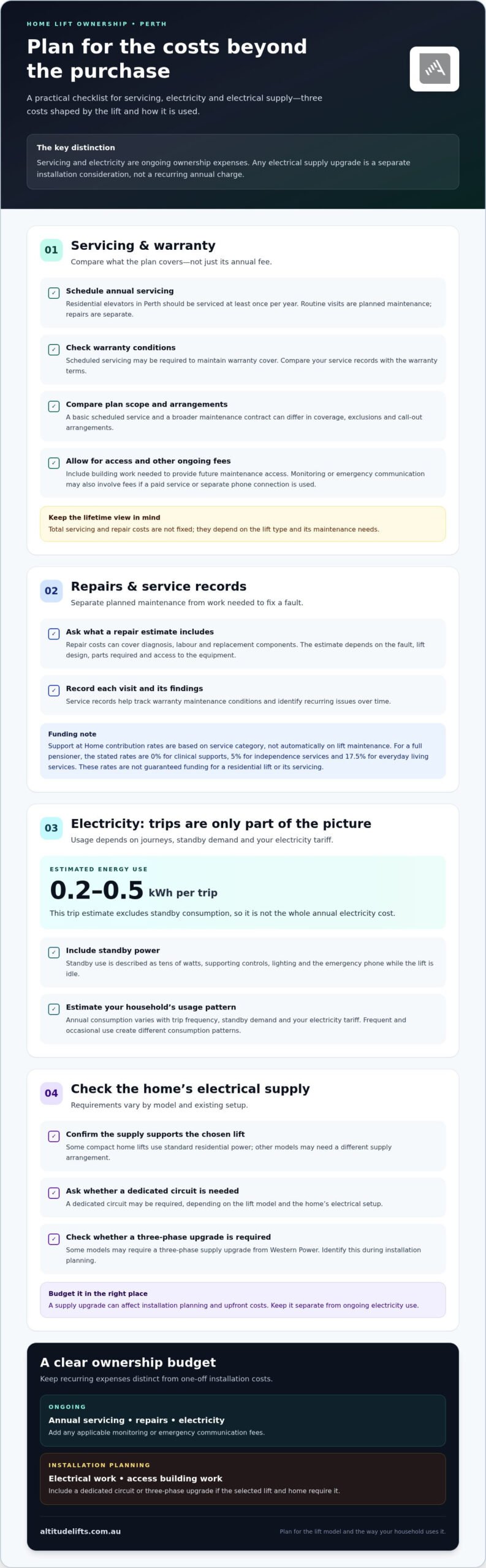
A residential lift uses roughly 0.2 to 0.5 kWh per trip. The trip estimate excludes standby consumption, so it isn’t the whole annual electricity cost.
Standby power is described as tens of watts, supporting controls, lighting and the emergency phone while the lift is idle. This means the lift may draw electricity between journeys as well as during movement. Your annual total therefore depends on trip frequency, standby demand and your electricity tariff. A household using the lift often will have a different consumption pattern from one making occasional journeys.
Electrical requirements vary by model. Some compact home lifts use standard residential power, while others may require a three-phase supply upgrade from Western Power. A dedicated circuit may also be needed. An upgrade can affect installation planning and upfront costs, rather than becoming a recurring annual charge.
To understand the electrical requirements for your home, assess the existing supply alongside the chosen lift. Key questions include whether the supply supports the model, whether a dedicated circuit is needed and whether a three-phase upgrade is required. This helps distinguish ongoing electricity use from one-off electrical work.
- Per-trip use: roughly 0.2 to 0.5 kWh.
- Standby use: power for controls, lighting and the emergency phone.
- Supply work: a dedicated circuit or three-phase upgrade, if needed.
Separate these costs when budgeting: electricity is an ongoing expense, while electrical work is part of installation. The lift model and your home’s existing supply affect both.
Home lift purchase price compared with annual costs
The purchase is a one-off investment, while electricity, servicing and any insurance adjustment can recur. Comparing the two gives you a fuller picture of ownership after installation and a useful starting point for budgeting home lift ongoing costs in Perth.
An annual estimate brings together several expenses, not one fixed bill. Electricity use depends on trips and standby demand; servicing depends on the lift’s maintenance needs. Keep these items separate to see which costs recur and which apply to your situation.
The purchase price depends on the lift and property, and is provided after a quote request. Lift type, number of levels, site conditions and required building work all affect the estimate. The intended use matters, too: a residential lift for everyday access may have different equipment and site requirements from a platform lift for a specific mobility need.
For a useful comparison, group costs by when they occur. Record purchase and installation as upfront expenses, then list annual electricity, servicing and any insurance adjustment separately. This makes home lift ongoing costs in Perth easier to compare with the initial investment.
Lifts differ in service requirements and power use, so compare similar options. Check what the quote includes, then list recurring expenses separately. This gives you a clearer view of the longer-term costs of different home lift options.
To discuss a residential lift for your home, request a tailored lift quote that accounts for your installation requirements.
Altitude Lifts: Swift Home Lift Lite
The Swift Home Lift Lite is one option for residential vertical mobility. Altitude Lifts designs and installs residential lifts to fit existing structures, helping homeowners consider a solution suited to their property and access needs.
Compare a lift’s suitability for your home with its ongoing costs, including servicing, electricity and any electrical work. Start with your household’s mobility needs, the home’s layout and installation requirements. Altitude Lifts also offers the Swift Lift Pro, Compact Elegance Home Lift and Alpha Stairlift for different home mobility needs.
If you’re ready to discuss your home lift requirements, visit Altitude Lifts.
Plan your next step with confidence
Planning home lift ongoing costs in Perth starts with considering how the lift will fit your household’s routines over time. Think about who will use it, how it will support movement between levels and what daily access at home needs to look like. These priorities help guide a practical discussion about the right lift for your home.
Altitude Lifts can discuss your home lift requirements and the factors that influence costs for your situation. Sharing details about your home and mobility needs is a useful starting point for exploring suitable options. You can contact Altitude Lifts to discuss costs and take the next step at a pace that feels right for you.
A considered choice can help your home work more comfortably for the people who live there.
Frequently Asked Questions
How much does a residential lift cost in Australia?
There is no single installed price for every Australian home lift. The total depends on the lift type, number of levels, site access, electrical requirements and building work. For a meaningful estimate, separate equipment and installation from property-specific preparation. Compact residential lifts, stairlifts and platform lifts serve different access needs, so compare them against your home’s layout and intended use.
Are home lifts expensive to run?
That total covers recurring ownership expenses, not the lift’s purchase or installation. Usage affects electricity consumption, while service arrangements influence maintenance costs. Treat the total as a planning guide and list each expense separately in your household budget to see which costs apply.
How much does a home lift add to my power bill?
Your electricity bill depends on how often the lift travels, its standby demand and your electricity tariff. Frequent trips use more power during operation, and controls and lighting may also draw electricity while the lift is idle.
What are the typical annual servicing costs for a home lift in Perth?
The amount depends on the lift type and service scope. Compare a routine visit with any broader maintenance arrangements, which may cover different work or service terms. Service records help you track maintenance against the lift’s warranty conditions.
How much electricity does a residential lift use, and what does it cost in Perth?
A residential lift uses roughly 0.2 to 0.5 kWh per trip. Standby draw adds to consumption between journeys, so the per-trip calculation isn’t the full bill. Trip frequency and the household’s electricity tariff shape the total.
How often should a home lift be serviced under Australian standards or manufacturer guidelines?
Plan for servicing at least annually in Perth, and follow the maintenance schedule for the specific lift model. Manufacturer guidance can set out the checks and service intervals relevant to its equipment. Regular maintenance also matters for warranty conditions, so keep a record of completed visits. If the lift is used frequently or supports everyday mobility, include that pattern when planning its ongoing care.