
What if the easiest home lift to live with isn’t simply the one with the fewest moving parts? Choosing low maintenance home lifts Perth homeowners can manage over time starts with matching the lift to the home, its layout and the care it needs. That matters when you want reliable access without making ongoing upkeep feel complicated or disruptive.
It’s understandable to want clear answers before choosing. “Low maintenance” doesn’t mean maintenance-free; it means understanding the care planned for a specific model and how its design and installation environment may affect ownership. With the right information, you can compare options on more than appearance or space alone.
This practical 2026 checklist explains what can influence lift upkeep and what to consider when comparing models. You’ll also see how a tailored site assessment can bring access, layout and ownership needs together. As a locally owned Western Australian specialist, Altitude Lifts designs and installs residential compact lifts, stairlifts and platform lifts, with solutions intended to fit existing structures while minimising major alterations.
Key Takeaways
- For low maintenance home lifts Perth homeowners can manage confidently, compare the lift’s care guidance alongside its intended users and fit for your home.
- Use the manufacturer’s documentation for each model to compare care requirements fairly, rather than relying on lift type alone.
- Consider whether the installation layout allows practical access for future inspection, and how the lift will fit your household’s daily routines.
- Plan servicing around the specific model’s guidance, and keep its manual, service records and installation details easy to find.
- A tailored site assessment from a local specialist can help bring your access needs, property layout and installation plan together.
Low-maintenance home lifts in Perth: what does upkeep really involve?
“Low maintenance” should mean care that’s manageable, clearly explained and guided by the manufacturer, not a lift that needs no attention. Every residential lift has components that require appropriate oversight. No residential lift should be described as maintenance-free. The useful questions are what care a particular model calls for, who should carry it out and how easily it can be planned around household life.
Upkeep can vary with the lift’s design, installation, operating conditions and frequency of use. A lift used every day may have a different pattern of use from one used occasionally. The installation setting matters too: available space and surrounding conditions can affect access for inspection. General explanations of elevator technology and history introduce common lift components and types, but the manual for your specific model is the guide to its care.
Broad claims about a whole category can therefore be misleading. Two lifts may serve a similar purpose but have different manufacturer instructions. Before comparing options, look for documentation that explains the expected care, owner checks and service requirements for each specific model. Don’t assume that a particular drive system or a simpler-looking design removes the need for professional attention.
What routine home lift care can include
Some care is observational, not technical. Keep the lift’s access area clear and pay attention to changes from its usual operation, such as unfamiliar sounds or altered movement. Use the manual for approved cleaning methods and any checks intended for the owner. If something seems different, note what you observed and follow the manufacturer’s instructions about what to do next.
Leave adjustments, fault-finding and repairs to a qualified technician. Opening equipment or attempting a repair yourself can create safety risks and may make it harder to identify the underlying issue. The manual should make the boundary clear: simple owner observations are not a substitute for inspection or servicing.
Why the right Perth home lift depends on your household
Start with the people who’ll use the lift, how often they’ll use it and the access they need now and over time. Then consider the home: the floors to connect, available space and how the lift could fit into the existing layout. These details shape the lift type and installation plan, as well as how practical it may be to live with.
A Perth-based site assessment brings those considerations together. Altitude Lifts assesses properties and discusses intended use, with tailored fitting designed to work with existing structures while minimising major alterations. This is a practical first step towards comparing low maintenance home lifts Perth homeowners can choose with a clearer picture of both the installation and ongoing care.
How lift design and installation can shape ongoing upkeep
A lift’s long-term practicality is shaped before it’s installed. Its configuration, position in the home and the space around it can affect how straightforward it is for a technician to access for future inspection or servicing. A well-chosen model can still be awkward to maintain if the installation leaves little practical room to reach the areas that need attention.
That’s why the lift and the property should be considered as one project. Site conditions, the floors to be connected and the household’s daily routines all inform the choice. Installation planning can also identify how the lift will sit within the existing structure and how people will move around it. Make practical access for future servicing part of the design conversation from the start.
Match the lift type to the home and its users
Different lift categories address different access needs and layouts. A compact home lift may suit travel between levels; a stairlift may suit someone who needs support using a staircase; and a platform lift may be relevant where the access requirement and property layout call for that type of solution. The right fit depends on the people using it, the route they need and the space available.
Altitude Lifts offers residential compact lifts, including Swift Home Lift Lite, Swift Lift Pro and Compact Elegance Home Lift, as well as stairlifts and platform lifts. These examples give you a starting point for discussing options, not a shortcut to deciding what fits your home. Compare each model using its own documentation. Don’t assume similar-looking lift types have identical care requirements, or that one category always needs less maintenance. For more context on project planning, see the Perth home lift installation guide.
Plan installation around future access and care
Think beyond where the lift will sit. Consider whether its position leaves clear, practical access for future inspection, and how it affects household movement through the area. A location that works on a floor plan may feel less convenient once doors, furniture and everyday routines are taken into account.
Discuss these details during the site assessment, not after installation. A tailored assessment can consider available space, the levels served, intended use and the relationship between the lift and the home’s existing layout. It can also surface project requirements early, so the installation plan responds to the property rather than relying on assumptions. Altitude Lifts provides site assessment and custom fitting, with solutions designed to fit existing structures while minimising major alterations.
For homeowners comparing low maintenance home lifts Perth options, installation access and model-specific care guidance belong in the same conversation. If you’re considering a lift for your property, explore your home lift project with Altitude Lifts as part of planning a solution around your household and home.
Compare low-maintenance home lifts in Perth with this decision framework
A useful comparison looks beyond a lift’s name or apparent simplicity. Start with the access need and property, then compare each specific model’s care instructions and how installation and future service access are planned. This makes it easier to compare low maintenance home lifts Perth households are considering using practical, like-for-like criteria.
Use the table as a starting point. Details vary by model and project, so rely on the manufacturer’s current documentation rather than assumptions about a whole lift category.
| Lift type | Intended users and access | Site fit to consider | Care guidance to review | Local installation support |
|---|---|---|---|---|
| Compact home lift | Household members needing access between levels | Available space, floors served and position within the home | Model-specific checks and servicing described by the manufacturer | Assessment and custom fitting for the property |
| Stairlift | A user who needs support travelling along a staircase | Staircase layout and how the lift fits household movement | The owner guidance and service instructions for that model | Review of the home and intended use as part of project planning |
| Platform lift | Users whose access needs are suited to a platform lift | Installation location and the route it needs to serve | Current manufacturer instructions for the specific model | Site assessment to consider access, layout and installation |
Questions to compare before choosing a lift
Compare options using the same questions: Who will use the lift, how often and for what access needs? How does each option fit the home’s layout and the route between levels? What do its owner documents say about regular checks, cleaning and servicing? Does the project plan account for practical access during future service work?
Keep the answers together with the relevant model documentation. If a sales description says “low maintenance”, look for the specific care instructions behind that phrase. Check that you’re comparing equivalent information, not one model’s detailed manual against another model’s general claims. Servicing requirements can be model-specific, so check the current manufacturer instructions.
Compare lift types without assuming one is always easier to maintain
A compact lift, stairlift and platform lift perform different access roles, and each has different installation considerations. That doesn’t establish which will need less care. Requirements depend on the particular model and its operating environment, so suitability, access and safety should remain central to the decision. If space is a key concern, the small footprint home lifts guide can help frame your questions about compact options.
Altitude Lifts’ site assessment and custom fitting bring the household’s needs and property layout into the comparison. As a locally owned Western Australian specialist, Altitude Lifts considers how a residential lift can fit an existing structure while minimising major alterations. Learn about planning a home lift project with Altitude Lifts.
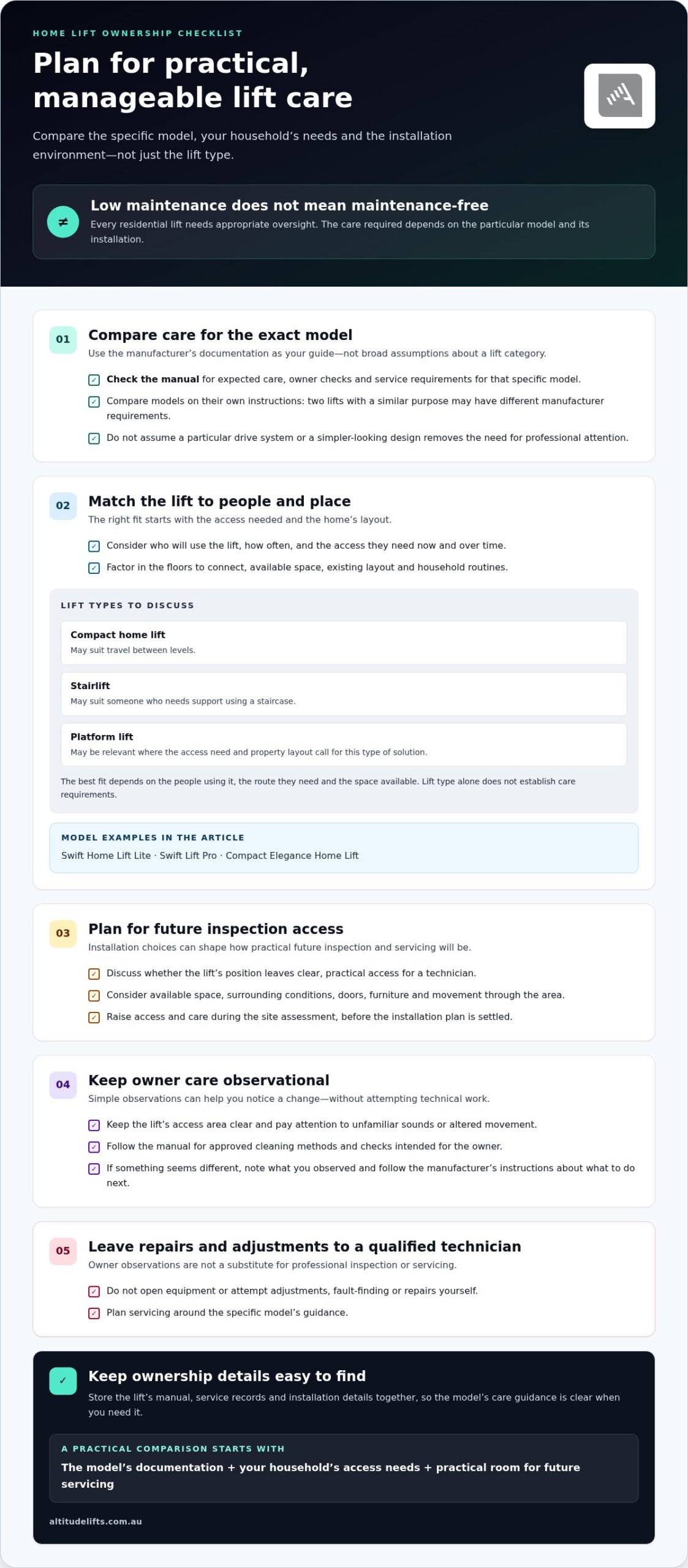
Perth homeowner checklist for lift care and annual servicing
A simple annual review can help keep lift information organised and make it easier to plan care. It isn’t a substitute for servicing, and it doesn’t set a universal service interval. Follow the current manufacturer instructions for your specific model, including the recommended servicing schedule. If the lift is new to your household, find its documents and make sure you know who to contact with questions or concerns.
A simple annual lift ownership review
Use this checklist to review your records and household readiness, not to carry out technical checks. Keep the information together so it’s easy to refer to when arranging service or discussing a change in operation:
- Review the manual. Note the manufacturer’s maintenance instructions and any owner checks it describes. Follow only the actions approved for owners.
- Look over the service history. Keep service records with the manual and note any follow-up advice or work recorded by a qualified professional.
- Keep installation details accessible. Store relevant project information alongside the lift documents, so it’s available when discussing the model or its service history.
- Refresh household guidance. Make sure users know the basic operating instructions and who to contact for assistance.
- Record observations. Note changes from normal operation, when you noticed them and any relevant context. Share those details with a qualified lift professional.
Use the review as a planning prompt. The manufacturer’s schedule, not the calendar reminder, determines when the model needs professional servicing. Don’t assume an annual appointment applies to every lift.
When a change in operation needs attention
Pay attention to differences from the lift’s usual operation. You might notice an unexpected noise, inconsistent movement, visible damage or another change that concerns you. These observations aren’t a diagnosis, but they’re useful information to pass on.
- Follow the instructions in the lift manual for the situation.
- Record what has changed and when you first noticed it, without opening or adjusting the equipment.
- Report the concern through the appropriate service channel and seek qualified advice promptly.
- If the manual advises against using the lift in those circumstances, follow that instruction and don’t delay seeking advice about a safety concern.
Leave technical checks, adjustments and repairs to a qualified lift professional. Owners shouldn’t open equipment or attempt to troubleshoot internal components. Clear records and a concise description of what you’ve observed can help the professional understand the concern, without you needing to identify its cause or predict the repair.
For guidance on lift selection and installation in Perth, Altitude Lifts can assess your property and discuss how the project could address your household’s access needs and layout.
Choosing a Perth lift specialist for a practical long-term solution
A practical lift decision brings four things together: your household’s access needs, the home’s layout, the selected model’s documented care requirements and a considered installation plan. Comparing these factors helps you look beyond the initial fit and think about how the lift will work within daily life over time. Low maintenance home lifts Perth homeowners can feel confident choosing are a matter of informed selection, not a promise of upkeep-free ownership.
Altitude Lifts is a locally owned and operated Western Australian specialist providing site assessment, custom fitting and installation of residential compact lifts, stairlifts and platform lifts. Its tailored solutions are designed to fit existing structures while minimising major alterations. The aim is to consider the property and intended use together, so the proposed lift and installation approach respond to the project rather than a generic template.
What a tailored lift discussion should cover
A useful discussion starts with the people who’ll use the lift and the access they need, then considers the home: available space, the route to be served and how the installation will sit within existing rooms. Bring questions about operation and ownership into the conversation too. This gives the assessment a practical focus from the outset.
- Property and access: Discuss the home’s layout, floors involved and the household’s intended use.
- Model documentation: Review the selected model’s owner guidance and manufacturer maintenance instructions, including the checks and servicing it describes.
- Installation approach: Understand how the lift is proposed to fit the property and how the project accounts for practical access around the installation.
- Ongoing records: Know which model and installation details to keep, so information is available for future servicing conversations.
Altitude Lifts’ site assessment and custom fitting bring these considerations into one project plan. Clear explanations matter: you should be able to understand why the proposed lift suits the access need, how it fits the home and where to find the manufacturer’s guidance for its care. Specific servicing requirements depend on the model, so use the current instructions for the chosen lift rather than assuming one schedule suits every option.
Take the next step towards a low-maintenance home lift
Before deciding, bring together your household’s priorities, property considerations, model documentation and installation questions. That checklist can help you have a more focused conversation and compare options on suitability as well as upkeep. You don’t need to resolve every technical detail alone; a tailored assessment can help clarify how a lift project may fit your home and intended use.
Altitude Lifts works with Perth homeowners on residential lift selection, assessment and installation. Discuss a home lift for your Perth property and take a considered next step towards a solution shaped around your household.
Make your next lift decision with confidence
Choosing a lift is also a chance to think ahead about how you want to move through your home. Consider which everyday activities you’d like to make easier, who may use the lift and what would help it feel like a natural part of your living space. Those priorities can guide a more focused conversation about low maintenance home lifts Perth homeowners are considering.
You don’t need to arrive with every answer. A few notes about your home, access needs and ownership questions can give an initial discussion a useful starting point. From there, you can explore an option that suits your circumstances and understand the next steps at a comfortable pace.
Altitude Lifts can discuss your Perth project and help shape a tailored approach to assessment and fitting. Discuss a home lift for your Perth property and take the next step towards greater confidence in your home’s accessibility.
Frequently Asked Questions
How often should a home lift be serviced?
There’s no single service interval for every residential lift. Follow the current manufacturer instructions for your specific model, taking its use and installation conditions into account. A calendar reminder can help you review the manual and service records, but it shouldn’t replace the model’s schedule. If you’re unsure how an instruction applies to your lift, discuss it with a qualified lift professional. Note any changes in operation rather than waiting for a routine review.
Are home lifts maintenance-free?
No, a home lift shouldn’t be assumed to need no care. Even if day-to-day ownership feels straightforward, the manufacturer’s care and servicing instructions still apply. If you move into a home with an existing lift, find its manual and available service history so you can understand what guidance applies to that equipment. Keep the area around the lift clear, and leave technical adjustments or repairs to a qualified professional.
What can I check between home lift services?
Use the owner manual to guide any checks you’re permitted to do. For example, keep the approach to the lift unobstructed and make sure household members know how to use it as instructed. If you notice a change, record the date and what you observed, rather than trying to test or recreate it. Don’t open equipment or carry out technical checks unless the manufacturer specifically identifies a safe owner task.
Does a low-maintenance home lift still need annual servicing?
Not necessarily on an annual schedule; the correct servicing interval depends on the specific model’s manufacturer guidance. “Low maintenance” isn’t a reason to skip service or assume a yearly visit is right for every lift. Use an annual reminder to check the documentation, service history and any upcoming requirements. Then arrange servicing according to the instructions for your equipment, and keep a record of completed work for future reference.
Which type of home lift is easiest to maintain?
There isn’t a reliable answer based on lift type alone. Compact home lifts, stairlifts and platform lifts meet different access needs, and care requirements vary between specific models. If two options appear suitable, compare their manufacturer documentation side by side, including owner guidance and servicing instructions. Then weigh that information alongside the user’s needs and the property fit. A seemingly simpler option isn’t automatically the more practical choice.
What should I do if my home lift starts making an unusual noise?
Treat a new or unusual sound as a change to report, not a fault to diagnose yourself. Follow the lift manual’s instructions, and note when the sound occurs and whether you’ve noticed another change in operation. Don’t open the equipment or repeatedly operate it to investigate. If the manual advises you not to use the lift in that situation, follow its guidance and seek advice from a qualified lift professional promptly.
Can an existing Perth home be fitted with a lift that is practical to maintain?
It may be possible, depending on your property, access needs and the equipment selected. A site assessment can help consider the lift location, the route it needs to serve and how the installation fits the home. For an existing Western Australian home, discuss practical access around the proposed installation as well as the model’s care documentation. This helps you judge whether the overall solution suits your household, not just whether it can fit.