
Could staying in the home you love make more sense than moving to a single-level property? For Perth homeowners, comparing the cost of installing a lift vs moving home Perth means looking beyond the lift’s upfront cost or the next property’s asking price.
A lift can sound like a major building project, while moving may mean leaving familiar neighbours, routines and surroundings. Moving expenses can also add up: Cotality reported Perth’s median house value at A$1,017,734 in September 2026, and REIWA’s calculator puts transfer duty on a property at that value at about A$43,580, before agent, settlement and removalist costs.
This guide compares the financial picture and personal trade-offs, including how your home’s layout, mobility needs and future plans may shape the decision. You’ll also learn how a tailored assessment can clarify whether a lift could suit your home, without assuming it’s the right answer for every household.
Key Takeaways
- Compare the cost of installing a lift vs moving home Perth by considering the full financial picture, not just one headline price.
- Separate upfront expenses from ongoing costs, then compare each option over the same period.
- Weigh practical factors such as disruption, mobility needs, support networks and how long you plan to stay.
- Use a step-by-step checklist to clarify your priorities before deciding whether to adapt your home or relocate.
- A tailored assessment can help you explore whether a residential lift could suit your home and household needs.
Installing a lift or moving home in Perth: what decision are you really making?
It can be difficult to weigh the comfort of a familiar home and community against the possibility of a property that better suits changing mobility needs. The decision isn’t simply whether a lift costs less than a new home. It’s whether to stay and adapt the home you know, or sell, buy and relocate, with the financial and personal changes that entails.
The cost of installing a lift vs moving home Perth depends on the property, household and period you’re comparing. A lift is a defined project, but its scope varies. Moving brings sale and purchase expenses, and may mean adapting the current home for sale or the next one for everyday access. Either option can also affect routines, relationships and future independence.
Whole-of-decision cost includes the direct expenses of each option, the disruption involved and how well the outcome will suit your future needs. This broader view helps avoid comparing a lift quote with a property’s sale price alone. Use dated, sourced figures and make your assumptions clear. Lift pricing isn’t universal.
What does the cost of installing a lift include?
A lift project may involve assessing the home and household’s needs, choosing a suitable solution, installation and any work required for that property. Residential lifts vary in type and design, as outlined in this overview of the Residential elevator. Altitude Lifts tailors solutions to the home, with designs intended to fit existing structures while minimising major alterations.
- Assessment and selection: consider the household’s mobility needs and the available layout.
- Installation: the chosen solution and site conditions determine the project scope.
- Associated work: property-specific building or electrical work may affect the overall outlay.
For more detail on the process, see the Perth home lift installation guide.
What does moving home in Perth involve beyond the sale price?
A move’s total cost may include selling expenses, the purchase transaction, settlement and conveyancing, removalists, and costs related to settlement timing. In Western Australia, transfer duty can be a substantial factor, but the amount depends on the transaction and any applicable concessions or exemptions. Don’t assume every buyer has the same duty liability.
- Preparing the current property for sale, where needed.
- Agent and settlement costs associated with selling and buying.
- Removal and temporary arrangements if settlement dates don’t align.
- Adapting the next home if its layout doesn’t meet access needs.
These expenses are only part of the comparison. Moving may provide a better-fitting layout, while adapting may let you stay in familiar surroundings. Compare both paths using the same timeframe and household priorities.
How to compare the full cost of a home lift with moving
A fair comparison puts both options on the same footing. Choose a realistic timeframe, such as five years, then list one-off expenses separately from costs that may recur during that period. Five years is an example for organising your comparison, not a forecast or recommendation. Choose a period that reflects how long you expect to stay and how your needs may change.
Comparing a lift quote with the purchase price of another home alone misses the costs of selling, buying, moving and making the new property work for you. Property prices also change over time. The ABS publishes Australian residential property price trends, including capital-city data that can help put market movements in context. It won’t predict the price of a specific home.
Use the framework below to build your comparison. Add actual quotes and transaction estimates where you have them. The only example amount here is a moving-cost benchmark, not a personalised estimate.
| Scenario | One-off costs to record | Recurring costs during your chosen period | Assumptions to make explicit |
|---|---|---|---|
| Stay and install a lift | Lift and installation scope; property-specific building or electrical work | Any ongoing maintenance or household support you expect to budget for | Home layout, chosen solution, project scope and length of stay |
| Sell and move | Selling and buying expenses, applicable WA transfer duty, conveyancing, removal, storage and necessary access changes | Relevant housing and household expenses over the same period | Sale and purchase prices, transaction details, settlement timing and services used |
| Stay without modification | No lift project; record any other changes you choose to make | Any additional support or practical arrangements the household expects to need | How the current layout works now and as needs change |
Which costs belong in a lift-installation comparison?
Keep the lift and installation scope separate from associated property work. The home’s layout, the solution selected and site requirements affect what the project involves, so an industry-wide figure can’t replace a home-specific estimate. Include practical impacts too, such as temporary inconvenience or household adjustments during the project, without assigning them invented dollar values. A tailored assessment clarifies the scope for your home.
Which Perth moving costs should go into the other column?
Allow for both sides of the transaction: selling, purchasing, settlement or conveyancing, removal and any storage, cleaning or accessibility changes that are genuinely needed. WA transfer duty depends on the transaction and buyer eligibility, so don’t assume one amount applies to everyone. Separate essential expenses from optional upgrades. For context, KEYS The Moving Solution’s July 2026 guide estimates A$900 to A$1,500 for a typical three-bedroom local move, based on its stated Perth removalist assumptions.
Avoid counting the same expense twice. If you’d pay for cleaning or storage under either option, include it in both scenarios only if it genuinely applies to both. An individual home lift assessment can help clarify the installation scope for comparison with your moving estimates.
Lift installation vs moving: compare disruption, lifestyle and future needs
The numbers are only part of the decision. Your home may hold years of memories, familiar routines and easy access to family, friends or local support. Moving could bring a layout that better fits your needs, but it also means leaving some of that behind. Consider what daily life would look like after either choice, not just the upfront cost.
Time matters too. If you expect to remain in your home for years, exploring adaptations may be worthwhile. If your needs extend beyond access between floors, a move could address several concerns at once. Compare planning and work for a lift project with preparing a property for sale, finding another home and managing the move. Neither path is disruption-free, and the impact varies between households.
| Consideration | Stay and adapt | Sell and move |
|---|---|---|
| Familiarity and support | May preserve established routines, community ties and proximity to support. | Could mean leaving familiar people and places, though a new location may better suit support needs. |
| Access needs | A suitable residential lift may help with movement between levels; it won’t necessarily address other access challenges. | A single-level home or different layout may address several needs together, depending on the property. |
| Disruption | Involves assessment, installation planning and any project-specific work, with household adjustments as needed. | Involves sale and purchase processes, packing, settlement coordination and establishing a new home. |
| Future suitability | May suit a household that wants to stay, if the home can accommodate an appropriate solution. | May offer a better overall fit if location, layout or other property needs are changing. |
| Resale considerations | Buyer interest in an installed lift can vary; don’t assume it will increase the home’s value. | The next home’s future appeal and value are also uncertain and depend on the market and property. |
When staying and adapting may fit better
Staying may feel right if your current home and neighbourhood remain central to daily life and the main barrier is moving between levels. A professional assessment can establish whether the property is suitable. Compact lifts and stairlifts are different types of vertical mobility solution, and the right option depends on the household’s needs and the home’s layout. Neither should be assumed to solve every access issue.
When moving may make more sense
A move may be worth considering if a single-level layout, a different location or other features would address needs that a lift alone cannot. The current property may require broader changes beyond vertical mobility, or may not suit a lift installation. Selling and relocating can be demanding, but it could lead to a home that better fits your household as a whole.
When comparing the cost of installing a lift vs moving home Perth, weigh these trade-offs against how long you hope to stay, the support you rely on and what “a good fit” means for your future. A lift is one possible way to remain in a familiar home, not the right answer for everyone.
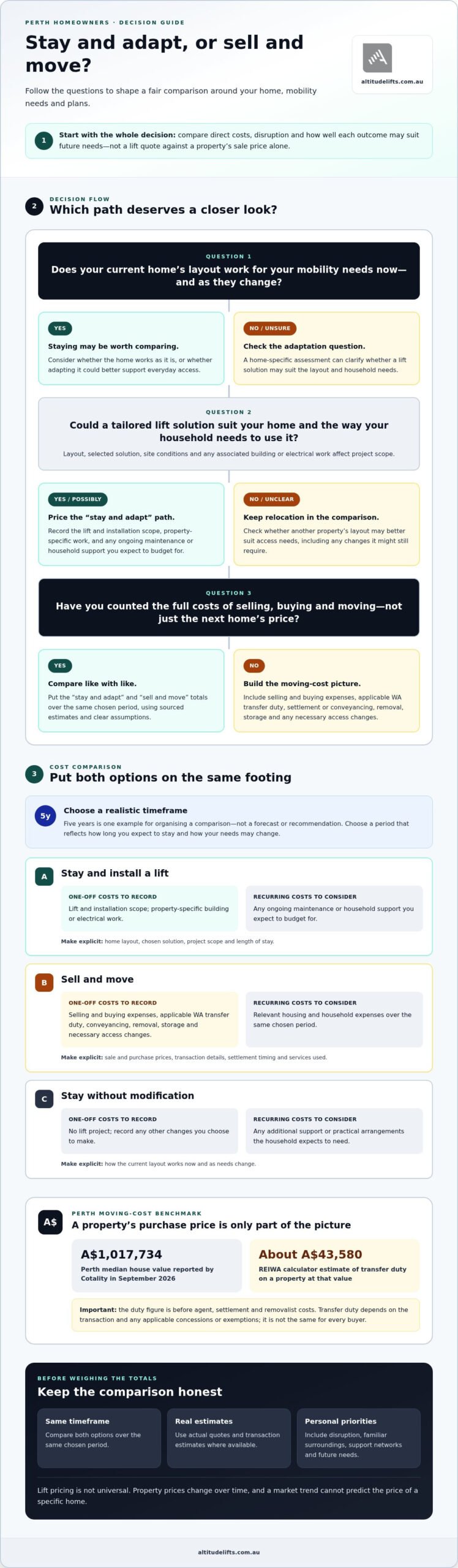
A practical Perth decision checklist for lift costs versus moving
A structured comparison can make a complex choice more manageable. Use these steps to organise information, not as financial advice. Keep estimates, assumptions and practical considerations together so you can see what each option means for your household.
- Write down access needs. Note which parts of daily life are difficult now and what may change during the period you’re comparing. Include who lives in the home, how they use each level and any support they rely on.
- Outline the lift project. A property-specific assessment can establish whether a suitable lift solution may fit your home and what the project could involve. For context on compact options, explore the small-footprint home lifts guide.
- Estimate the full cost of moving. Record likely selling, buying, settlement, removal and storage expenses, along with any access changes needed at the next property. Use current sources for Perth housing and services, and check current WA transfer duty information because liability depends on the transaction and buyer circumstances.
- Compare the everyday impact. Set out the expected time in each home, the disruption involved, the location and access to family or support. Note assumptions, such as settlement timing or whether changes at the next home are essential or optional.
- Review the options side by side. Compare direct costs over the same period, then consider how well each path could meet your household’s needs. Keep “stay without modification” in view too, while noting any practical difficulties or support arrangements it may involve.
For the cost of installing a lift vs moving home Perth, consistency matters: use the same timeframe and distinguish confirmed quotes or transaction figures from estimates. Record each figure’s source and date. If property prices or transfer duty assumptions change, update the comparison rather than relying on an old calculation.
Include funding and support needs in the decision
If disability-related needs are part of the picture, include possible funding pathways as a separate consideration rather than treating funding as guaranteed. Altitude Lifts provides NDIS-registered services, but NDIS decisions depend on individual circumstances and current programme requirements. The NDIS-funded home lifts Perth resource guide offers relevant information on the topic.
Once you’ve mapped your household’s priorities, a property-specific assessment can clarify whether adapting the home is practical. Explore a tailored home lift assessment as one step in your comparison.
Explore a tailored home lift solution with Altitude Lifts
If staying in your home remains a serious option, a property-specific assessment can help make it a practical part of your comparison. It considers the home and the people who live there, rather than assuming one type of lift or layout will suit every household. That clarity can help you decide whether to explore adapting your home or focus on moving.
Altitude Lifts is a locally owned and operated Western Australian specialist that designs, supplies and installs residential compact lifts, stairlifts and platform lifts. Its solutions are designed for existing homes while aiming to minimise major alterations. An assessment helps you understand the possibilities for your home and needs, but it doesn’t determine whether staying is better value.
What a tailored lift discussion can help you understand
The number of levels, the home’s structure and the access challenges you’re experiencing all inform which type of vertical mobility solution may be appropriate. Altitude Lifts’ range includes the Swift Home Lift Lite, Swift Lift Pro and Compact Elegance Home Lift, as well as the Alpha Stairlift. These options suit different situations, and suitability depends on the property and household. The aim is to explore how a solution could fit your home while minimising major alterations.
This context makes your cost comparison more meaningful. Instead of treating a lift as a generic figure, you can compare the project scope with the moving estimates you’ve gathered. If your home isn’t suitable, that information can also help you make the stay-or-move decision with a clearer understanding of what adapting this particular property would involve.
Take the next step without pressure
Before discussing an assessment, gather a few basics about your home and household. You don’t need every answer. A short list of what’s difficult now and what may change can help focus the conversation.
- Note the levels you need to access and where movement is most challenging.
- Describe the household’s current mobility needs and any likely changes.
- Record the location, layout and features that make your home important to you.
- Bring the assumptions behind your moving comparison, such as how long you hope to stay.
These details connect a possible lift solution to your priorities, not just the building’s structure. As you weigh the cost of installing a lift vs moving home Perth, a tailored discussion can help clarify whether an assessment should be your next step. Altitude Lifts provides NDIS-registered services, while funding decisions depend on individual circumstances and current programme requirements.
If you’d like to explore whether adapting your home could suit your plans, discuss a tailored home lift assessment with Altitude Lifts. It’s a practical way to consider the lift option alongside the personal and financial factors that matter to you.
Make your next step a clearer one
You don’t have to settle the whole stay-or-move question today. Start with what’s still uncertain: whether your home could support a lift, whether another layout would better meet your needs, or how long your current home is likely to suit you. Turning that question into something you can investigate makes the decision more manageable.
As you weigh the cost of installing a lift vs moving home Perth, keep your priorities close: the routines you want to preserve, the access you need and the changes you’re prepared to manage. A clearer understanding of your home’s possibilities can help you decide what to do next, without assuming that staying or moving is automatically right.
Altitude Lifts can help you explore what a lift solution could look like in your home. Explore a tailored lift solution for your Perth home and take a considered next step towards a home that works for you.
Frequently Asked Questions
Is installing a lift cheaper than moving home in Perth?
Not necessarily. The cost of installing a lift vs moving home Perth depends on your property, the move and how long you plan to stay. A lift may address access between levels, while moving could also change your location or solve other layout challenges. Compare tailored project estimates with the costs of selling and buying, then weigh each against the home and lifestyle you want. Neither option always costs less.
What costs should I include when comparing a lift with moving?
For a lift, record the equipment and installation scope, any property-specific work and ongoing costs relevant to your chosen timeframe. For moving, include selling and purchase expenses, applicable transfer duty, conveyancing, removal and any access changes needed at the next home. Put estimates beside confirmed amounts, noting the source and date. If you’d incur an expense under either option, list it in both scenarios only where it genuinely applies.
Can a lift be installed in an existing Perth home?
Yes. Residential lifts can be designed for existing homes, and Altitude Lifts’ solutions are intended to fit existing structures while minimising major alterations. That doesn’t mean every property is suitable or that no building work will be needed. The home’s levels and available layout, for example, can affect which solution is practical. A property-specific assessment helps establish whether a lift could work in your home and what the project may involve.
Does installing a home lift increase a property’s value?
There’s no guaranteed increase in property value from installing a home lift. Buyer interest can depend on the home, local market conditions and whether a prospective buyer sees the lift as useful for their needs. Treat resale value as uncertain rather than assuming you’ll recover the project cost when you sell. Consider the day-to-day benefit to your household while you live there as a separate part of the decision.
Do I have to pay transfer duty when buying another home in Western Australia?
You may need to pay transfer duty, but the amount and whether a concession or exemption applies depend on your circumstances and the transaction. Factors such as the property and buyer eligibility can affect liability, so don’t use another purchaser’s calculation as a guide. Check current information from the WA Government’s revenue office and use the details of the property you’re considering when estimating duty in your moving budget.
Can NDIS funding help with a home lift?
Disability-related home modifications may be considered through an NDIS plan, but funding isn’t automatic. Decisions depend on the participant’s circumstances, plan and current NDIS requirements. Altitude Lifts provides NDIS-registered services, which doesn’t guarantee that a lift will be funded. If this may apply to you, discuss the proposed modification with your support coordinator or planner and check current requirements before relying on funding in your comparison.
How do I know whether my Perth home is suitable for a lift?
A property-specific assessment is a practical way to explore suitability. Beforehand, note which levels you need to access, where movement is difficult and what may change as your household’s needs evolve. If you have a floor plan or information about the home’s layout, keep it handy for the discussion. An assessment considers the property alongside the household’s requirements, helping clarify whether a vertical mobility solution is worth pursuing.
Should I decide on a lift before I start planning a move?
You don’t need to commit to a lift before considering a move, but exploring suitability early can make your options clearer. If you’re viewing homes, note whether their layouts would meet your access needs or require changes. An assessment of your current home can also clarify what staying might involve. Comparing both possibilities before making major decisions gives you more relevant information for the choice ahead.