
What if a home lift makes your property more appealing without automatically increasing its sale price? If you’re asking “does a home lift add value to property Australia?”, the honest answer is that it depends on your home, its likely buyers and how well the lift meets a practical need.
It’s understandable to weigh the lifestyle benefits against the cost and wonder whether a lift could narrow your future buyer pool. Market value and buyer appeal aren’t the same thing. A lift may make a multi-storey home easier to use for some buyers, while others may see it as unnecessary. Its placement, design and fit with the property matter too.
This 2026 guide explains what can influence a lift’s usefulness at resale, which homes and buyers may benefit most, and how to separate everyday value from a measurable price uplift. You’ll also find practical checks to make before committing, including how to assess your home’s layout and seek local property advice. The aim is a considered decision that suits your needs now and takes your property’s likely market into account.
Key Takeaways
- Does a home lift add value to property Australia? It may improve appeal for some buyers, but a higher valuation or quicker sale isn’t guaranteed.
- Consider whether easier movement between levels suits your household now and could matter to likely future buyers.
- Compare a home lift with stairlifts and other access changes by looking at the need, layout and installation impact.
- Assess your home’s feasibility, weigh personal benefits separately from resale expectations, and seek advice from relevant local professionals.
- Use a site assessment to explore suitable options before committing, with long-term usefulness, not a promised resale return, as your guide.
Does a home lift add value to property in Australia? Start with the realistic answer
A home lift may make a property more appealing to buyers who value easier movement between levels, but it doesn’t guarantee a higher sale price. The answer to “does a home lift add value to property Australia?” depends on the home and the people likely to buy it. Location, layout, lift design and buyer priorities all shape whether it’s seen as a useful feature or an unnecessary one.
A lift can offer an accessibility benefit without proving a price premium. That distinction matters. A property may work better for its current occupants or attract interest from a particular group of buyers without receiving a higher valuation.
What does “adding value” mean when selling a home?
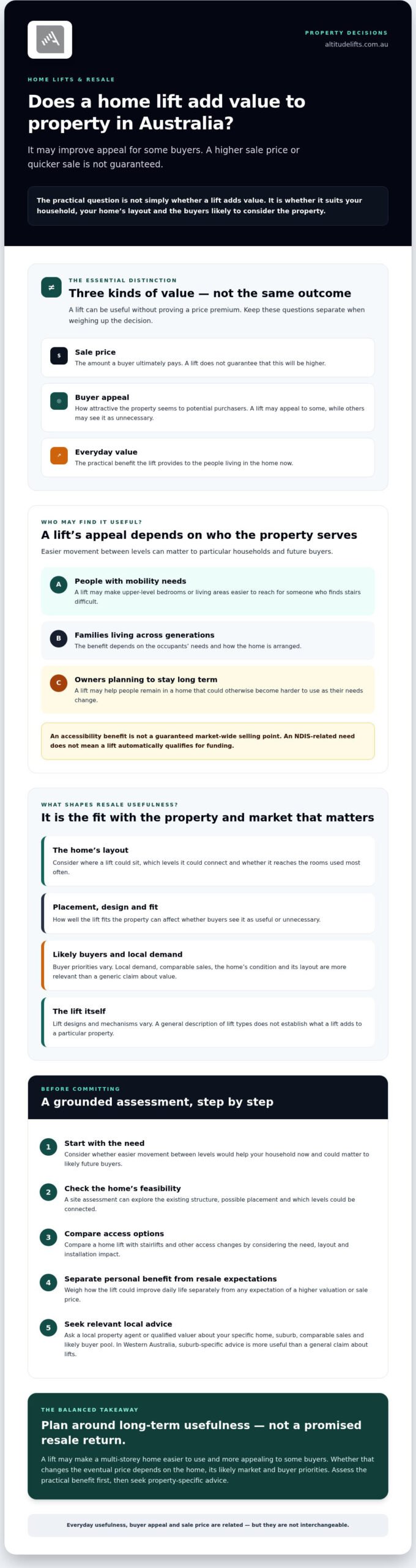
Sale price is the amount a buyer ultimately pays. Buyer appeal is how attractive the home seems to potential purchasers, while everyday value is the practical benefit the lift provides to the people living there. These outcomes are related, but they aren’t interchangeable.
A lift could attract interest from buyers looking for easier access or planning to stay in a multi-storey home long term. But a feature that appeals to some won’t necessarily lead to a higher offer from every buyer. Ask a local property agent or qualified valuer to assess your specific home and market. In Western Australia, advice based on your suburb and the types of homes buyers are considering is more useful than a general claim about lifts.
Why there is no guaranteed lift-related price premium
Property value is assessed in context. Comparable sales, the home’s condition and layout, and local buyer demand offer a more relevant guide than a generic percentage or claim about payback. Even where a lift helps a home stand out, other factors can influence the eventual offer and how long the property takes to sell.
Australian evidence isolating the effect of residential lifts on sale prices may be limited, so be cautious about broad claims unless they’re supported by relevant local sales data. Lift designs and mechanisms also vary. A general overview of different types of elevators can help explain that variety, but it won’t establish what a lift adds to your property’s value.
Think about three separate questions: what a valuer might assess, whether the feature could attract suitable buyers, and how much it improves daily life in your home. A site assessment can help explore whether a lift is feasible for the existing structure, including where it could sit and which levels it could connect. For a resale perspective, discuss the property with a local professional who understands your suburb and likely buyer pool. This gives you a more grounded basis for weighing potential appeal against personal usefulness, without treating either as a guaranteed financial return.
How a home lift can change a property’s appeal to Australian buyers
A lift can change how a multi-storey home works day to day. For someone who finds stairs difficult, it may make upper-level bedrooms or living areas easier to reach. It can also support homeowners planning to stay in their home as their needs change. Those practical benefits may matter to particular buyers, but they won’t make a lift a selling point for everyone.
A lift’s appeal depends on who the property serves and how well it fits. That’s a more useful way to assess whether a home lift adds value to property in Australia than assuming all buyers want the same features.
Which households may place greater value on a lift?
Households with mobility needs may value easier access between levels. So might families living across generations, or owners who want to remain in a home that would otherwise become harder to use. In each case, the lift’s usefulness depends on the occupants’ needs and how the home is arranged. For example, consider whether the lift would connect the entrance level with the rooms used most often, rather than simply whether there is space for a lift somewhere in the house.
Accessibility is a practical benefit, not a guaranteed market-wide selling point. NDIS-related needs may also be part of a household’s planning, but a lift in a property doesn’t automatically qualify for funding. The South Australian Government’s Home Modifications: An investment in healthy ageing discusses the broader value of home modifications, which is distinct from any promise about resale price.
How the home’s design affects buyer perception
Placement and fit matter. A lift that connects the levels people need to use, sits comfortably within the layout and preserves useful living space may feel like a considered part of the home. By contrast, an awkward position or a finish that clashes with surrounding rooms could prompt buyers to question the design or anticipate changes.
Consider how the lift affects circulation, access to key rooms and the overall presentation of the property. Check whether its position would interrupt a hallway, reduce the usefulness of a room or make access to the stairs awkward. The right solution depends on the home’s structure and household priorities; no single lift style will suit every Australian buyer or dwelling.
A site assessment can help establish what may fit the existing structure before you make decisions. For Western Australian homeowners, a local specialist can help explore residential lift options alongside the home’s access needs. Keep the aim practical: choose an option that supports everyday living, while recognising that future buyers may value it differently.
Home lift versus other accessibility upgrades: compare the value, not just the feature
The right upgrade depends on the access problem you’re trying to solve. A home lift may suit someone who needs to travel between levels regularly, while a stairlift or smaller access change may address a more specific barrier. Neither option guarantees a property-value gain. Compare how each could support daily life, fit the building and affect the way people move through the home.
Use this framework to guide a conversation with a qualified assessor. It’s not a substitute for advice based on the person’s needs and the property’s structure.
| Option | Intended need | Layout to consider | Disruption to assess | Questions for an assessor |
|---|---|---|---|---|
| Home lift | Regular movement between levels | Available space and a practical route between floors | Structural work, access and impact on usable rooms | Can it connect the levels needed and fit this home? |
| Stairlift | Making a particular staircase easier to use | Stair shape, landings and access at either end | How the equipment affects stair use and circulation | Is it suitable for the person and this staircase? |
| Smaller access changes | Addressing a specific obstacle, such as an awkward entry | The location and nature of the barrier | Scope of changes and effect on nearby spaces | Could a targeted change meet the need safely? |
If space is a concern, a small footprint home lifts guide can help you think through design and planning questions. Use examples to identify questions about location, access and usable space, then check what is feasible in your own home.
When might a home lift suit the property better?
A lift may be worth assessing when moving between floors is a continuing, everyday need, rather than an occasional inconvenience. Feasibility depends on the structure, available space and the route between the levels the person needs to reach. When discussing options, be ready to explain which rooms need to be accessible and how the household uses them. A site assessment can help clarify these constraints. For broader planning considerations, see a home lift installation in Perth guide.
When might another accessibility upgrade be more appropriate?
If stairs are the main challenge, a stairlift may be one option to discuss. If the difficulty is limited to a particular access point, a smaller change may be more suitable than adding vertical transport. Get professional advice before choosing equipment or altering the home. In the end, the question “does a home lift add value to property Australia?” is best weighed alongside whether the solution fits the person, the building and the household’s long-term needs.
How to assess whether a home lift makes sense for your property
A clear decision starts with the need, not a resale promise. Work through these checks to understand whether a lift could suit your household and home, then consider any possible effect on future buyers separately.
- Clarify the need. Identify who would use the lift, which levels they need to reach and how often. Consider whether the need is ongoing or likely to change, and which parts of the home matter most in daily life.
- Check feasibility. Ask a lift specialist to assess the site, including possible locations, access between floors, available space and installation requirements. Find out what disruption may be involved and whether the proposed position affects rooms or circulation.
- Consider likely buyers. Discuss the property’s location, layout and likely buyer profile with a local agent. Ask whether a lift might support the home’s presentation to those buyers, without assuming it will suit everyone.
- Seek independent property advice. A qualified valuer can explain how the feature might be considered in an assessment and whether relevant local comparable sales exist.
- Compare options. Weigh a lift against other ways to address the access need. Compare the expected day-to-day benefit, fit with the home and installation implications, not just the possibility of resale appeal.
Keep two questions separate: “How much would this improve life in the home?” and “Could it influence a future sale?” The first can be explored with the people who’ll use the lift and a specialist. The second calls for local property advice and remains uncertain. That distinction is central to answering “does a home lift add value to property Australia?” for your particular circumstances.
Questions to ask a local agent or property valuer
Ask whether comparable local properties with lifts provide useful evidence, or whether there’s too little relevant data to draw a firm conclusion. Discuss the likely buyer profile and how the lift could affect the home’s presentation. If a valuer offers an opinion, ask them to distinguish documented sales evidence from professional judgement and explain the assumptions behind their assessment. In Western Australia, make sure the examples relate to a market and property type that are relevant to your home.
Questions to resolve before choosing a lift
Be ready to describe the intended users, access needs, available space and preferred location. Ask the specialist to assess the site, outline installation requirements and explain potential disruption. If you’re exploring NDIS funding, check eligibility and funding requirements through the relevant channels; a lift’s presence alone doesn’t establish that funding applies.
If you’re in Western Australia, a site assessment can help explore feasibility before you commit. Request a home lift site assessment from a local specialist to discuss your home’s layout and access needs, without treating a resale return as guaranteed.
Plan a home lift around long-term usefulness, not a promised resale return
Start with the need the lift would meet in your home. If moving between levels is becoming difficult, or you’re planning for changing mobility needs, easier access may make daily life more manageable. That lived benefit can matter even if a future buyer values the feature differently.
A lift’s suitability still depends on the property. Available space, placement, installation work and how well the solution connects the levels you use all deserve careful consideration. The future buyer pool is another unknown, so don’t base your decision on an assumed sale-price increase. Ask “does a home lift add value to property Australia?” alongside a more immediate question: would it make this home work better for the people living in it?
A balanced decision: benefits and considerations
Weigh the potential for easier movement and a more accessible home against practical questions about fit, installation and long-term suitability. Consider who will use the lift, how often, and whether the home’s layout supports the access they need. Any possible resale effect is uncertain, so assess it separately from the everyday benefit.
It can help to discuss the home’s likely buyer profile with a local property professional, while asking a lift specialist to assess site feasibility. These are different perspectives: one helps you think about the market, the other about the building and possible lift options.
Discuss your home and mobility needs with a WA lift specialist
Altitude Lifts is a locally owned and operated Western Australian specialist supplying and installing residential lifts, stairlifts and platform lifts. A site assessment can help explore possible placement, the home’s layout and which solution categories may be appropriate. Custom fitting is intended to work with the existing structure, but the suitable option and any installation requirements need to be assessed for your property.
If you’re considering a lift in Perth, explore residential lift installation in Perth before arranging a conversation. Bring practical details, such as the levels you need to access, who will use the lift and any space constraints. That gives you a useful starting point for discussing feasibility, without treating the assessment as a promise of increased property value.
Make the decision for the home you live in. If a lift addresses a continuing need and suits the property, its everyday usefulness may be reason enough to explore further. Any resale appeal is a possible consideration, not a guaranteed return.
Make a decision that suits your home and your future
So, does a home lift add value to property Australia? It may strengthen a home’s appeal to buyers who need or appreciate easier access between levels, but a higher sale price isn’t guaranteed. The more dependable question is whether a lift addresses a continuing need and fits the property.
Consider the likely benefit to the people living there, alongside available space, installation requirements and the possibility that future buyers may see the feature differently. A lift, stairlift or platform lift may each suit different homes and access needs, so a site assessment can help you explore what’s feasible before committing.
Altitude Lifts is locally owned and operated in Western Australia, with site assessment and custom fitting as part of its service. If you’d like to discuss options for your home, discuss your home lift options with Altitude Lifts. Take the next step at your own pace, with a clearer understanding of what could work for your household.
Frequently Asked Questions
Does a home lift increase property value in Australia?
A home lift may improve a property’s appeal to buyers who value easier access between floors, but it doesn’t guarantee a higher sale price. If you’re asking “does a home lift add value to property Australia?”, the answer depends on the home’s location and layout, how well the lift fits, and local buyer demand. Ask a local agent and qualified property valuer whether relevant comparable sales support a resale claim.
Do home lifts add value to a house in Western Australia?
A home lift may make a Western Australian property more practical for households that need easier movement between levels, but not every buyer will pay more for one. Local market conditions, the home’s layout and how the lift is integrated all matter. Consider its everyday usefulness separately from any possible resale effect, and seek advice from property professionals familiar with your area before treating it as a financial investment.
Can a home lift make a property harder to sell?
It could narrow a property’s appeal if the lift takes up useful space, feels poorly integrated or doesn’t suit likely buyers. For others, easier access between levels may be a real advantage. There’s no universal outcome. Before installation, consider how placement affects the home’s layout and presentation, then ask local agents how buyers in your suburb might respond to the feature.
Is a home lift a good investment for resale?
It’s difficult to judge a home lift solely by resale because a future price premium isn’t guaranteed. For some owners, its main value is practical, such as making everyday movement around a multi-level home easier. Before deciding, weigh that personal benefit against installation requirements and the space available. Ask a local property valuer whether comparable sales in your area provide evidence of a resale effect.
Which home improvements add more value than a lift?
There’s no reliable ranking that applies to every Australian home. The value of an improvement depends on the property’s condition, location, buyer expectations and quality of work. Compare options by asking what need each one addresses, whether local buyers are likely to value it and how it may affect the home. A local property professional can help identify features that matter in your suburb.
Does an accessibility upgrade increase a home’s resale value?
An accessibility upgrade may make a home more suitable for people who need easier movement, but its effect on resale value varies. Buyers have different priorities, and the property’s layout and finish influence how an upgrade is received. Don’t assume the work will pay for itself. Consider the improvement’s day-to-day benefit, and seek a professional assessment before relying on potential market interest.
Should I install a home lift before selling my house?
Don’t install a home lift solely on the assumption that it will increase your sale price. First consider whether it suits the property, how it may affect presentation and whether local buyers might value it. Ask an agent and qualified valuer for advice specific to your area. If easier access is a current household need, weigh that benefit separately from uncertain resale outcomes.